
Key Takeaways
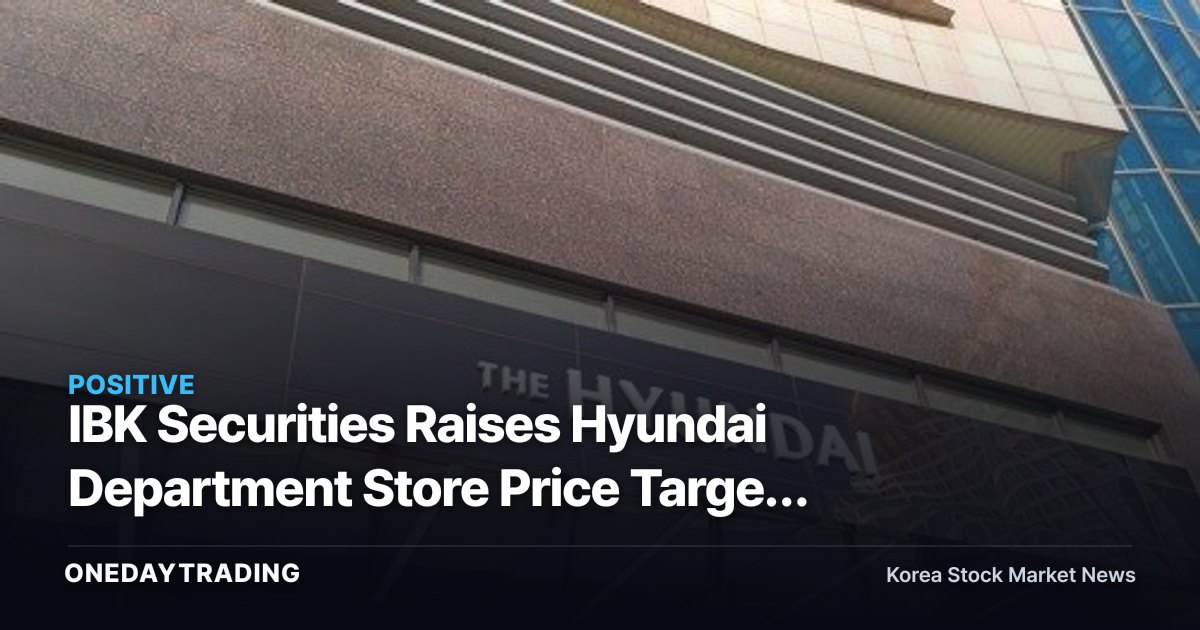
IBK Investment & Securities raised its price target on Hyundai Department Store, judging that the company's second-quarter earnings improved sharply on even, broad-based growth across every product category. The fact that this was a simultaneous gain across all segments — rather than strength in a single category — reads as a signal that consumption momentum has broadened, not a temporary rebound. The key questions, however, are whether the higher target is already priced into the stock and how a potential slowdown in second-half spending will play out.
What Happened
When a brokerage raises its price target on a particular stock (ticker) on the basis of improving earnings, it means the firm sees the company's profit-generating capacity stepping up a notch versus prior estimates. The crux of this note is the quality of the growth. A rebound that leans only on luxury or high-end categories is vulnerable to external swings, but growth shared across all categories — apparel, accessories, food, and more — implies lower revenue volatility and stronger margin resilience.
The department-store sector has a cost structure with a high fixed-cost component. Once revenue clears the break-even point, a large share of incremental revenue converts into operating profit — operating leverage at work. Even, broad-based growth across all categories maximizes this leverage, so profit growth can run steeper than top-line growth.
Background and Context
Hyundai Department Store operates not only department stores but also a complex of retail channels including duty-free shops and outlets. The department-store business has faced concerns over polarized spending and slowing average transaction values amid a high-interest-rate, high-inflation environment. Against that backdrop, confirmation of growth across all product categories is meaningful. It suggests that consumption may be recovering beyond just the luxury segment and into the mid-price range as well.
Impact on the Market and Stocks
- Hyundai Department Store: Simultaneous growth across all categories amplifies the operating-leverage effect, potentially making the improvement in operating profit larger than the top-line growth rate. It is the direct beneficiary of the price-target increase.
- Department-store peers such as Shinsegae and Lotte Shopping: If Hyundai Department Store's across-the-board strength is a signal of an industry-sector recovery, a positive read-through could spread to peers. That said, differences in store locations and duty-free exposure could lead to varying earnings outcomes.
- Duty-free and outlet channels: As a recovery in foreign-tourist arrivals meets domestic consumption, the rebound in these complex channels complements the core department-store business.
- Consumer-goods and fashion brands with store presence: A recovery in department-store sales feeds through to a recovery in the sales channels of tenant brands, improving upstream demand.
Investor Checkpoints
- Check whether the revenue growth rate and operating margin in the actual Q2 earnings release meet IBK's estimates, and which categories drove the growth.
- Use monthly department-store sales trends and the consumer sentiment index to assess whether the broad-based growth is a one-off base effect or carries into the third quarter.
- Examine whether the share price has already reflected expectations following the target increase, and the level of valuation burden (PER/PBR) relative to estimated earnings.
- Track persistent high interest rates, signs of a consumption slowdown, and the impact of exchange-rate moves on the duty-free segment.
Outlook
If even, broad-based growth across all categories continues, operating leverage could kick in to widen the improvement in profit, while a recovery in the complex channels supports the core business — a scenario that raises earnings visibility. Conversely, if households' real spending capacity contracts in the second half or luxury demand slows, average transaction-value growth could stall, and a share price that has already priced in the target increase could face profit-taking pressure. Ultimately, next quarter's earnings and monthly sales trends are the variables that will determine whether this optimism holds up.
Hyundai Department Store Through Real-Time Data
Hyundai Department Store's latest closing price is 197,700 won (-0.35% from the previous day), and the signal light — combining foreign and institutional investor supply-demand (order flow) with news and momentum — is 🟡 Neutral · Wait-and-See. With positive and negative signals mixed, this is a zone to watch.
- ▲ 52-week position — 96% toward the 52-week high — new-high territory
Recent related news is favorable, with 2 positive catalysts · 0 negative catalysts.
※ Price and foreign/institutional investor supply-demand (order flow) data are provided by Korea Investment & Securities (KIS), as of the time of publication.
This article is auto-summarized and analyzed content based on the original news report. View original (Yonhap News)