
3-Line Briefing
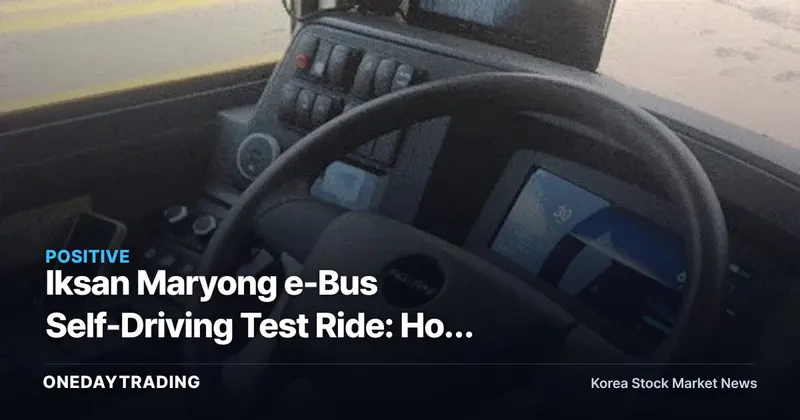
- The city of Iksan held a test-ride event for its Maryong e-Bus, a self-driving bus capable of changing lanes and stopping at stations even with the driver's hands off the wheel, as public-transit autonomous-driving pilots spread to small and mid-sized regional cities.
- The key point is that this is not a one-off event: local-government budgets combine with the central government's autonomous-driving pilot-zone policy to create a foundation of real demand for components such as LiDAR, V2X communications, and automotive semiconductors.
- That said, local-government pilots involve small revenue and a long road to commercialization, so investors need to distinguish between thematic expectations and actual earnings in their approach.
What's Changing
Until now, autonomous driving has been discussed mainly around a few hubs such as Pangyo and Sejong and centered on passenger cars. The fact that a low-density regional city like Iksan is applying autonomous driving to public-transit routes signals real demand to solve driver shortages and unprofitable routes through automation. Because buses repeatedly run fixed routes, applying autonomous driving is less difficult than for passenger cars, and with the public sector bearing the cost, it serves as a primer for early commercialization.
The important change is the nature of the demand. As pilot operations increase, each vehicle repeatedly carries sensors such as LiDAR, cameras, and radar, V2X communication modules that exchange signals between the vehicle and infrastructure, and the automotive semiconductors that process them. In other words, rather than a one-time vehicle sale, component demand accumulates in proportion to route expansion.
Moreover, local-government pilots are often tied to the central government's designation of autonomous-driving pilot zones and to subsidies, so it is more accurate to read this as a flow driven jointly by central and local policy rather than as a single city's event.
The Numbers and Context
Beyond the fact that this is a pilot event by the city of Iksan, no specific project size or order amount has been disclosed. Investment decisions, therefore, should reasonably be confirmed not by the reported facts themselves but by subsequent figures to be disclosed—such as the number of routes, vehicle count, operating budget, and any additional pilot-zone designations. At this stage, it makes sense to weight the directional trend of autonomous public transit spreading from hub cities to regional areas, while also factoring in the time lag before it shows up in earnings.
Beneficiary and Adversely Affected Stocks
- Hyundai Mobis: A core parts supplier within an automaker group that supplies integrated autonomous-driving control and sensor systems as well as electrification components, and could broaden its module-level order base as public-transit autonomous driving spreads.
- Kemtronics: A representative theme stock that holds autonomous-driving sensor businesses such as LiDAR as well as V2X communications, expected to be a direct beneficiary of communication-module demand as vehicle-to-infrastructure pilots increase.
- Telechips: A supplier of automotive semiconductors, structured so that chip demand rises as more autonomous-driving and infotainment systems are installed.
- Nextchip: A stock (ticker) specialized in image-processing and perception semiconductors for autonomous driving, whose upstream demand could grow as demand for processing sensor data expands.
- Hyundai Motor: An automaker that supplies autonomous bus and shuttle platforms; public-mobility autonomous driving could become a new demand source, though its weight in overall revenue is still limited.
Risk Check
- Local-government pilots are small in scale, making it hard for them to be reflected immediately in the relevant companies' earnings; if only thematic expectations are priced in ahead, valuation pressure grows.
- Commercializing autonomous driving presupposes the establishment of accident liability, insurance, and legal frameworks, so if the policy timeline is delayed, the materialization of demand is delayed as well.
- Sensors and semiconductors face fierce global competition, exposing domestic parts suppliers to price competition and the entry of overseas players.
- Businesses heavily dependent on public procurement carry the variable that orders can waver with budget cuts or changes in government policy.
Bottom Line in One Sentence
Regional public-transit autonomous-driving pilots are a positive signal that broadens the base of demand for autonomous-driving sensors, communications, and semiconductors, but given the pilot scale and the commercialization time lag, it is safer to separate thematic expectations from actual orders and earnings, and to approach step by step while monitoring pilot-zone expansion and order disclosures.
Hyundai Mobis Through Real-Time Data
Hyundai Mobis's latest closing price is 527,000 won (-7.38% versus the previous day), and its signal light—combining foreign and institutional investor order flow with news and momentum—is 🟡 Neutral · Wait-and-See. With positive and negative signals mixed, it is a zone to watch.
- ▲ Order-flow continuity — Foreign investors net buyers for 3 consecutive days (+700 million won)
- ▼ Trend alignment — Short- and mid-term downward alignment (today -7.4% · 1 week -20.2% · 1 month -21.3%)
Recent related news is favorable, with 1 positive catalyst · 0 negative catalysts.
※ Price and foreign/institutional investor order-flow data are provided by Korea Investment & Securities (KIS) and are as of the time of publication.
This article is content automatically summarized and analyzed based on the original news report. View original (Yonhap News, Industry)