
U.S. Stock Purchases Tracked by Korea Securities Depository
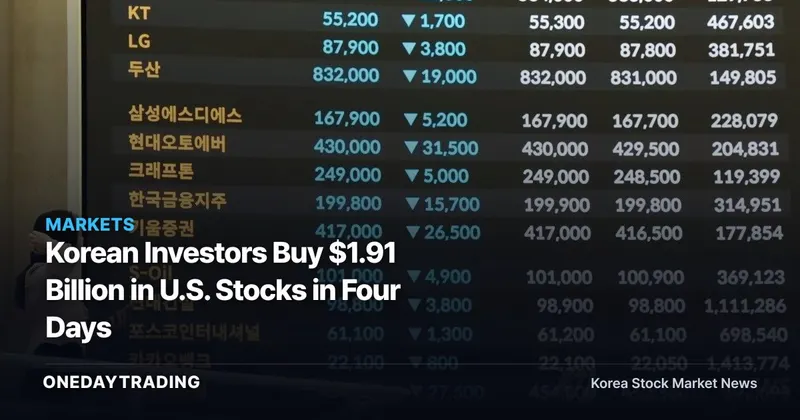
The key takeaway from Korean retail investors’ fund movements is not simply their preference for U.S. stocks, but the pace of purchases and the concentration in specific stocks (tickers). According to Korea Securities Depository data reported by Maeil Business Newspaper Securities, U.S. stock purchases recorded from November 2 to 5 totaled $1.90611 billion, or approximately 2.5865 trillion won. Although substantial funds poured in over a short period, it is too early to interpret this as a long-term view on the entire U.S. market.
These U.S. stock purchases refer to the amount Korean investors spent on U.S.-listed stocks and products during the period. The data confirms the purchase amount and selected assets, but does not disclose the specific sources of the funds or subsequent performance.
What the $1.90611 Billion Reveals About the Buying Pace
A comparison across periods makes the pace clear. The $1.90611 billion recorded from November 2 to 5 was similar to the $1.96234 billion purchased during the entire month of August. Purchases totaled $1.00128 billion in September and $5.42312 billion last month.
Purchases from November 2 to 5 amounted to 35% of last month’s figure. This number says more about execution speed than market direction. If purchases continue after this brief period, the case for sustained fund flow into U.S. stocks will strengthen. If they decline, the activity may be viewed as a temporary burst of concentrated buying.
Choices Narrowed to SOXL, Alphabet and TQQQ
SOXL attracted the most funds in November. Purchases totaled $1.30835 billion, accounting for 68% of the overall amount. This was not broad-based buying across U.S. stocks; instead, one product had an outsized impact on the total.
According to Maeil Business Newspaper Securities data, Alphabet purchases have totaled $480.33 million in November, while TQQQ recorded $187.72 million. Alphabet reflected demand for an individual company, whereas SOXL and TQQQ attracted funds at the product level. This is why views on the overall market and on individual companies should not be interpreted as the same signal.
Two Sides of the Picture: U.S. Purchases and Domestic Cash on the Sidelines
- U.S. stocks: Korean retail investors purchased $1.90611 billion from November 2 to 5.
- Domestic KOSPI market: Retail investor activity totaled 3.9 trillion won over the same period.
- Investor deposits: According to the Korea Financial Investment Association, deposits stood at 88.5338 trillion won as of November 5.
- Deposit benchmark: Investor deposits remained below 100 trillion won for nearly a month after October 13.
These figures alone do not prove that domestic funds moved directly into the U.S. market because the source of the money used for U.S. stock purchases has not been confirmed. The increase in purchases is established, but the path of the fund flow remains unknown.
How to Assess Alphabet and Related Products
- Alphabet: Purchases of $480.33 million have been recorded in November. This demonstrates demand from Korean investors for the stock (ticker), but does not explain the company’s earnings or future market performance.
- SOXL: The figures of $1.30835 billion and 68% reveal the concentration of the overall trend. If subsequent purchases fall, investors may be able to distinguish between changing demand for U.S. stocks overall and a short-term concentration in SOXL.
- TQQQ: Inflows have reached $187.72 million in November. More important than the size itself is its inclusion alongside SOXL and Alphabet among investors’ top choices.
The Next Figures Investors Should Monitor
- Check the Korea Securities Depository’s SEIBro securities information portal to see whether U.S. stock purchases continue at this pace.
- If SOXL’s 68% concentration persists, it will be difficult to interpret the increase in U.S. stock purchases as diversified demand.
- Monitor whether Alphabet purchases increase in subsequent data to determine whether demand for the individual stock (ticker) is sustained.
- If investor deposits tracked by the Korea Financial Investment Association recover to 100 trillion won, the flow of domestic cash on the sidelines can be compared again.
Concentration Matters Before Sustainability
In an optimistic scenario, U.S. stock purchases would continue while SOXL’s share declines and investors broaden their choices to include Alphabet and other assets. That would provide grounds to assess whether the brief surge in buying has developed into wider demand.
The risk is that the large $1.90611 billion figure resulted from concentration in a specific product. Future investment levels and market performance remain unknown. The next assessment should begin not with return forecasts, but with subsequent purchase data from Korea Securities Depository, SOXL’s concentration, and changes in investor deposits reported by the Korea Financial Investment Association.
Key Alphabet MetricsAs of 2026-11-07
| Period Return | 1 Week +2.05% 1 Month -17.67% |
|---|---|
| Trading Value · Trading Volume | 24,620,204 shares |
Price and supply-demand (order flow) data are real-time figures from Korea Investment & Securities (KIS), while supply-demand (order flow) and news-tone assessments are calculated independently by One Day Trading.
Supply-Demand (Order Flow) and Momentum Assessment🟡 Neutral · Wait and See
Mixed positive and negative signals suggest a period of watchful waiting.
- ▼52-Week PositionWithin 10% of the 52-week low
This article was automatically summarized and analyzed from the original news report. View the original article (Maeil Business Newspaper Securities)