
Summary
The wealth-building philosophy championed by the late Charlie Munger, former vice chairman of Berkshire Hathaway, is drawing renewed attention. He warned that financial influencers on social media deliberately mislead investors, and instead of flashy short-term gains, he pointed to patience, compounding, and long-term ownership of quality companies as the core formula for wealth.
What Happened
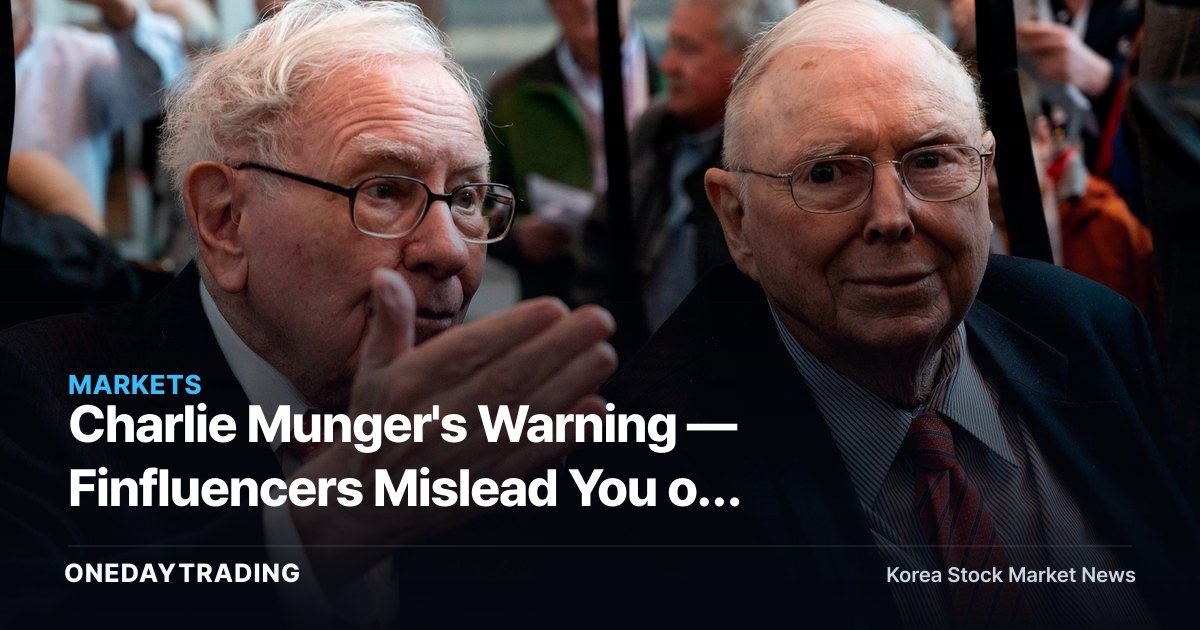
Alongside Warren Buffett, Munger built Berkshire Hathaway into a world-class investment holding company, and he is regarded as a symbol of rational value investing. The core of the message he left through numerous talks and interviews is clear: content creators who promise to make you rich quickly are driven by views, advertising, and product sales, and they prioritize their own interests over their viewers' long-term returns.
Munger held that real wealth comes not from short-term trading or chasing trendy stocks (tickers), but from living within your means, saving consistently, and the compounding effect that time creates. He repeatedly emphasized that accumulating your first $100,000 is the hardest part, but that this seed capital becomes the foundation for all subsequent wealth growth.
He also advised investing only in businesses you can understand and holding on to quality companies for the long haul once you buy them. Frequent trading, he argued, only magnifies fees, taxes, and psychological mistakes.
Structural Background
Behind the renewed circulation of this message lies a flood of social-media-based investment information. As provocative content surrounding short-term surging stocks (tickers), leverage, options, and crypto assets has multiplied, the risk of retail investors being exposed to unverified advice has grown. Munger's principles serve as a kind of line of defense in this environment.
Stock & Sector Impact
- Berkshire Hathaway: As a company that embodies Munger's philosophy directly, it may be revisited as the flagship example of the long-term value-investing model.
- Asset Management & Securities Sector: The importance of long-term, quality-stock-focused products and investor education is highlighted over the promotion of short-term trading.
- Index-Tracking ETFs & Index Funds: These align with the low-cost, long-term holding strategy Munger advocated, giving them a solid base of demand.
- High-Dividend & Quality Stocks: A message emphasizing compounding and patience may strengthen the preference for stocks (tickers) with stable cash flows.
Bull vs. Bear Scenarios
From a bullish perspective, the greater the volatility, the more Munger-style long-term, value-investing principles can restore investor confidence and reinforce a steady flow of capital into quality stocks and index products. A proven philosophy acts as a safeguard that reduces panic selling during market shocks.
From a bearish perspective, however, these principles have a limitation in that they are not an immediate catalyst for stock price gains. In a market dominated by short-term momentum, a long-term holding strategy can feel relatively frustrating, and even quality stocks struggle to avoid corrections depending on interest-rate and economic cycles.
Investor Action Points
- For short-term-trading or surge tips from unclear sources, first check the sender's vested interests and keep your distance.
- Build your portfolio around understandable businesses and quality companies, and extend your holding periods.
- Maximize the compounding effect through seed-capital accumulation, regular contributions, and low-cost index investing.
- Prioritize a structure that reduces costs, taxes, and psychological mistakes over short-term returns.
This article is content automatically summarized and analyzed based on the original news report. View Original (Yahoo Finance)