
Summary
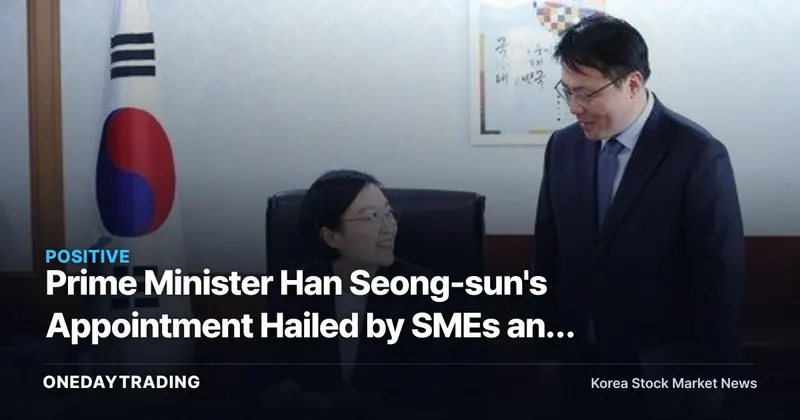
The industry moved first, on the very day the prime minister changed. The SME/venture business community and the women-owned business community issued welcoming statements immediately after Han Seong-sun's appointment as prime minister, calling her "the right person to lead innovation-driven growth." The speed of that response is itself a signal — not a mere ceremonial gesture, but a declaration of demand projecting onto the new prime minister's office the hope that SME and small-merchant policy will be maintained and strengthened.
What Happened
Han Seong-sun was officially appointed prime minister of the Lee Jae-myung administration — its second — on July 1, 2026. She is only the second woman to hold the office in South Korea's constitutional history. On the day of her appointment, the SME/venture business community and the women-owned business community issued statements simultaneously, describing her as the right person to lead innovation-driven growth.
What stands out is both the speed and the substance of the response. Industry statements following a change in prime minister are typically limited to formal congratulations, but this time they carried concrete expectations for continuity and reinforcement of SME and small-merchant policy. The Prime Minister's Office wields real authority over inter-ministerial budget coordination and regulatory adjustments — policy direction at the Ministry of SMEs and Startups, the Fair Trade Commission, and other agencies is effectively determined through the prime minister's office. The industry's welcome is an expression of expectations directed at that authority.
Structural Backdrop
It's worth first looking at the current landscape of SME and small-merchant policy. Support budgets and policy-finance volumes have continued to expand, but the economy on the ground still feels like it's in a cooling phase. Under the twin pressures of high interest rates and sluggish domestic demand, policy effects are slow to reach the field. The market has already priced in much of the policy intent itself — this is the backdrop behind the relative strength of policy-finance-related stocks such as IBK Industrial Bank in the first half of this year. What the market has not yet priced in is the speed of execution and the specifics of budget allocation. The key question is how quickly the new prime minister can close that gap.
Impact on Stocks and Sectors
- IBK Industrial Bank (024110): As the state-run bank dedicated to SME financing, its loan growth rate and interest income are directly tied to whether the prime minister's office maintains a policy of expanding policy-finance supply. Since expectations of benefiting from policy finance are already partly priced into the share price, the trigger for further gains will be concrete details on the actual scale of budget allocation.
- Small-cap KOSDAQ growth and venture stocks: If policies to strengthen support for innovative startups and the venture ecosystem take concrete shape, improved expectations for funding access could feed into valuations across small-cap KOSDAQ innovation stocks more broadly. That said, this is a lagging variable — share-price reactions tend to emerge once actual implementation becomes visible, rather than at the point of policy announcement.
- Consumer goods, distribution, and dining: Under a scenario of strengthened policies to protect small-merchant commercial districts and boost domestic demand, related consumer goods and distribution networks could see medium-term benefits. However, there is a lag of at least one to two quarters before policy effects show up in earnings.
- VCs and platforms tied to the women's startup ecosystem: If the symbolism of having only the second female prime minister translates into stronger support policies for women-led businesses, order-flow expectations for listed VC firms and SME-support platforms could rise. A limitation, however, is that the number of directly investable listed companies is limited.
Bullish vs. Bearish Scenarios
Bullish: If Prime Minister Han quickly presents a concrete package early in her term — one that includes expanded SME/small-merchant support budgets and regulatory easing — it could generate further momentum for policy-finance stocks such as IBK Industrial Bank and small-cap growth stocks on KOSDAQ. If the innovation-growth stance translates into expanded investment in the venture ecosystem, related listed companies could also benefit.
Bearish: A change in prime minister alone cannot resolve structural consumption weakness or the burden of high interest rates. With policy expectations already priced in, profit-taking could emerge if the actual policy content falls short of expectations or if implementation is delayed. The inter-ministerial coordination vacuum that typically follows a change in prime minister is also a near-term downside variable.
Investor Action Points
- Track Prime Minister Han Seong-sun's early official economic remarks and the schedule of key ministries' work reports to her office — this is when policy priorities first become clear.
- Check the second-half work plans that the Ministry of SMEs and Startups, the Fair Trade Commission, and other relevant ministries are due to announce in July–August for whether small-merchant support budgets become concrete and which direction regulatory easing takes.
- Watch IBK Industrial Bank's third-quarter earnings release for changes in SME loan growth and net interest margin (NIM) — this is where any expansion in policy finance gets verified in the numbers.
- For small-cap KOSDAQ growth stocks, rather than chasing short-term momentum right after a policy announcement, it makes more sense to wait until budget execution becomes visible and confirm actual earnings improvement before taking a position.
IBK Industrial Bank: A Real-Time Data Snapshot
IBK Industrial Bank's most recent closing price was KRW 20,200 (+1.51% from the previous day), and the composite signal — reflecting foreign/institutional order flow along with news and momentum — reads 🟡 Neutral, Wait-and-See. With positive and negative signals mixed, this is a segment worth monitoring.
- ▼ Order-Flow Continuity — Foreign investors have posted net sales for 7 consecutive days (−KRW 3.0 billion)
- ▲ Trend Alignment — Short- and medium-term trends are aligned to the upside (+1.5% today · +0.2% over 1 week · +0.7% over 1 month)
※ Price and foreign/institutional order-flow data are provided by Korea Investment & Securities (KIS) and are current as of publication.
This article was automatically summarized and analyzed based on the original news report. View original (Yonhap News, Industry)