
At a Glance
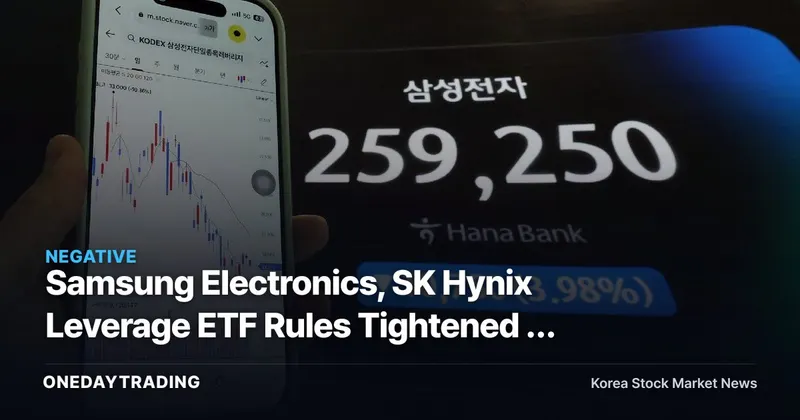
Financial authorities are tripling the margin deposit requirement for margin trading in single-stock leverage exchange-traded funds (ETFs) tracking Samsung Electronics and SK Hynix, raising it from 10 million won to 30 million won. The measure, originally set to take effect on August 5, has been moved up five days to July 31. In a Realmeter poll, 64.7% of respondents said the introduction of the rule itself was wrong — yet regulators chose to accelerate it rather than slow down.
Why It Matters Now
Tripling the deposit requirement is not a minor adjustment to the threshold. Until now, an account holding just 10 million won in cash could open a margin position and bet on leverage ETFs that track Samsung Electronics and SK Hynix at double exposure. A large share of these accounts will be pushed out of the market once the bar rises to 30 million won. In practice, this means part of the trading value driven by retail leverage supply-demand (order flow) during the current semiconductor rally could disappear starting at the end of this month.
The reasoning behind moving the effective date up by five days has not been explained in detail by officials. That said, this kind of early implementation typically occurs when supervisory authorities judge that margin loan balances or the pace of growth in leverage ETF net assets have reached a level of concern. It is reasonable to read this as a preemptive move to prevent a rush of new margin accounts trying to get in before the rule takes effect.
Public sentiment toward the measure, however, is far from favorable. The finding that 64.7% of respondents consider the rule a mistake highlights a paradox: the very retail investors the regulation is meant to protect don't want it. If the gap between policy credibility and actual effectiveness widens, demand could shift toward workarounds such as contracts for difference (CFDs) or similar products listed overseas in order to bypass the deposit threshold — a possibility that cannot be ruled out.
FAQ
- Why is the deposit requirement being raised?: The goal is to curb excessive debt-funded speculation by raising the minimum capital retail investors need to trade leverage ETFs on margin.
- Why was the effective date moved up?: Official explanations remain limited, but the move is widely interpreted as an attempt to preemptively block a rush of margin trading ahead of the rule taking effect.
- Does this directly affect the share prices of Samsung Electronics and SK Hynix?: It has no bearing on either stock's (ticker's) earnings or fundamentals, but reduced short-term buying through leverage ETFs could lower average daily trading value and volatility.
- What happens to existing holders of the leverage ETFs?: There is no mechanism for forced liquidation of existing holdings, but investors' ability to add to positions via margin trading will be reduced.
Related Stocks (Tickers) and Sector Impact
- Samsung Electronics, SK Hynix: Day-trading supply-demand (order flow) driven by leverage ETFs may contract, potentially lowering average daily trading value, though this has no direct impact on earnings or export fundamentals.
- Leverage ETF managers (Samsung Asset Management, Mirae Asset Global Investments affiliates): Slower inflows of new capital could moderate growth in management-fee-based revenue.
- Brokerages with a high share of retail margin trading, such as Kiwoom Securities: Growth in margin-lending interest income may be limited, and net growth in leverage accounts could stall.
- KOSPI semiconductor large caps broadly: As short-term volatility driven by retail leverage supply-demand (order flow) cools, the relative weight of institutional investors and foreign investors supply-demand (order flow) could become more prominent.
Investment Considerations
- Watch for follow-up announcements from the Financial Services Commission on whether this deposit increase will be extended to other leverage and inverse products.
- Keep an eye on whether the 64.7% opposition found in the Realmeter survey leads to any easing of the policy or adjustments to the implementation details.
- A pullback in margin trading reflects a supply-demand (order flow) factor, not a sign of deteriorating fundamentals — it should not be misread as a sign of weakening earnings.
- If demand shifts toward overseas-listed semiconductor leverage products to avoid the domestic deposit threshold, the potential impact on liquidity in domestic exchanges should also be monitored.
Overall Outlook
If the regulation succeeds in filtering out excessive debt-funded trading as intended, short-term volatility in Samsung Electronics and SK Hynix could ease, with a stabilizing effect as the relative share of longer-term capital grows. At the same time, the 64.7% opposition rate can also be read as a signal that communication with retail investors was lacking during the policy's design process, and continued debate over its effectiveness leaves room for the implementation details to be revised again. The next things to watch are the actual trends in leverage ETF net assets and margin loan balances after the July 31 effective date, and whether the Financial Services Commission introduces any additional supplementary measures.
Samsung Electronics: A Real-Time Data Snapshot
The most recent closing price for Samsung Electronics was 249,500 won (-7.59% versus the previous session), and the signal combining foreign investor and institutional investor supply-demand (order flow) with news and momentum reads 🔴 Caution. With foreign investors, institutional investors, and momentum all skewing negative, caution is warranted at this time.
- ▼ Dual-side selling — Foreign investors sold a net 868.0 billion won, institutional investors sold a net 858.8 billion won
- ▼ Trend alignment — Short- and medium-term trends aligned to the downside (-7.6% for the day, -2.2% for the week, -26.7% for the month)
- ▲ News flow — 8 positive catalysts vs. 3 negative catalysts — positive catalysts dominate
Recent related news skews favorable, with 8 positive catalysts versus 3 negative catalysts.
※ Price and foreign/institutional investor supply-demand (order flow) data are provided by Korea Investment & Securities (KIS) and reflect figures as of publication time.
This article was automatically summarized and analyzed based on the original news report. View original article (Maeil Business Newspaper, Securities)