
At a Glance
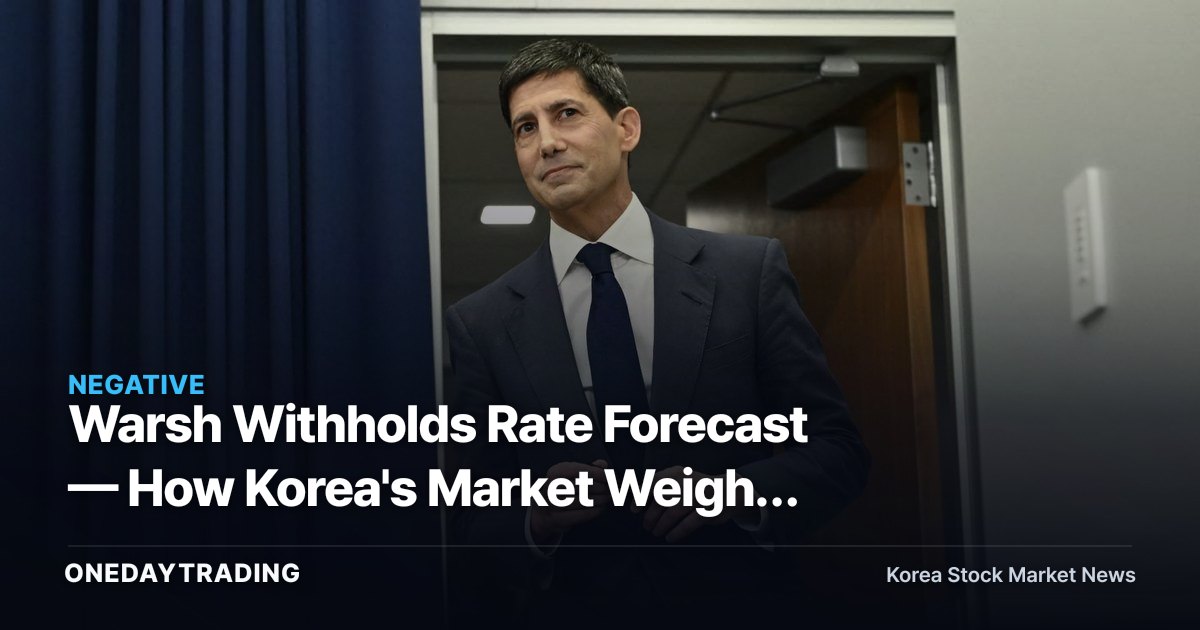
The Federal Reserve's dot-plot median pointed to a benchmark interest rate of 3.8% by the end of 2026. That sits 0.25 percentage points above the upper end of the current target range — a signal that the easing cycle markets had been counting on could stall or even reverse. The fact that Chair Warsh deliberately left his own projection blank adds to the uncertainty surrounding the path of monetary policy.
Why It Matters Now
The key isn't the 0.25-percentage-point figure itself, but the shift in direction. Until now, markets had aligned equity valuations and the exchange rate with a picture of rates gradually declining. Yet the fact that some Fed officials referenced an additional hike in 2026 means an internal judgment that inflation has not been sufficiently contained is still alive. A rising discount rate directly erodes the present value of growth stocks, which carry a heavy weighting of future cash flows.
For Korean investors, the more sensitive channel is the exchange rate. If U.S. rates stay elevated, the Korea–U.S. rate gap widens, the dollar strengthens, and the won comes under depreciation pressure. A weaker won boosts the won-denominated revenue of exporters, but it also encourages foreign investors to pull capital out of the KOSPI and KOSDAQ — so it cuts both ways for the indices.
Warsh's decision to withhold a projection cannot be brushed aside either. The Chair's silence is evidence of a wide split between the hawks and the hold camp within the Fed, and every inflation and employment data point released ahead of the next meeting could become a trigger that amplifies market volatility.
Frequently Asked Questions
- Why does 3.8% matter — Because it is 0.25 percentage points above the current target's upper bound, making it a hawkish signal that reverses expectations of further cuts.
- Why did Chair Warsh leave his projection blank — It is read as an intent not to pin the market to a single direction at a time when views among officials diverge sharply.
- Does it immediately affect Korean rates — The Bank of Korea won't follow suit instantly, but it faces indirect pressure through the Korea–U.S. rate gap and the value of the won.
- Which sectors are most sensitive — The paths diverge between growth stocks, which are sensitive to the discount rate, and bank stocks, whose loan-deposit margins improve.
Affected Stocks and Sectors
- Bank stocks (KB Financial, Shinhan Financial Group, Hana Financial Group) — If high rates persist, they help defend net interest margins (NIM), and their dividend appeal comes to the fore.
- Large-cap exporters (Hyundai Motor, Samsung Electronics) — A weaker won is favorable for won-denominated earnings, but at the same time high rates pressure tech-stock valuations, which can offset the benefit.
- Growth and platform stocks (Kakao) — Stocks with a heavy weighting of future profits are the most vulnerable to a rising discount rate.
- Construction and real-estate-related stocks — A prolonged funding-cost burden is unfavorable on the front of presales and financing costs.
What to Watch When Investing
- The dot plot is merely the officials' projections, not a fixed path. The actual trend should be reconfirmed against the next FOMC meeting and U.S. inflation data (CPI and PCE).
- Use the won-dollar exchange rate level as a checkpoint, but distinguish that a simple depreciation does not translate directly into a positive catalyst for every exporter.
- Examine whether expectations of margin improvement at banks are already priced into their shares, along with any valuation burden.
- It is worth tracking the Bank of Korea's next Monetary Policy Board decision and its commentary on the Korea–U.S. rate gap separately.
Overall Outlook
If a scenario of rates staying higher for longer materializes, banks with improving margins and exporters with rising won-translated earnings have relative room to hold up. The opposite risk is just as clear. If a rising discount rate drags down valuations across growth stocks and a weaker won leads to foreign investors pulling out, downward pressure on the indices themselves could intensify. Since Chair Warsh withheld his projection, the market's direction hinges on whether the upcoming inflation and employment data side with the hawks or the doves.
This article is content automatically summarized and analyzed based on the original news report. View original (CNBC)