
Key Takeaways
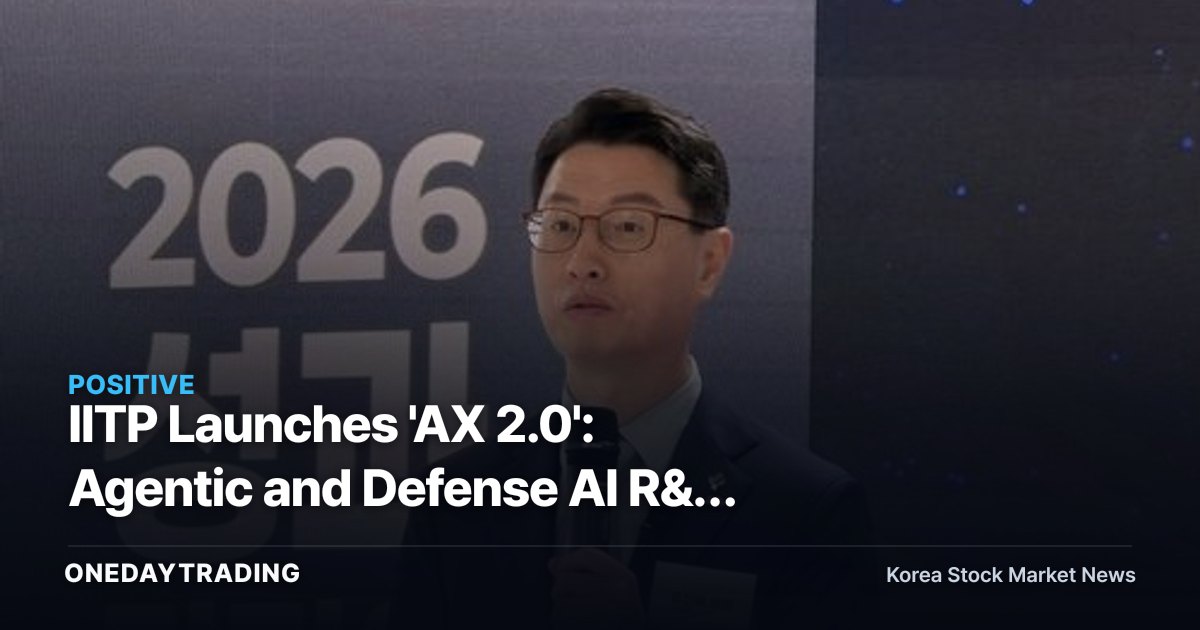
The Institute for Information & Communications Technology Planning & Evaluation (IITP), the control tower for the government's AI research and development, has embarked on an 'AX 2.0' R&D pivot centered on agentic AI and defense AI. This signals a shift in policy focus away from a pure model-performance race and toward "AI applied to real industrial settings," and a gradual impact is expected on the business environment of domestic companies with application-level and domain-specialized AI capabilities.
What Happened
IITP is the body that plans and manages national R&D in Korea's AI and ICT sectors, and it has now redefined its strategic direction as 'AX (AI Transformation) 2.0.' Whereas the previous focus emphasized securing foundational technologies such as large language models, the new direction places its weight on broadening the scope of applications to include agentic AI — which sets its own goals and carries out tasks autonomously — as well as defense AI tailored to the national defense domain.
This is read as an intent to elevate AI from a laboratory achievement to a stage where it is embedded in on-the-ground operations across manufacturing, defense, the public sector, and more. If the structure of government projects is reorganized around applications and field validation, companies holding the relevant technologies could see more opportunities to win projects and build up reference cases.
Background and Context
This aligns with the broader trend in which the center of gravity in global AI competition is shifting from models themselves toward "agents" and industry-specific deployment. Defense AI, in particular, is an area where nations are increasing investment in autonomous reconnaissance, target recognition, and command-and-control, giving state-led R&D a clear policy rationale. That said, this announcement is largely a matter of "setting direction," and tangible effects will depend on subsequent budget execution and detailed project solicitations.
Impact on the Market and Stocks
- Naver: With its in-house LLM HyperCLOVA X and its cloud offering, Naver has room to participate as a platform provider in agentic AI applications and public-sector projects.
- Kakao: Kakao is working to internalize AI models and services, and as demand for applied AI expands, it could broaden its footprint in the B2B and public-sector arenas.
- Samsung SDS: Backed by its enterprise AI platform and SI capabilities, the company is well positioned to absorb implementation demand for field-deployable AX projects.
- Hanwha Systems: Holding defense AI and command-and-control system technologies, the company has significant direct exposure to the expansion of defense AI R&D.
- LIG Nex1: As AI adoption grows in autonomous weapons and precision guidance, the company could see expanding frontline demand and research-collaboration opportunities.
Investor Checkpoints
- IITP's follow-up detailed project solicitations and budget scale: Verify whether the directional announcement materializes into actual funding allocations.
- Disclosures of individual companies' government-project wins and field-validation agreements: Check the path by which reference cases translate into revenue.
- For defense AI, the timing of defense-budget and requirement decisions is a variable, so track the progress of the related programs alongside.
- Note that for companies with a small share of applied-AI revenue, policy expectations alone may be slow to show up in earnings.
Outlook
If the government concentrates policy resources on applied and domain AI, the medium-to-long-term business foundation of domestic AI software and defense companies could be strengthened. On the other hand, a policy announcement in itself has a weak link to near-term earnings, and stocks that have already priced in AI expectations also carry the opposing variables of valuation burden and uncertainty over project wins. An approach that confirms developments through actual data — execution and contract wins, rather than expectations — is warranted.
Naver by Real-Time Data
Naver's most recent closing price was 246,000 won (+1.65% from the prior day), and the traffic-light signal — which combines foreign and institutional investor supply-demand (order flow) with news and momentum — reads 🟢 Buy-Favored. With news and momentum turning positive, the stock is worth a closer look.
- ▲ Trend Alignment — short- and medium-term upward alignment (today +1.6% · 1 week +8.4% · 1 month +20.9%)
- ▲ News Flow — 5 positive catalysts vs. 2 negative catalysts — positive catalysts lead
Recent related news is favorable, with 5 positive catalysts and 2 negative catalysts.
※ Price and foreign/institutional investor supply-demand (order flow) data are provided by Korea Investment & Securities (KIS) and are as of the time of publication.
This article is content automatically summarized and analyzed based on the original news report. View Original (Yonhap News, Industry)