
3-Line Briefing
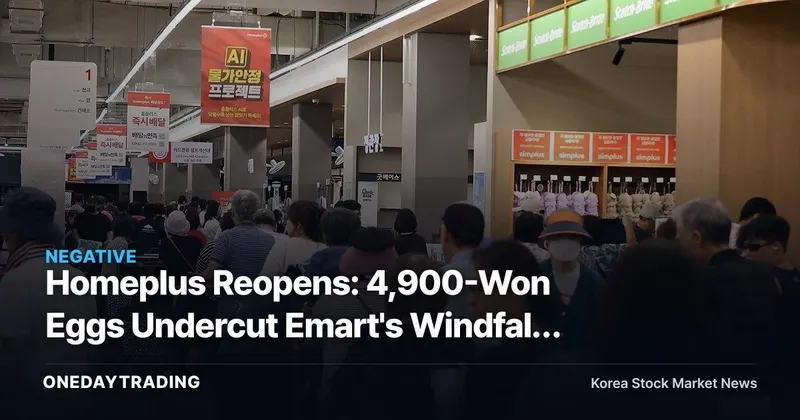
- On the first day of Homeplus's reopening, customers returned to the Daejeon store, drawn in by loss-leader prices such as a 30-pack of eggs for 4,900 won, green onions for 2,900 won, and pork neck for 8,000 won.
- What matters to investors isn't the rehabilitation headline itself but the restocking of shelves. Once fresh food is back on the shelves, hypermarket traffic is the first thing to return.
- Expectations that demand fleeing Homeplus would flow to Emart and Lotte Shopping have been conditionally scaled back. That windfall was a premium attached to the bankruptcy scenario.
What's Changing
Through analyst Park Se-ra's lens, this reopening marks the first line of a data recovery rather than a sentimental one. Customers remarking that the store finally feels like Homeplus again isn't just a scene from the field — it matters. In hypermarket earnings, fresh food is the gateway that drives visit frequency. When eggs, green onions, and pork neck are priced low, consumers fill their entire basket at the same store. A single discounted item pulls both food revenue and accompanying non-food purchases along with it.
After entering court-led rehabilitation proceedings in March last year, Homeplus scaled back its 126 hypermarkets to focus on 67 core stores. Through measures including the closure of 37 non-core outlets, the sale of its Express convenience-store chain, and workforce cuts, the company says it has lowered costs by roughly 1.2 trillion won. Its logic is straightforward: once supply and operations normalize, the 67 stores can generate operating profit in the 80 billion won range, rising to as much as 150 billion won within three years.
The problem is that this logic is still a restart hypothesis, not an income statement. The crowds on day one reflect a mix of discount and reopening effects. For that to translate into repeat visits, suppliers need to accept credit risk again and shelf out-of-stock rates need to come down. For retail stocks, it's inventory turnover and purchasing terms — not traffic — that ultimately determine profit.
Numbers and Context
A tray of eggs at 4,900 won sends a strong price signal to consumers. This year, Homeplus has also led with prices in the 5,000-won range for imported eggs, selling out more than 46,000 trays of fresh Thai eggs and adding sales of American white eggs. When basket-level inflation is elevated, fresh food is the fastest way for a hypermarket to reclaim its price image.
That said, the 200 billion won in emergency operating funds is a restart cost, not the end of rehabilitation. The money goes out first for normalizing supply, covering wages and utilities, and rebuilding inventory. Even as revenue returns, heavy discounting will compress gross margin. So while this news is a positive catalyst that raises Homeplus's odds of survival, it looks more like a near-term negative catalyst for its listed competitors.
Stocks to Watch: Winners and Losers
- Emart: Expectations that it could capture demand left vacant by Homeplus are weakening. In particular, if the pace at which grocery shoppers defect from Homeplus slows, existing spillover-benefit estimates could be revised down.
- Lotte Shopping: Lotte Mart likewise expected inflows in local trade areas stemming from Homeplus store closures or stockouts. As Homeplus shelves recover, the cost of price competition returns as well.
- GS Retail: Some nearby grocery-shopping demand had shifted to convenience-store and supermarket channels, but hypermarket fresh-food discounts could pull part of that demand back.
- BGF Retail: This creates limited pressure on grocery-style convenience-store sales. However, since immediate-consumption purchases make up a larger share of its business, the intensity of direct competition with hypermarkets is lower than for Emart or Lotte Shopping.
- Harim Holdings: Following NS Shopmall's acquisition of Homeplus Express, there is strategic significance in the expansion of its food-distribution footprint. That said, this should be distinguished from any direct earnings link to the normalization of Homeplus's core business.
Risk Check
- The crowding on day one may simply reflect the discount event. It remains to be seen whether repeat-visit rates and average spend per customer hold up two to four weeks later.
- If supplier credit recovery is delayed, fresh-food stockouts could recur. In a retail turnaround, supply-chain trust matters as much as funding.
- If discount competition intensifies before pricing normalizes, it will erode margins for both Homeplus and its rivals. Rising revenue does not automatically mean improving profit.
- If the rehabilitation process or M&A timeline falters, employee attrition and worsening terms for partner suppliers could resurface.
Bottom Line
Homeplus's reopening strips away part of the bankruptcy premium that had been priced into its listed rivals' expected windfall, but the real verdict will hinge on the out-of-stock rate, average spend per customer, and the pace of supply normalization over the coming month.
Emart: A Real-Time Data Snapshot
Emart's most recent closing price was 76,400 won (-4.38% versus the prior day), and the composite signal combining foreign-investor/institutional-investor supply-demand (order flow) with news and momentum reads 🔴 Caution. With foreign investors, institutional investors, and momentum all negative, caution is warranted right now.
- ▼ Dual-side selling — Foreign investors −2.0 billion won and institutional investors −1.5 billion won in combined net selling
- ▼ Trend alignment — Short- and medium-term downtrend alignment (day -4.4% · 1 week -6.1% · 1 month -4.9%)
- ▼ 52-week position — Near the 52-week low, at the 9th percentile
* Price and foreign/institutional investor supply-demand (order flow) data are provided by Korea Investment & Securities (KIS) and reflect figures as of publication time.
This article is automatically summarized and analyzed content based on the original news report. View original (Yonhap News, Industry)