
At a Glance
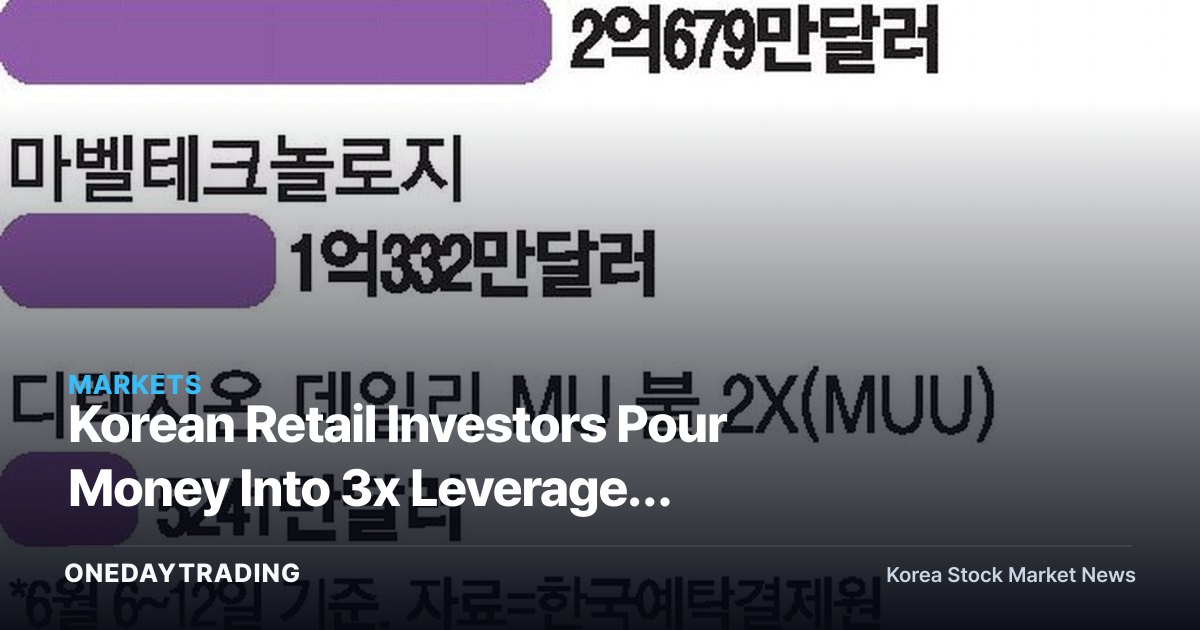
During the recent sharp correction in U.S. and Korean equity markets, Korean retail investors who invest in overseas equities have shifted large amounts of money into 3x leveraged semiconductor ETFs. The trend reflects market sentiment that views the pullback as a bargain-buying opportunity. However, given the high-risk structure that tracks three times the daily return, it is hard to read this as a straightforward positive catalyst.
Why It Matters Now
The 3x leveraged semiconductor ETF is best represented by SOXL, which tracks three times the daily moves of the group of stocks in the U.S. Philadelphia Semiconductor Index. When the index falls, losses also magnify threefold, but during a rebound it offers the potential for explosive gains — which is why retail investor money piles in during every bout of volatility.
This inflow is read as a sign that expectations for AI demand and a recovery in the memory chip cycle remain strong. It means many investors see the correction as a temporary dip and are betting on a return to the uptrend. At the same time, an intensifying rush into leveraged products during periods of high volatility can become a factor that amplifies market swings.
For Korean investors, it is important to keep in mind that this is a complex, multi-variable market in which the exchange rate, U.S. interest rates, and the earnings reports of big-tech names including Nvidia are all at play simultaneously.
Frequently Asked Questions
- What is a 3x leveraged ETF? It is a derivative product designed to track three times the daily return of an underlying index, and volatility decay can accumulate if held over the long term.
- Why does money pile in during a correction? Because of the expectation that the larger the price drop, the larger the rebound — the result of bargain-buying and short-term trading demand overlapping.
- How does it differ from a regular semiconductor ETF? A standard ETF tracks the index one-for-one, whereas a leveraged product amplifies both gains and losses, making both the risk and the expected return larger.
- Is it suitable for long-term investing? Because its value erodes in sideways or declining markets, it is better suited for short-term tactical plays than for long-term holding.
Impact on Related Stocks and Sectors
- SOXL The direct target of the inflows, it moves most sensitively to swings in the semiconductor index.
- Nvidia With a large weighting in the semiconductor index and as a core driver of AI demand, it dictates the index's direction.
- Broadcom and AMD As major constituents of the Philadelphia Semiconductor Index, they are linked to leveraged fund flows.
- SK Hynix and Samsung Electronics (005930) If global semiconductor investment sentiment recovers, a favorable mood could spread to Korea's leading memory chip stocks as well.
- Securities and asset management industry Rising overseas ETF trading increases opportunities for fee income.
Points to Watch When Investing
- Due to volatility decay, the longer a leveraged ETF is held, the greater its divergence from the index.
- If the correction deepens further, losses can expand threefold, making money management essential.
- Exchange-rate movements act as an additional variable that further shakes won-denominated returns.
- Rather than chasing prices on herd sentiment, it is important to scale in gradually and set stop-loss levels.
Overall Outlook
As long as expectations for an AI and memory-cycle recovery hold, leveraged money can reap high returns when semiconductors rebound. However, if the correction drags on due to interest-rate, earnings, and geopolitical variables, losses will likewise swell rapidly. This is a phase in which risk management — rather than conviction in market direction — determines success or failure, and a reasonable approach is to deploy only a portion of one's assets on a short-term, tactical basis.
This article is content automatically summarized and analyzed based on the original news report. View original (Maeil Business Newspaper, Securities)