
Three-Line Briefing
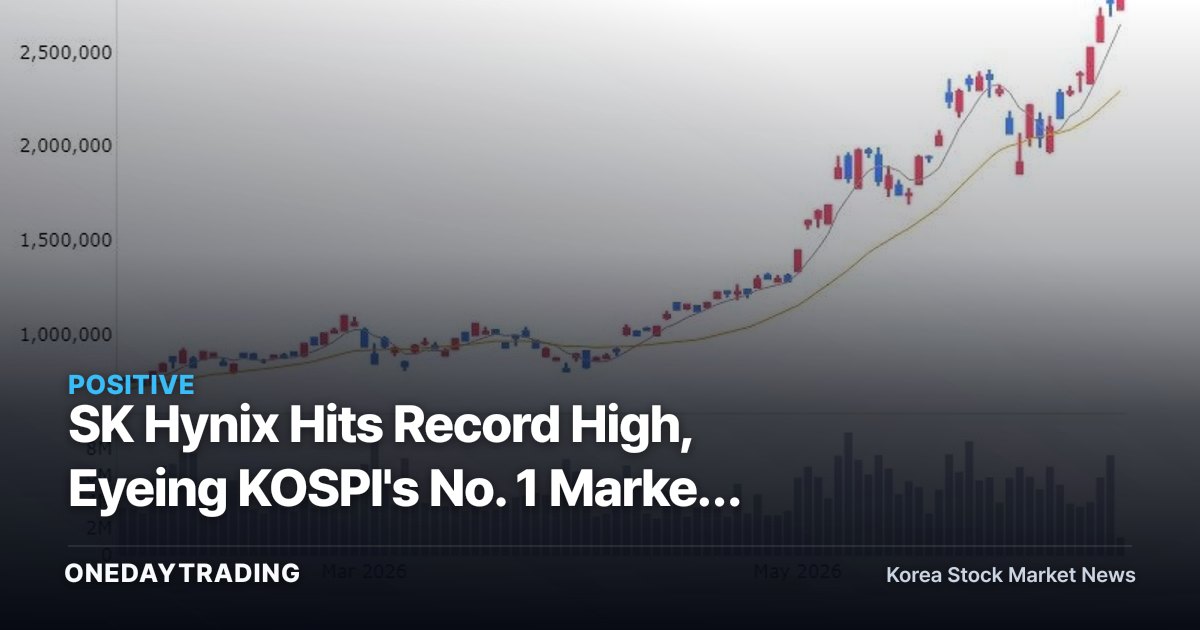
- On the 22nd, SK Hynix at one point jumped 148,000 won (5.35%) versus the previous session, setting an all-time record high.
- The driver behind the rally is not mere order flow, but rather that leadership in high-bandwidth memory (HBM)—used in AI accelerators—is simultaneously lifting both earnings and valuation.
- As the gap with Samsung Electronics for the top KOSPI market capitalization spot narrows, the potential for a leadership reshuffle within the memory industry sector is being put to the test.
What Is Changing
The significance of this record high for investors goes beyond the strength of a single stock. The fact that the No. 1 market cap structure—a symbol of the Korean stock market for over 20 years—is being shaken signals that the market has begun to price in a shift in the memory industry's profit engine, moving from commodity DRAM and NAND to high-value-added memory dedicated to AI. Whether or not SK Hynix actually claims the top market cap spot, the very fact that the possibility is being discussed is the cumulative result of judgments that the company's product mix holds an edge over its competitors.
The core mechanism lies in HBM's profit structure. HBM is supplied to AI accelerator makers such as Nvidia essentially through pre-orders and long-term contracts, and unlike commodity memory, it must pass customer-specific design and qualification, creating high barriers to entry. As a result, its pricing power and margins far exceed those of standard DRAM. SK Hynix leads in early mass production and customer acquisition in this market, so even under the same memory market conditions, its earnings leverage works to a greater degree.
Conversely, this carries a double-edged quality: once latecomers begin to catch up, the premium could shrink rapidly. Samsung Electronics' next-generation HBM customer qualification and Micron's capacity expansion timeline are the variables to watch.
Viewing Through Numbers and Context
The day's move of 5.35%, or 148,000 won, is unusual as a single-session swing for a large-cap stock with a market capitalization in the tens of trillions of won. The record high carries the technical meaning that the overhang of supply trapped at the prior peak has been cleared, while also showing that foreign investors and institutional investors are reassessing the earnings visibility of the AI memory cycle. That said, a sharp short-term gain (surge) brings with it commensurate profit-taking pressure and heightened volatility, so whether the trend continues needs to be confirmed through earnings and order flow rather than price.
Beneficiary and Affected Stocks
- SK Hynix: As the HBM frontrunner, a direct beneficiary of rising AI memory demand. A structure in which an upgraded product mix expands margins and earnings leverage.
- Samsung Electronics: Faces the dual challenge of defending its No. 1 market cap position and catching up in HBM. Progress on next-generation HBM customer qualification will dictate its relative share-price trajectory.
- Hanmi Semiconductor: As a supplier of key HBM back-end equipment (TC bonders), it has a clear path to upstream benefit from capacity expansion and yield improvements.
- Isu Petasys and materials/parts/equipment partners: Potential trickle-down effects when downstream demand—such as AI servers and high-layer-count substrates—expands, though individual earnings vary widely.
Risk Check
- Valuation burden following the short-term sharp gain (surge) and profit-taking supply could heighten volatility.
- Risk that the price premium and market share shrink once competitors' HBM customer qualification and capacity expansion get into full swing.
- If the AI investment cycle slows or data center capital expenditure is adjusted, the assumptions for downstream demand could be shaken.
- Macro variables such as the exchange rate and interest rates, along with the cyclicality of the semiconductor market, are structural variables that amplify the swings in memory profits.
One-Line Conclusion
The shift in profit structure created by HBM is the substantive basis for SK Hynix's re-rating, but with expectations of the No. 1 market cap spot already priced in, it is reasonable to confirm the trend's durability through the HBM revenue share in the next earnings release and competitors' qualification timelines.
SK Hynix Through Real-Time Data
SK Hynix's most recent closing price is 2,918,000 won (+5.57% versus the prior day), and the signal light combining foreign and institutional order flow with news and momentum is 🟢 Buy-Favored. With news and momentum positive, the stock is worth watching.
- ▲ Trend Alignment — Short- and mid-term upside alignment (intraday +5.6% · 1 week +27.5% · 1 month +67.2%)
- ▲ 52-Week Position — 99% of the 52-week upper range — record-high territory
- ▲ News Flow — 22 positive catalysts vs. 3 negative catalysts — positive catalysts dominate
Recent related news stands at 22 positive catalysts · 3 negative catalysts, a favorable balance.
※ Price and foreign/institutional order flow data are provided by Korea Investment & Securities (KIS), as of the time of publication.
This article is content automatically summarized and analyzed based on the original news. View original (Maeil Business Newspaper, Securities)