
At a Glance
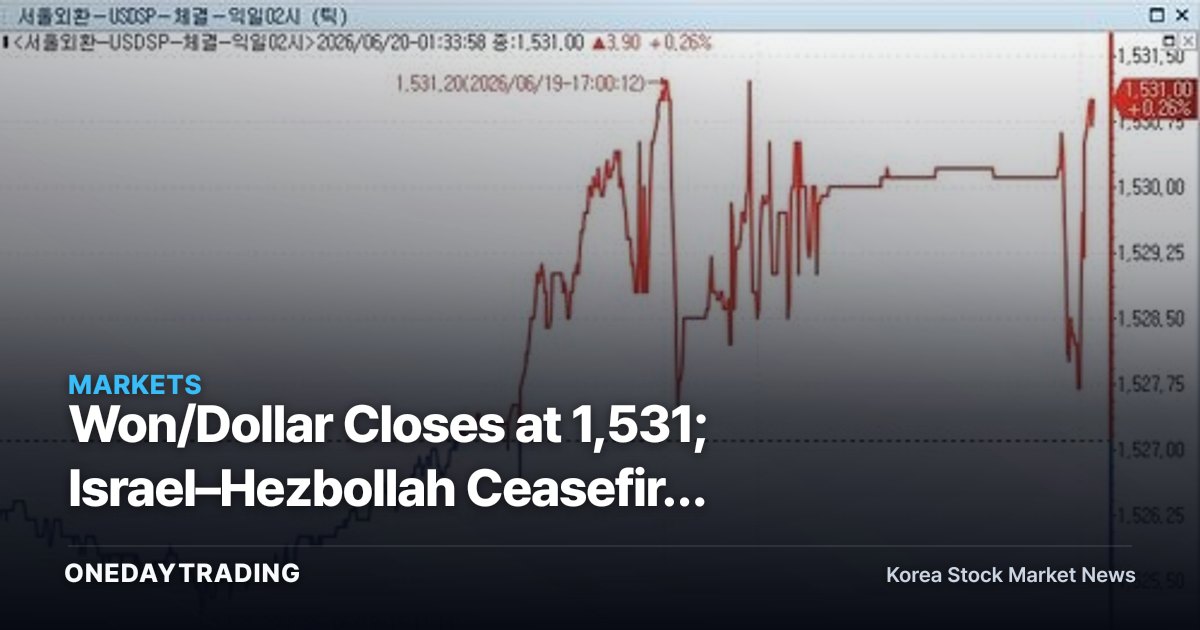
The dollar-won exchange rate fell intraday on hopes of easing geopolitical risk in the Middle East before reversing again to close at 1,531 won. Which way the exchange rate swings is not just a number—it is a variable that simultaneously divides the fortunes of large-cap exporters, which earn a substantial share of their revenue overseas, and airlines and refiners, which import raw materials.
The key point is that the absolute level of 1,531 won is itself a historically very weak-won zone. While ceasefire hopes stoked risk appetite, the fact that the exchange rate ultimately returned to where it started can be read as a signal that dollar-strength pressure remains firmly in place.
Why It Matters Now
The prospect of a ceasefire between Israel and Hezbollah works along two tracks. First, easing geopolitical tension reduces demand for the dollar as a safe-haven asset, which is favorable for the won. The intraday drop in the exchange rate shows that this channel temporarily had the upper hand. Second, easing Middle East risk is a factor that caps the upside in international oil prices, which can ease the cost burden on the Korean economy, which imports all of its crude oil.
However, the exchange rate's return to 1,531 won means that the ceasefire—a one-off positive catalyst—could not overcome U.S. interest rate and dollar fundamentals. As long as the exchange rate hovers in the mid-1,500-won range, raw-material import costs, valuation losses on foreign-currency debt, and concerns over foreign investors pulling out their funds remain persistent burdens on the broader market.
Even at the same high exchange rate, the impact splits in opposite directions by industry sector. Exporters that receive most of their revenue in dollars see their won-converted revenue and margins expand, whereas companies that pay for fuel and raw materials in dollars see their costs balloon.
Frequently Asked Questions
- Why did the exchange rate fall and then rise again — Ceasefire hopes stoked risk appetite and reduced dollar demand, but structural forces such as the U.S.–Korea interest rate gap and dollar strength remained, causing the exchange rate to reverse.
- Is 1,531 won a high level — By historical standards it is a very weak-won zone, a level that increases import inflation and the burden of foreign-currency debt.
- Is the Middle East ceasefire a positive or negative catalyst for the Korean stock market — Oil-price stability and risk appetite are favorable, but the effect is limited if the exchange rate does not come down.
- Which companies are most sensitive to the exchange rate — Large-cap manufacturers with high export exposure benefit, while airlines and refiners that buy fuel and raw materials in dollars are on the burdened side.
Impact on Related Stocks and Sectors
- Hyundai Motor / Kia — With a high share of overseas sales in markets such as the U.S., they are a representative beneficiary sector whose converted revenue and operating profit rise when the won weakens.
- Samsung Electronics / SK Hynix — They receive semiconductor export proceeds in dollars, so a high exchange rate is favorable for margins, though the global demand cycle has a greater impact.
- Korean Air — Because jet-fuel payments and foreign-currency lease debt are denominated in dollars, a high exchange rate acts as a cost and valuation-loss burden, making it a representative case of damage.
- S-Oil / SK Innovation — They import crude oil in dollars, so there is an exchange-rate burden, but oil-price stability from the Middle East ceasefire is a double-edged variable that increases refining-margin volatility.
- Airline and travel sector — Overseas travel demand tends to shrink at a high exchange rate, so the exchange-rate level becomes a barometer for earnings.
Points to Watch When Investing
- It is difficult to determine the direction of the exchange rate based on one-off ceasefire news. The path of U.S. interest rates and the trend in the dollar index must be viewed together.
- The logic of benefiting from a high exchange rate only translates into earnings when export prices and volumes provide support as well. Using the exchange rate alone as a basis for buying is risky.
- In periods of sharp exchange-rate swings, FX-related valuation gains and losses at companies with large foreign-currency debt can distort quarterly earnings.
- The situation in the Middle East carries a persistent risk of re-escalation, which could cause oil prices and the exchange rate to swing again.
Overall Outlook
If the ceasefire actually takes hold and the upside in oil prices is capped, eased cost pressure and a recovery in risk appetite could combine to allow the exchange rate to stabilize gradually. In that case, cost pressure on import-dependent sectors would ease, and exporters could continue to enjoy a favorable environment.
Conversely, if the dollar-strength trend persists or the Middle East situation re-escalates, the entrenchment of the rate in the 1,500-won range could lengthen, and import inflation and foreign investors' supply-demand (order flow) burden could weigh on the broader market. As confirmation indicators, it is practical to check the schedule of the next U.S. interest rate decision, the level of international oil prices (Brent crude), and whether the exchange rate settles back below 1,500 won.
This article is content automatically summarized and analyzed based on the original news report. View original (Yonhap News, Securities)