
Key Takeaways
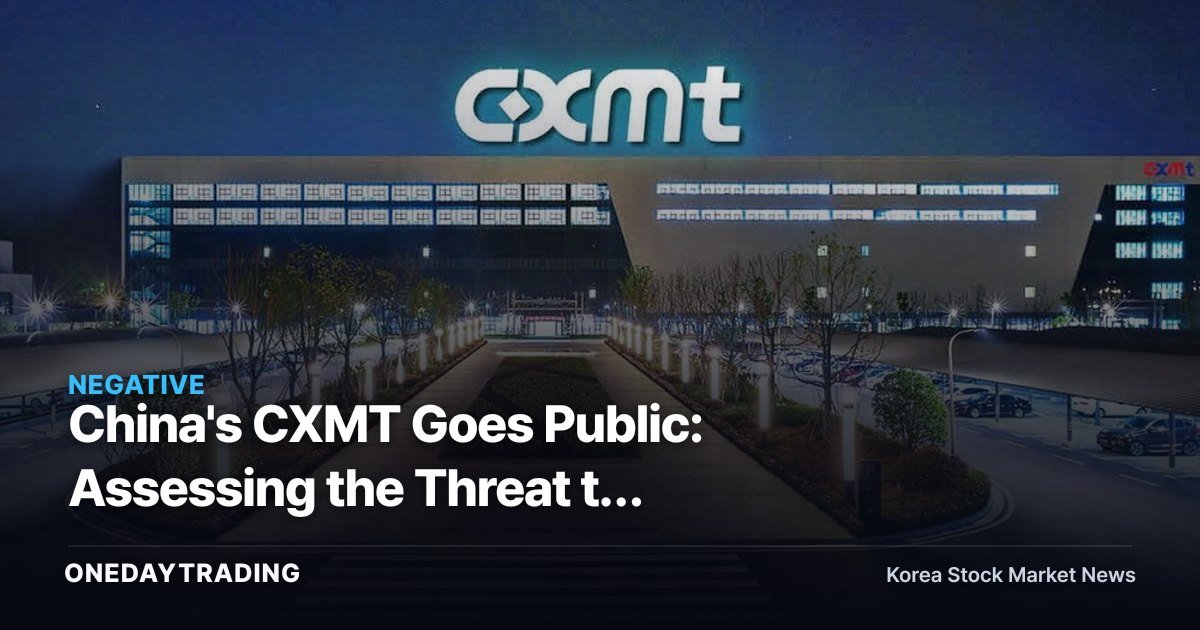
Chinese memory maker ChangXin Memory Technologies (CXMT) has climbed to become the world's fourth-largest DRAM producer and is now gearing up for a large-scale listing. The valuation being floated in the market sits around 675 trillion won — a figure comparable to the combined market capitalization of Korea's two memory giants. The real issue is not simply the arrival of a new competitor, but how far the profitability of Samsung Electronics' and SK Hynix's commodity memory could be squeezed as China — backed by its own capital and policy funding — accelerates legacy DRAM capacity expansion.
What Happened
CXMT is a company that has rapidly scaled its production capacity around commodity DRAM such as DDR4 and LPDDR4. Despite being a latecomer, its volumes have grown enough to put it in the fourth spot in global DRAM shipment rankings, and the funds raised through this listing are likely to be plowed back into expanding capacity and improving processes.
What deserves attention is the nature of the funding. On top of the external capital that the listing itself attracts, China has long poured national-level funds and subsidies into achieving semiconductor self-sufficiency. While U.S. export controls on advanced equipment block entry into cutting-edge processes, on legacy nodes outside those controls there is room for China to instead grow its domestic equipment and materials ecosystem and mount a volume offensive.
Background and Context
The DRAM market splits into advanced and commodity segments. HBM and high-capacity DDR5 products used in AI servers are effectively an oligopoly held by Samsung Electronics, SK Hynix, and Micron, with high barriers to entry. By contrast, commodity products like DDR4 and LPDDR4 that go into PCs, mobile devices, and consumer electronics have a relatively narrow technology gap, making it easy for a latecomer's capacity expansion to translate directly into oversupply and falling prices. This legacy market is precisely where CXMT's expansion collides head-on.
Impact on the Market and Stocks
- Samsung Electronics: With a relatively large share of commodity DRAM, it is exposed to China-driven legacy supply expansion. That said, its diversification across HBM, foundry, and NAND acts as a buffer that disperses the shock.
- SK Hynix: Its high reliance on DRAM makes it sensitive to price swings, but its leadership in HBM and the growing share of high-value-added products partly shield it from a direct hit from legacy competition.
- Hanmi Semiconductor: As a beneficiary of HBM bonding equipment, its relative gains strengthen the further Korea widens its lead in the advanced segment. Chinese competition may even become a variable that accelerates the shift to cutting-edge products.
- Micron: A U.S. player competing in the same commodity DRAM segment, it faces pressure on market share and pricing similar to the Korean makers when Chinese volumes expand.
Investor Checkpoints
- Confirm CXMT's actual listing timing and fundraising scale, as well as its plan for allocating the proceeds to capacity expansion, through disclosures and local reporting.
- Monitor the monthly trend in contract prices for commodity DRAM such as DDR4 to gauge the real impact of Chinese volumes on pricing.
- In the quarterly earnings of Samsung Electronics and SK Hynix, separate out legacy DRAM shipments and inventory from changes in the HBM revenue mix.
- Watch the policy calendar, since shifts in the intensity of U.S. semiconductor equipment export controls on China will dictate the pace of China's process upgrades.
Outlook
The optimistic scenario is one in which Korea's two giants shift their center of gravity toward the high-value-added HBM and DDR5 segments, separating their competitive turf from China. In that case, even if legacy prices waver, overall profitability is held up by advanced products. The opposite risk is clear. If China's capacity expansion comes faster than expected and the memory cycle enters a downturn, falling commodity prices could amplify the earnings volatility of the two giants. How long the moat of the advanced-technology gap can be maintained will determine the direction of this competition.
Samsung Electronics in Real-Time Data
Samsung Electronics' latest closing price is 362,500 won (+4.62% from the previous day), and its traffic-light signal — combining foreign and institutional investor order flow with news and momentum — is 🟢 Buy-leaning. Foreign investors, institutional investors, news, and momentum are all positive, making it worth watching.
- ▲ Dual-engine buying — foreign investors +872.7 billion won · institutional investors +689.0 billion won, buying in tandem
- ▲ Trend alignment — short- and medium-term aligned to the upside (same day +4.6% · 1 week +21.2% · 1 month +29.0%)
- ▲ 52-week position — 98% of the 52-week high range — new-high territory
- ▲ News flow — 30 positive catalysts vs. 9 negative catalysts — positive catalysts dominate
Recent related news is favorable, with 30 positive catalysts and 9 negative catalysts.
※ Price and foreign/institutional investor order-flow data are provided by Korea Investment & Securities (KIS), as of the time of publication.
This article is content automatically summarized and analyzed based on the original news report. View original (Maeil Business Newspaper, Corporate)