
At a Glance
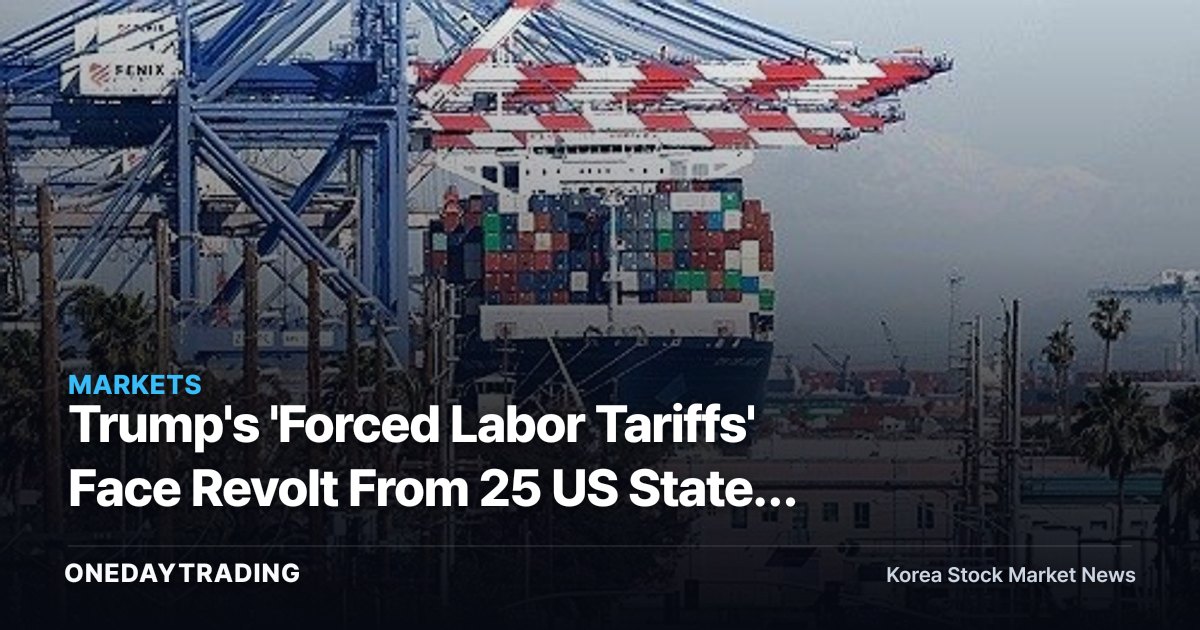
The lawsuit takes direct aim at the scope of Section 301 of the Trade Act, which the Trump administration has used as the legal basis for its tariffs. On the 3rd (local time), 25 US states led by Democratic governors, including New York and California, filed suit in federal court arguing that the Section 301 tariffs imposed on forced-labor grounds are unlawful. At issue is whether tariffs justified by forced labor have, in practice, skipped the procedural requirements of trade law while simply expanding the president's tariff discretion — and depending on the outcome, the tariff risk premium for domestic companies with heavy exposure to the US export market could be adjusted once again.
Why It Matters Now
This lawsuit is not an isolated case. Tariff policy under the second Trump administration has already faced disputes reaching the Supreme Court over tariffs based on the International Emergency Economic Powers Act (IEEPA), with the judiciary steadily building precedent by scrutinizing the administration's legal grounds for tariffs one by one. This latest Section 301 suit is an extension of the same trend. Regardless of which provision of trade law a tariff relies on, it signals that the courts continue to reaffirm the boundaries of just how far presidential tariff authority can extend.
Section 301 was originally designed as a tool for the US Trade Representative (USTR) to respond to unfair trade practices by trading partners — such as intellectual property infringement or unfair subsidies — following a formal investigation and comment period. This is precisely where the 25 states take issue: they argue that by fitting the human-rights issue of forced labor into Section 301's unfair-trade-practice framework, the administration failed to fully observe the investigation and justification procedures the law requires. The outcome of this legal dispute will determine whether the administration can continue expanding tariffs as a policy tool, or whether each provision will face stricter invocation requirements going forward.
That said, the lawsuit is only a starting point and does not mean the tariffs will be withdrawn immediately. The process — a lower-court ruling, appeal, and potentially a Supreme Court review — could take anywhere from several months to several years. That is why the market should be cautious about treating this lawsuit as an immediate resolution of tariff risk, and instead watch for the possibility of a prolonged legal battle similar to the earlier IEEPA tariff litigation.
FAQ
- What are the Section 301 forced-labor tariffs? These are tariffs the Trump administration imposed on specific imported goods under Section 301 of the Trade Act, citing forced-labor practices as the justification.
- Why do the 25 states claim they are unlawful? They argue the administration expanded the human-rights issue of forced labor into a tariff justification without conducting the unfair-trade-practice investigation and procedures that Section 301 requires.
- Will this lawsuit remove the tariffs immediately? No. The case could proceed from a federal district court ruling through appeal, meaning a final resolution could take considerable time.
- Did Republican-led states join the suit? No. The lawsuit was brought by a coalition of 25 states led by Democratic governors, reflecting the political alignment of states more critical of the administration's tariff policy.
Related Stocks (Tickers) and Sector Impact
- Domestic manufacturers with high exposure to US exports If the scope of Section 301 is narrowed, the tariff risk premium could ease, offering hope for lower export cost burdens.
- Import-dependent industry sectors sensitive to trade-policy uncertainty Until the lawsuit is resolved, the legal basis for tariffs remains in flux, which could delay cost planning.
- Exporters tied to the KRW/USD exchange rate Tariff-related legal risk interacts with dollar strength or weakness, indirectly affecting the valuations of exporters that stand to benefit from favorable currency swings.
- Industry sectors broadly involved in US trade negotiations If precedent narrowing Section 301 authority accumulates, it could also curb attempts to expand tariffs on other product categories.
Investment Considerations
- The lawsuit has only just been filed, and even a first-instance ruling could take considerable time — it is too early to treat this as a short-term catalyst.
- In the earlier IEEPA tariff litigation, the courts sided with the administration, so there is no basis for assuming the 25 states will prevail.
- Tariff risk should be assessed not just by the lawsuit's outcome alone, but also by how the administration responds afterward.
- Worth monitoring going forward: the federal court's hearing schedule, whether the administration appeals, and the level of the KRW/USD exchange rate.
Overall Outlook
In the optimistic scenario, the courts interpret the administration's tariff-invocation requirements strictly — as they did in the IEEPA tariff litigation — narrowing the legal basis for the Section 301 forced-labor tariffs. In that case, both the cost burden on affected goods and the policy-uncertainty premium could ease somewhat. Conversely, if the courts broadly affirm the administration's discretion, Section 301 would remain a tool that can be used to expand tariffs under a variety of justifications going forward. Either way, a resolution could take anywhere from several months to several years, so it is the coming hearing schedule and the administration's response — rather than the filing of this lawsuit itself — that will ultimately determine the real direction of tariff risk.
This article was automatically summarized and analyzed based on the original news report. View original (Yonhap News Securities)