
At a Glance
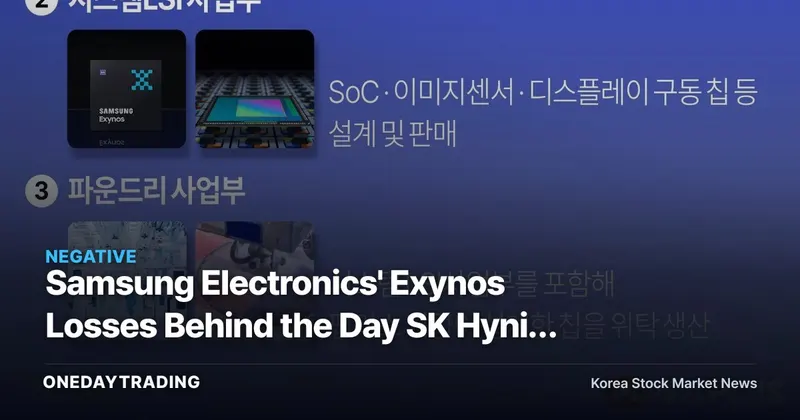
Samsung Electronics' (005930) common stock market capitalization recently overtook — and was in turn briefly overtaken by — SK Hynix's common stock market capitalization. While SK Hynix, a company smaller than Samsung Electronics in both business scale and profit scale, has seen its share price fully reflect the benefits of the memory supercycle, Samsung Electronics has been held back by its foundry and System LSI business, and in particular by the chronic losses at its in-house mobile AP, Exynos. Exynos is caught in a bind: if Samsung tries to scale it up, foundry yields can't keep pace; if it scales back, foundry utilization and negotiating leverage collapse together.
Why It Matters Now
Breaking down the supply chain step by step, the root of the problem lies not in design but in process technology. Exynos is manufactured on Samsung Foundry's 3nm GAA (Gate-All-Around) process, and repeated assessments that this process's yields trail those of rival foundries' 3nm nodes have resulted in AP chips of the same generation falling behind Snapdragon in power efficiency and thermal management. No matter how much the design team refines core layout and clock speeds, low foundry yields push up die costs, making the chip less cost-competitive for inclusion in finished devices.
This dynamic is already visible in the set division's choices. Much of the Galaxy S series' top-tier lineup already relies entirely on Snapdragon for global shipments, with Exynos remaining only in some entry-level or mid-range models, or in specific regions. The problem is that this shrinkage feeds the next link in the vicious cycle. As adoption volume declines, internal demand for the foundry's 3nm line falls, along with the opportunities needed to run the learning curve required for yield improvement. With yields not improving, costs don't come down, and with costs not coming down, the set division gains one more reason to lean further into Snapdragon.
Still, discontinuing Exynos is not an easy call either. One weakness of the foundry business is the lack of a strong flagship reference case to show external customers that this process has been proven at mass-production scale — and if Exynos, the in-house demand, disappears too, that reference case is lost entirely. At the same time, the set division would become entirely dependent on Qualcomm alone for its top-tier AP, effectively surrendering its own pricing leverage. Samsung Electronics' inability to either scale up or shut down Exynos stems from weighing these two losses against each other.
FAQ
- Q. What exactly is causing Exynos's losses? A. The prevailing view is that the culprit is less the design itself than the yields of Samsung Foundry's 3nm GAA process. Low yields push up per-die costs, and higher costs make the set division reluctant to adopt the chip — a cycle that keeps repeating.
- Q. What does the market cap reversal have to do with Exynos? A. This reversal was driven by improving conditions in SK Hynix's memory business, but it also exposed the fact that Samsung Electronics still hasn't fully offset its non-memory losses with memory profits.
- Q. Could Samsung fully discontinue Exynos? A. Industry views suggest an immediate full withdrawal is unlikely, given the risk of losing its foundry reference case and becoming solely dependent on Qualcomm for AP supply. That said, the shrinking share within the Galaxy lineup is already underway.
- Q. Is there room for improvement? A. If yields stabilize on next-generation processes, there is room for Exynos's cost competitiveness to recover. The key question is when the new foundry process's yields actually improve.
Related Stocks and Sector Impact
- Samsung Electronics: If losses at Exynos and the foundry business persist, improvement in non-memory earnings could be delayed, potentially prolonging an earnings structure that leans heavily on memory profits.
- SK Hynix: With a relatively simpler business structure amid the memory supercycle, the company may command a valuation edge over Samsung Electronics.
- Qualcomm: The more Snapdragon's adoption share grows within the Galaxy lineup, the more Qualcomm benefits from expanded AP supply volume and revenue growth.
- Domestic semiconductor equipment and materials suppliers: If utilization at Samsung Foundry's 3nm line stays low, related equipment and materials orders could also be delayed.
Investment Considerations
- Foundry earnings are often disclosed bundled together with System LSI, making it difficult to precisely isolate Exynos's standalone profit and loss.
- The market cap reversal may be a temporary phenomenon driven by the memory price cycle, and could reverse again once the cycle turns.
- Official announcements on foundry yield improvement are rare, so investors should look for indirect signals such as AP adoption share in the next Galaxy models and commentary on foundry utilization in upcoming quarters.
Overall Outlook
In the optimistic scenario, yields stabilize on the next-generation process, restoring Exynos's cost competitiveness and allowing its Galaxy adoption share to rise again. Conversely, if yield improvement is delayed, the shrinkage of Exynos and deepening reliance on Qualcomm could become entrenched, leaving the foundry business at a continued disadvantage in attracting external customers. The next indicators to watch are the System LSI/foundry commentary from Samsung Electronics' upcoming quarterly earnings release and the AP configuration of the next Galaxy model.
Samsung Electronics in Real-Time Data
Samsung Electronics' most recent closing price was 286,000 won (-9.06% from the previous day), and the signal combining foreign investor/institutional investor supply-demand (order flow) with news and momentum reads 🔴 Caution. With foreign investors, institutional investors, and momentum all turning negative, caution is warranted at this time.
- ▼ Supply-Demand Continuity — Foreign investors net sold for 10 straight days (−1,471.5 billion won)
- ▼ Double-Sided Selling — Foreign investors −1,471.5 billion won · Institutional investors −616.2 billion won, selling in tandem
- ▼ Trend Alignment — Short- and medium-term downtrend alignment (same-day -9.1% · 1-week -20.2% · 1-month -20.7%)
- ▲ News Flow — 11 positive catalysts vs. 3 negative catalysts — positive catalysts prevail
Recent related news skews favorable, with 11 positive catalysts versus 3 negative catalysts.
※ Price and foreign/institutional investor supply-demand data are provided by Korea Investment & Securities (KIS) and reflect the time of publication.
This article was automatically summarized and analyzed based on the original news report. View original (Maeil Business Newspaper)