
SK Hynix Leveraged Investment: Three-Line Briefing
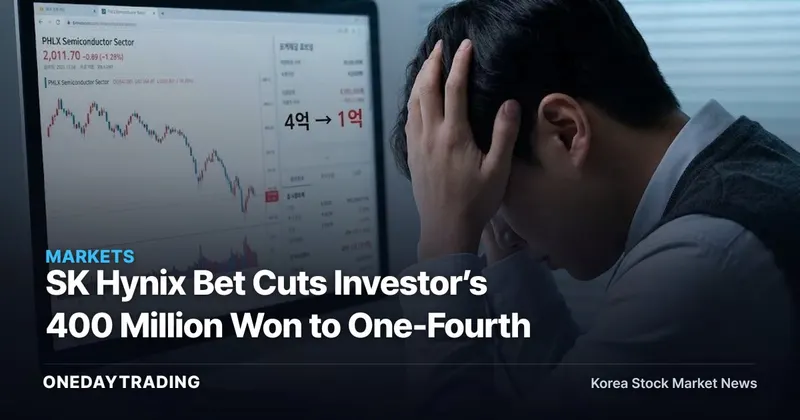
- The story that drew online attention on the 14th highlights the risks of the investment structure more than the outlook for the stock (ticker). An office worker in his late 30s, identified as A, said he invested about 400 million won in SK Hynix and a 2x leveraged product, among other assets, before his wealth fell to roughly one-fourth of its original value.
- In a post reported by Maeil Business Newspaper’s securities desk, A said he invested money saved over 10 years of employment, along with more than 300 million won from a deposit that matured in May.
- This case alone cannot be used to assess SK Hynix’s corporate value or share-price direction. What can be confirmed is that semiconductor-stock concentration, leveraged exposure, and delayed selling all converged in a single account.
A’s Loss Says More About the Investment Structure Than the Stock
Interpreting the incident as evidence about the semiconductor cycle simply because SK Hynix was involved would miss the point. More directly relevant to investors is the sequence in which A committed a large sum to a 2x leveraged product designed to amplify movements in the underlying asset, then could not sell after losses mounted because he expected a rebound. Because 2x leverage increases exposure to movements in the underlying asset, its profit-and-loss path differs from directly holding the stock.
A said that since May, he had invested about 400 million won in semiconductor-related stocks using existing equity-investment funds and proceeds from a matured deposit. The main investments were SK Hynix and a 2x leveraged product whose exact name was not disclosed. If the assets were allocated to both a single stock and a linked product, they would remain exposed to price movements in the same direction despite having different names.
From Early Trading Gains to a Major Bet in Late June
A wrote that early in his trading, he “bought in the 300,000-won range and sold in the 500,000-won range, then bought in the 600,000-won range and sold in the 1 million-won range.” He also said he later made an ultra-short-term trade, buying at 1.5 million won and selling at 1.51 million won. The information provided does not identify which product corresponded to each price, the quantities traded, or the actual profits.
The turning point came in late June. A said he invested a large sum in the leveraged product because he expected the uptrend to continue. At that point, expectations about the market’s direction combined with an increase in position size. It is unclear how the results of his early trades influenced his subsequent investment decision, but it is important to distinguish when the large sum was committed from the period when losses accelerated sharply.
Loss Exceeds 40% After Three Days of Declines
A wrote that his loss exceeded 40% after the market declined for three consecutive days. “I couldn’t cut my losses because I thought even a small rebound would let me recover them,” he said. The account shows how continued price declines can destabilize not only a portfolio but also an investor’s original selling rules.
The article states that his assets, worth about 400 million won before the investment, fell to 100 million won after the losses—one-fourth of their original value. However, the exact value of the remaining assets, the breakdown between realized and unrealized losses, and the amounts invested in SK Hynix and the leveraged product were not disclosed. It is also unclear whether the anonymous post and the reported losses were independently verified.
No Confirmed Impact on SK Hynix
- SK Hynix: The company is directly connected to the case as one of A’s main investments. However, the individual case contains no information indicating changes in the company’s earnings, supply chain, shipments, customer orders, or corporate value, so its share-price impact is classified as neutral.
- 2x leveraged product: The product’s exact name was not disclosed. There is therefore no basis for identifying any particular listed product or asset manager as directly responsible for the loss.
- Semiconductor-related stocks: These were cited as the category in which A invested about 400 million won, but no company other than SK Hynix was identified. The scope cannot reasonably be expanded to other related stocks.
Key Conditions That Differentiate Leveraged Investments
- Investors should first determine whether continued declines in the same direction would simultaneously increase loss exposure in both the underlying stock and the leveraged product.
- If a rebound is the only condition for selling, the decision point for limiting losses will keep being postponed if the price does not recover.
- An investment assessment requires the product’s exact name and the amount invested in each stock (ticker). Neither was provided in this case, making it impossible to calculate each product’s contribution to the losses.
- To evaluate the investment case for SK Hynix, investors should look separately at business indicators subsequently disclosed by the company, such as shipments, yields, and customer orders, rather than the outcome of an individual account.
The Lesson From Assets Shrinking to One-Fourth
This is not corporate news that changes the outlook for SK Hynix. It is a case showing how dramatically an individual’s wealth can fluctuate when a concentrated semiconductor investment is combined with 2x leverage and hopes for a rebound. A stock’s technological competitiveness and an investor’s account structure are separate issues. Keeping them distinct should be the starting point for the next decision as well.
Key SK Hynix MetricsAs of 2026-11-14
| Period Return | 1 Week +8.92% 1 Month -2.30% |
|---|---|
| Trading Value · Trading Volume | 104.3 billion won · 4,909,256 shares |
| Supply-Demand (Order Flow) | Foreign Investors Net sales of 570.2 billion won Institutional Investors Net purchases of 36.5 billion won |
| Recent News Tone | 3 positive catalysts · 3 negative catalysts |
Price and supply-demand (order flow) data are real-time figures from Korea Investment & Securities (KIS), while supply-demand (order flow) and news-tone tallies are calculated independently by One Day Trading.
Supply-Demand and Momentum Assessment🔴 Caution
Foreign-investor and momentum indicators are showing negative signals.
Upcoming Events to Watch
- 11.26Bank of Korea Monetary Policy BoardHighBenchmark interest rate decision meeting
- 12.09FOMC Policy Rate DecisionHighU.S. Federal Reserve monetary-policy announcement — direction of interest rates and the dollar
- 12.10Futures and Options ExpirationMediumQuadruple witching — watch for volatility and supply-demand (order flow) disruptions
- 01.14Index Options Expiration DateLowKOSPI 200 options expiration
This article was automatically summarized and analyzed based on the original news report. View the original article (Maeil Business Newspaper Securities)