
Key Takeaways
The fact that the KOSPI and KOSDAQ both fell more than 5% together, with Samsung Electronics and SK Hynix dropping 7% and 8% respectively, is not simple panic selling. What this really tells us is that when interest rates and oil prices pressure valuations at the same time, the market first sheds its most overvalued growth stocks and leading semiconductor names.
The trouble with buying the dip is confusing the feeling that prices have gotten cheaper with the reality that the discount rate has risen. As long as concerns about further FOMC rate hikes persist, any rebound needs the market's blessing on liquidity before it can lean on earnings.
What Happened
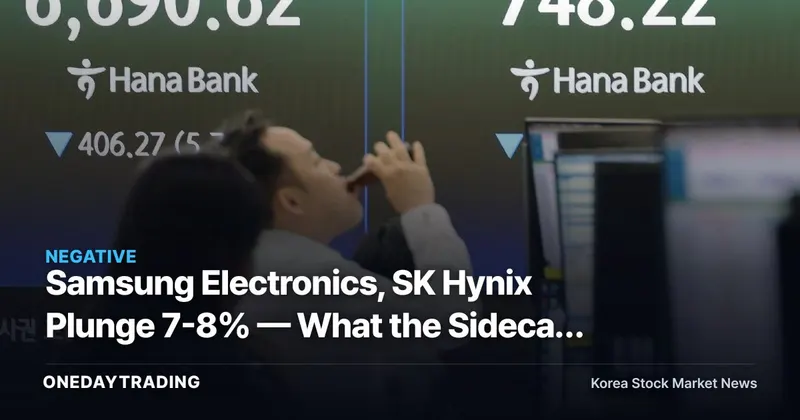
Domestic equities showed the character of a sharp sell-off all week. According to reports, the KOSPI and KOSDAQ each fell more than 5%, and market sentiment cooled so quickly amid the surge in volatility that a sidecar (program-trading circuit breaker) was triggered. Large-cap semiconductor stocks (tickers) were at the center of the index decline.
Samsung Electronics (005930) fell 7%, and SK Hynix (000660) fell 8%. These two stocks (tickers) simultaneously represent both the domestic market's earnings outlook and foreign investor supply-demand (order flow). Their declines should therefore be read not as company-specific issues but as a repricing of the risk premium on the Korean market as a whole.
The combination of negative catalysts was clear. A sharp gain in global oil prices stoked fears of reaccelerating inflation, while the possibility of a rate hike from the U.S. FOMC pushed up the discount rate. When oil prices rise, inflation becomes unstable; when inflation is unstable, interest rates struggle to come down. And if rates don't come down, equity valuation multiples struggle to hold up.
Background and Context
Semiconductor stocks are more sensitive to interest rates the greater the expectation of an earnings recovery, because this is an industry sector that prices in future profits ahead of time. If a memory market upturn, AI server demand, and HBM expectations are already baked into share prices, then rising rate concerns cut into the present value of those expectations.
What the market has already priced in is the expectation that the semiconductor cycle has passed its trough. What it has not yet fully priced in is the possibility that rising oil prices could once again alter the path of inflation and interest rates. If the exchange rate becomes unstable on top of that, foreign investor supply-demand (order flow) could reverse direction within a single day.
Impact on the Market and Individual Stocks
- Samsung Electronics (005930): Both its index weight and its sensitivity to the memory market are at play here. The 7% drop is best read as a move in which the impact of interest rates and foreign investor supply-demand (order flow) got priced in ahead of earnings estimates.
- SK Hynix (000660): The 8% decline shows that stocks (tickers) with the biggest AI/HBM expectations are the most vulnerable to changes in the discount rate. Even when the quality of expected earnings is good, share prices move first when the multiple gets compressed.
- Semiconductor equipment and materials stocks: The correction in large caps also weighs on expectations for an order recovery among upstream suppliers. Stocks (tickers) whose share prices ran up faster than their customers' actual investment pace may see even greater volatility.
- Refining and energy stocks: A sharp gain in global oil prices could, in the near term, stimulate inventory valuation gains and refining-margin expectations. However, if the rise in oil prices spreads into an economic slowdown and rate pressure, the benefit won't last long.
- Growth stocks broadly: The greater the FOMC rate-hike concerns, the harder it becomes to justify high valuations for far-off future profits. Internet, biotech, and some battery stocks (tickers) with low earnings visibility may see limited rebound momentum.
Investor Checkpoints
- The rate path after the FOMC meeting: If the signal for further hikes is strong, the multiple recovery for semiconductors and growth stocks will be delayed. What matters more than a simple pause is the dot plot and the language around the inflation outlook.
- The trajectory of global oil prices: Investors need to distinguish whether the sharp gain in oil is a temporary supply shock or a trend that will feed back into reaccelerating inflation. If it's the latter, the ceiling for any market rebound gets lower.
- Foreign investor supply-demand (order flow): Watch whether foreign selling in Samsung Electronics and SK Hynix comes to a stop. Any rebound in the Korean market lacks real strength without a recovery in supply-demand (order flow) for large-cap stocks (tickers).
- Confirmation from semiconductor earnings: Share prices have already priced in an industry recovery. The next round of earnings needs to prove out that expectation with actual numbers on memory prices, inventory levels, and AI server demand.
Outlook
The optimistic scenario is straightforward. If the rise in oil prices settles down and the FOMC signals a wait-and-see stance rather than further tightening, this decline could turn out to be nothing more than a multiple correction in leading semiconductor stocks (tickers). In that case, Samsung Electronics and SK Hynix would become the first channel for an index rebound.
The trigger for the opposite scenario is oil and interest rates. If oil prices climb further and concerns about a U.S. rate hike resurface, the market will weigh the rise in the discount rate more heavily than any earnings recovery. The next things to watch are the FOMC's commentary, the level of oil prices, and whether foreign investors turn to net buying in semiconductors. A lower price is not the same as risk having disappeared.
Samsung Electronics: A Real-Time Data Snapshot
Samsung Electronics (005930)'s most recent closing price was 249,500 won (-7.59% from the previous day), and the signal light combining foreign/institutional investor supply-demand (order flow) with news and momentum reads 🔴 Caution. Foreign investors, institutional investors, and momentum are all negative, so caution is warranted right now.
- ▼ Dual-side selling — Foreign investors sold −₩868.0 billion, institutional investors sold −₩858.8 billion, in tandem
- ▼ Trend alignment — Short- and medium-term trends aligned to the downside (-7.6% today · -2.2% over 1 week · -26.7% over 1 month)
- ▲ News flow — 10 positive catalysts vs. 2 negative catalysts — positive catalysts dominate
Recent related news skews favorable, with 10 positive catalysts versus 2 negative catalysts.
※ Price and foreign/institutional investor supply-demand (order flow) data are provided by Korea Investment & Securities (KIS) as of the time of publication.
This article was automatically summarized and analyzed based on the original news report. Read the original (Maeil Business Newspaper, Securities)