
Summary
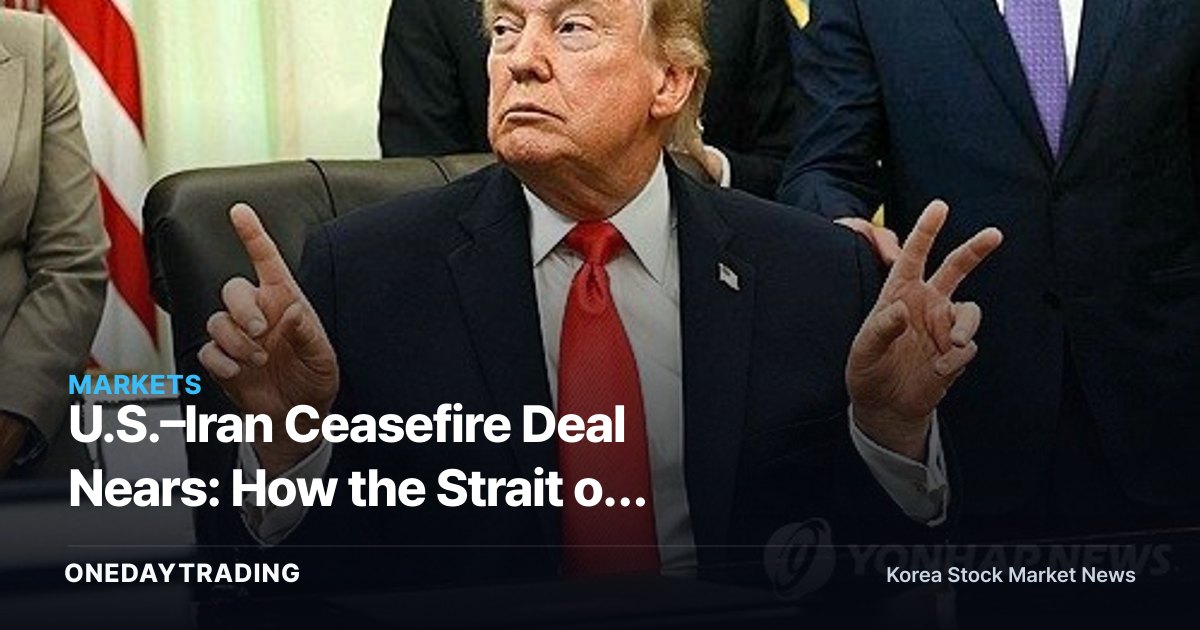
Even as signals point to an imminent U.S.–Iran ceasefire, the delayed release of the actual agreement text has thrust a tug-of-war over transit conditions in the Strait of Hormuz—a chokepoint for the world's crude oil shipments—into the spotlight as a new wildcard. The direction and pace of the deal feed directly into the profit and loss of Korea's refiner, airline, and shipping stocks through short-term swings in international oil prices.
Easing fears of a Strait of Hormuz blockade would put downward pressure on oil prices, but if negotiations over transit fees and who administers the strait drag on, an uncertainty premium could be priced back into oil.
How It Unfolded
While a mood has formed that the U.S. and Iran have agreed to halt hostilities, the document spelling out the deal's specific terms has yet to be made public. This suggests that even with a broad framework in place, the two sides' interests are clashing over the finer clauses.
The issue drawing particular attention is whether transit fees will be levied in the Strait of Hormuz. This strait is a bottleneck through which a substantial share of the world's seaborne crude passes, and the two sides are reportedly engaged in a war of nerves over whether passage should be charged or kept free. Transit terms go beyond a simple cost question, taking on the character of a contest for influence over who controls order in the strait.
Until the agreement is published, the market has no choice but to simultaneously price in the positive catalyst of a ceasefire and the burden of uncertainty over the detailed clauses. In this window, oil prices are prone to an event-driven trade that swings on a single headline.
Structural Backdrop
The Strait of Hormuz is the key passage for Middle Eastern crude headed to Asia. Because Korea relies on the Middle East for a substantial portion of its crude imports, the stability of passage through this strait is a structural variable directly tied to domestic energy costs and the trade balance. Each time blockade risk comes to the fore, a geopolitical premium is added to oil prices, and when tensions ease, that premium is unwound—a pattern that has repeated time and again.
Should transit fees materialize, transport costs would rise, which could affect refining margins and freight-rate structures—so this should be read not as mere diplomatic news but as a cost and logistics variable.
Stock and Sector Ripple Effects
- Refiner stocks (S-Oil, SK Innovation, GS, HD Hyundai Oilbank affiliates): If oil prices stabilize lower, the burden of crude procurement costs eases, but valuation gains on held inventory shrink. Conversely, if transit uncertainty drives oil prices back up, refining margins and inventory effects diverge, amplifying short-term volatility.
- Airline stocks (Korean Air, Asiana Airlines): With fuel costs making up a large share of operating expenses, an oil-price decline driven by ceasefire expectations acts as a direct cost-saving positive catalyst. That said, the benefit is only complete if Middle East route risk eases at the same time.
- Shipping stocks (HMM, Pan Ocean): Strait of Hormuz transit conditions and the stability of Middle East routes are directly tied to freight rates and rerouting costs. A newly imposed transit fee could be a factor pushing up operating costs, making the impact double-edged.
- Gas, power, and chemical materials: Changes in crude and LNG procurement costs are reflected, with a lag, across the cost structures of power and petrochemicals.
Bull vs. Bear Scenarios
The bullish scenario (stable oil prices, cost benefits) is one in which the agreement is published swiftly and Strait of Hormuz passage settles into an effectively free, stable footing. In that case, the geopolitical premium drains away, easing cost burdens for airlines and logistics, while refiners benefit from stable procurement costs.
The bearish scenario (persistent uncertainty) is one in which the tug-of-war over the detailed clauses drags on or transit fees become reality. If confidence in the deal wavers, a risk premium would once again attach to oil prices, and rising transport costs could squeeze the margins of airlines and shipping companies. The very fact that the agreement remains unpublished could be a sign of stalled negotiations—a clear risk factor.
Investor Action Points
- Watch for the timing of the agreement's release and the final wording of the Strait of Hormuz transit-fee clause. Whether passage is free or charged, and who administers it, are the key turning points.
- Monitor the intraday range of international oil prices (WTI, Brent) to gauge whether the geopolitical premium is contracting or expanding.
- For refiner stocks, separate the oil-price direction from the offsetting pull of refining margins and inventory effects; for airline and shipping stocks, check both the share of fuel costs and whether Middle East routes are normalizing.
- In the next refiner and airline earnings releases, verify in the numbers how fuel costs and inventory gains/losses reflect the oil-price swings.
This article is content automatically summarized and analyzed based on the original news report. View original (Yonhap News)