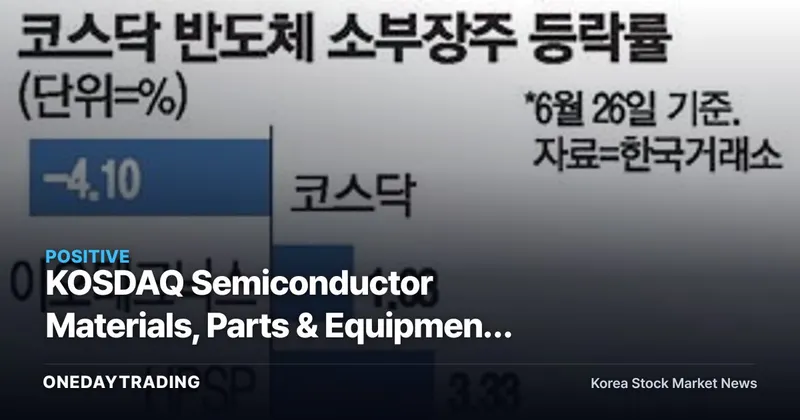

The crux of this move is not simply a broad KOSDAQ rally, but rather an early signal of sector rotation — supply-demand (order flow) that had been concentrated in large-cap semiconductor names is shifting toward back-end processes, materials, and equipment. The fact that institutional investors were accumulating KOSDAQ MP&E stocks at the very moment large-caps were absorbing profit-taking on short-term surge fatigue suggests that the warmth of the memory cycle recovery is spreading from the front end (finished products/sets) to the back end (processes/components). In other words, this is consistent with the classic capital rotation that occurs when the semiconductor investment cycle transitions from a price-appreciation phase to a capital expenditure (capex) deployment phase.
Three-Line Briefing
- Amid broad domestic market weakness, KOSDAQ semiconductor MP&E stocks staged a solo rally.
- As profit-taking concentrated in large-cap semiconductor names, supply-demand (order flow) rotated into small- and mid-cap process and equipment stocks.
- Institutional buying drove the outperformance, raising the possibility that this represents a supply-demand-backed sector rotation rather than a one-off thematic move.
What Is Changing
Until now, the semiconductor rally was dominated by large-caps with direct exposure to HBM and memory prices. However, once valuations reach a certain level, the burden increases and the market begins looking toward back-end names within the same recovery theme that have yet to re-rate. The current MP&E strength closely resembles that textbook playbook.
Earnings at MP&E companies lag the capex decisions of their memory-manufacturer customers. Accordingly, when expectations form that large-cap cycle improvement will translate into expanded capex, improvements in order intake and utilization rates at equipment and materials companies tend to get priced in ahead of the actual results. Institutional investors stepping in at this juncture can be seen as a bet on order and revenue visibility beyond the next quarter.
That said, the sustainability of the rally hinges on trading value and the continuity of the buyer base. If institutional buying dries up within a few days and only retail investor chasing remains, this could end up being a one-time gap-fill rather than genuine sector rotation.
Numbers and Context
The source article weights supply-demand (order flow) dynamics over specific figures. Investors would therefore be well advised to independently verify the quantitative indicators that validate the qualitative signals being reported. The key metrics are: the direction of memory spot and contract prices, major manufacturers' quarterly capex guidance, and new order announcements from KOSDAQ MP&E companies. When all three point in the same direction, sector rotation hardens into a trend.
Beneficiaries and Risks by Stock
- Back-end/inspection equipment: Directly tied to HBM stacking and test demand — stands to see the strongest order momentum when capex expands.
- Front-end deposition/etch equipment: Structured so that revenue share recovers quickly when line expansions and conversion investments resume.
- Semiconductor materials (precursors, etchants, etc.): Consumables revenue proportional to utilization rates — earnings visibility is high when the cycle recovers.
- Large-cap memory stocks: Near-term profit-taking targets, but if the cycle itself hasn't turned, supply-demand (order flow) could return after the pullback.
- Package/substrate companies: Positioned as an indirect beneficiary of the continued ramp in advanced packaging adoption.
Risk Check
- Small- and mid-cap MP&E stocks have thin trading volume, so volatility can spike sharply if institutional buying stops.
- Because earnings lag customer capex, a delay in capex execution could leave expectations priced in with nothing to show — setting up a reversal.
- Stocks that have already posted a sharp gain (surge) face elevated valuation risk and are exposed to profit-taking pressure until earnings are confirmed.
- If memory prices and front-end demand soften again, the sector rotation thesis itself weakens.
Bottom Line
The supply-demand (order flow) shift from large-caps to MP&E names can be read as a signal that semiconductor recovery is broadening, but until sustained institutional buying, fresh order announcements, and memory prices are confirmed together, it is more prudent to treat this as a high-volatility sector rotation than a definitive trend change.
Han Mi Semiconductor — Real-Time Data Snapshot
Han Mi Semiconductor's most recent closing price was 257,500 won (–5.68% vs. prior day), and its composite signal — incorporating foreign investor and institutional investor supply-demand (order flow) alongside news and momentum — reads 🟡 neutral · wait-and-see. Positive and negative signals are mixed, warranting a monitoring stance.
- ▼ Trend alignment — Short- and medium-term downward alignment (day: –5.7% · 1-week: –12.7% · 1-month: –19.3%)
- ▲ News flow — Positive catalysts 7 vs. negative catalysts 2 — positive catalyst bias
Recent related news stands at 7 positive catalyst items vs. 2 negative catalyst items, reflecting a favorable backdrop.
※ Price and foreign investor/institutional investor supply-demand (order flow) data are provided by Korea Investment & Securities (KIS) and reflect conditions at the time of publication.
This article is auto-summarized and analyzed content based on the original news report. View Original (Maeil Business News — Securities)