
At a Glance
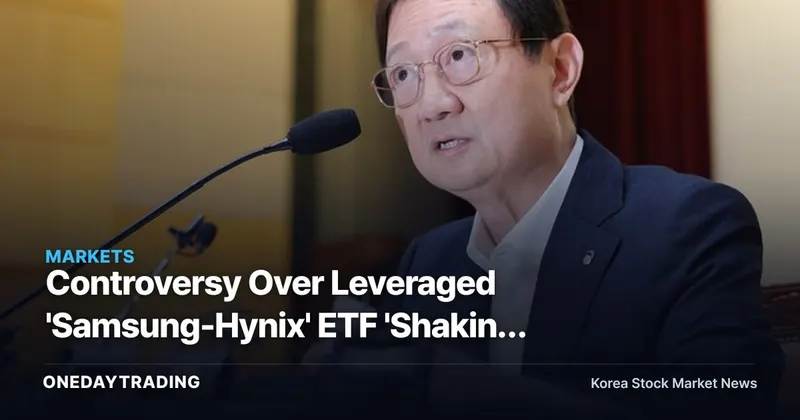
The so-called "Samjeon-Hynix" leveraged exchange-traded fund, which tracks Samsung Electronics and SK Hynix at double exposure, has been singled out as a source of KOSPI volatility. The controversy was elevated to a regulatory issue after Financial Supervisory Service (FSS) Governor Lee Chan-jin raised the concern directly at a press briefing. What matters here isn't the narrative but the numbers: the whole debate hinges on whether rebalancing trade volume, as a share of the two stocks' daily trading value, is actually large enough to move prices.
Why It Matters Now
Leveraged ETFs require structural rebalancing near the market close, buying or selling additional underlying shares to match double the benchmark index's daily return. Even when the underlying assets are KOSPI heavyweights like Samsung Electronics and SK Hynix, regulators' concern is that on days when the index swings sharply, the rebalancing volume itself grows larger and can land on the order book all at once near the closing auction. What the market is now trying to calculate is how much this volume actually contributes to closing-price volatility. If the share turns out to be small, the controversy will likely be dismissed as an overblown narrative; if it exceeds a critical threshold, it could provide grounds for regulatory measures such as adjusting the leverage ratio or spreading out rebalancing timing.
However, this calculation carries a reverse-causality trap. Rebalancing volume naturally grows larger on days when the index swings widely — and those are also the days when overall trading volume and volatility tend to expand anyway. The conclusion that "the ETF created the volatility" is a very different story from "ETF volume also grew on already-volatile days," and without making this distinction, neither the regulator's concern nor the market's rebuttal amounts to more than half an argument.
FAQ
- What is the Samjeon-Hynix ETF? — It's a market nickname for a domestic leveraged ETF designed to track twice the daily return of an underlying index composed of Samsung Electronics and SK Hynix.
- Why did this suddenly become controversial? — Because FSS Governor Lee Chan-jin pointed out at a press briefing that rebalancing trades by leveraged ETFs could amplify price swings in the underlying stocks.
- Does rebalancing actually move the stock prices? — The wider the index's daily swing, the larger the required volume, but counterarguments note that if this volume is small relative to the two stocks' average daily trading value, the impact would be limited.
- What indicators should investors watch? — The pace of growth in these ETFs' net asset value, and the trend in closing-auction trading value on days of sharp KOSPI moves.
Related Stocks and Sector Impact
- Samsung Electronics — As the direct target of rebalancing trades, its supply-demand (order flow) pattern near the close could be affected if the controversy leads to regulation.
- SK Hynix — Also subject to rebalancing, with exposure growing in proportion to the leveraged ETF's net asset growth.
- ETF asset management industry — If regulators revise leverage ratios or rebalancing methods, product design and operating costs would increase.
- KOSPI broadly — The spread of leveraged products concentrated in specific stocks (tickers) could itself become an index-volatility management issue.
Investment Considerations
- Separate from this controversy, investors should always keep in mind that leveraged ETFs' daily double-tracking structure can cause a growing divergence from the underlying index's cumulative return over long holding periods due to compounding effects.
- Whether the Governor's remarks will translate directly into actual regulation — such as adjusting the leverage ratio or changing trading hours — remains an unconfirmed policy variable.
- Before attributing increased volatility near the close solely to rebalancing, it's important to distinguish the cause by comparing it against overall market volatility levels that day.
- This issue does not change the price direction of Samsung Electronics or SK Hynix — semiconductor industry conditions and earnings remain the fundamental variables.
Overall Outlook
In the optimistic scenario, if rebalancing volume is confirmed to be a negligible share of the two stocks' average daily trading value, the controversy will settle as a one-off incident, and the leveraged ETF market will continue growing without significant regulation. Conversely, if that share turns out to be meaningful, the FSS could consider measures such as lowering the leverage ratio or spreading out rebalancing timing, which would have a real effect on the liquidity and tracking error of the related ETFs. Key things to watch next: whether the FSS announces follow-up measures, the pace of net asset growth for the two ETFs, and the trend in closing-auction trading value on days of sharp KOSPI swings.
Samsung Electronics: Real-Time Data Snapshot
Samsung Electronics (005930)'s most recent closing price was 314,500 won (0.00% versus the previous session), and the signal combining foreign investor/institutional investor order flow with news and momentum reads 🟡 Neutral / Wait-and-see. With positive and negative signals mixed, this is a period to watch closely.
- ▼ Order Flow Continuity — Foreign investors have been net sellers for 9 straight sessions (−₩1,082.1 billion)
- ▼ Dual Selling — Foreign investors −₩1,082.1 billion · institutional investors −₩585.4 billion, selling in tandem
- ▼ Trend Alignment — Short- and medium-term downtrend alignment (same-day +0.0% · 1-week −7.6% · 1-month −9.9%)
- ▲ News Flow — 12 positive catalysts vs. 2 negative catalysts — positive catalysts dominate
Recent related news skews favorable, with 12 positive-catalyst stories versus 2 negative-catalyst stories.
※ Price and foreign/institutional investor order-flow data are provided by Korea Investment & Securities (KIS), as of the time of publication.
This article was automatically summarized and analyzed based on the original news source. View Original (Maeil Business Newspaper, Securities)