
3-Line Briefing
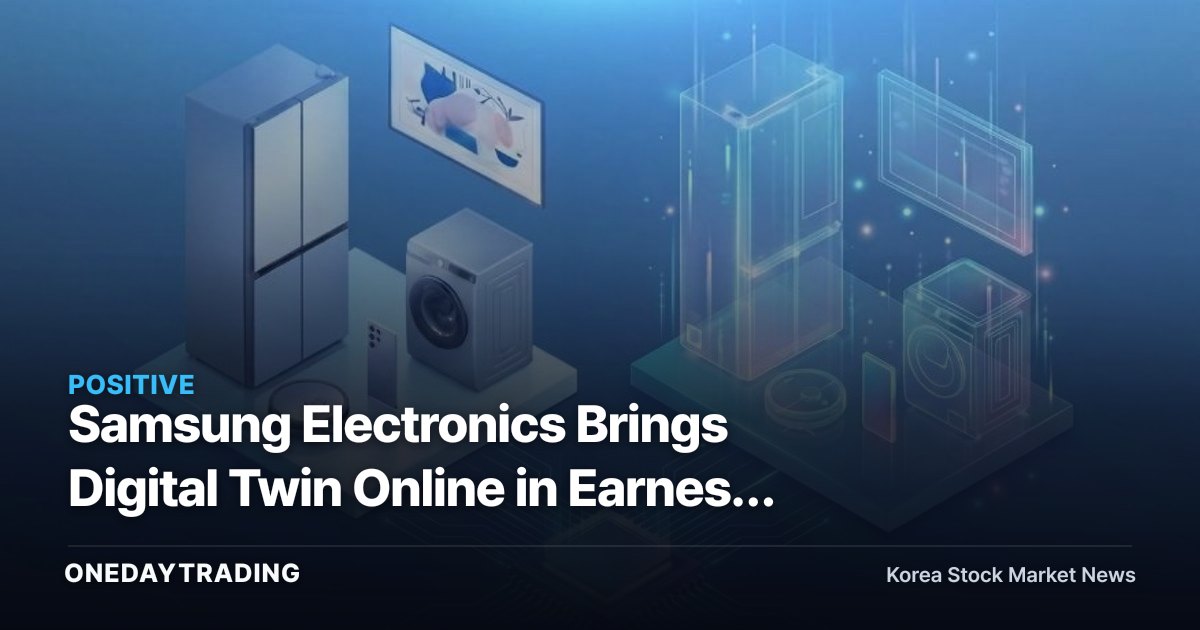
- Samsung Electronics' DX Division has brought online a high-performance computing (HPC) service running on 517 servers in earnest, applying a digital twin to product development.
- By replacing TV drop and durability validation — previously conducted by building physical prototypes — with virtual simulation, it has shortened testing that used to take 15 days to just 2.
- This infrastructure serves as the foundation for realizing a 2030 AI autonomous factory, with faster development and an improved cost structure as the core aim.
What Changes
The key point is that this is not merely an IT spending announcement, but an attempt to transform the development cost structure and time-to-market of the home appliance and TV business. Until now, product reliability validation relied on physical testing — repeatedly building actual prototypes to drop, shake, and heat them. This process incurs tooling, parts, and labor costs, and whenever a defect emerged, a new prototype had to be built and validated from scratch, lengthening the schedule.
A digital twin replicates the product and process identically in a virtual space, simulating impact, heat, and vibration through computer calculation. Cutting the validation cycle for a single drop test from 15 days to 2 means more than just saving time — it means more design variants can be tested in the same period and defect causes can be filtered out earlier in the process. A shorter development cycle directly affects the release cadence of new models and cost competitiveness.
It is also notable that the company defines this as the foundation for a 2030 AI autonomous factory. If virtual validation data from the design stage feeds into automated production-line control and quality prediction, there is room to extend the gains beyond home appliances to manufacturing efficiency across smartphones and consumer electronics as a whole.
By the Numbers and Context
The concrete figures confirmed in this announcement are the deployment of 517 servers and the reduction of the validation period from 15 days to 2. By simple arithmetic, the validation period is compressed to roughly one-seventh, which trims not only direct costs such as labor and prototype production, but also the opportunity cost of delayed launches. That said, building HPC infrastructure requires upfront spending on servers, power, and operations, so the point at which savings exceed the investment — and how quickly the technology spreads across product lines — will determine the actual bottom-line contribution.
Beneficiary and At-Risk Stocks
- Samsung Electronics: The principal company. Improvements in home appliance and TV development costs and time-to-market are positive for DX Division profitability, and as the autonomous factory expands, the effect could spread to overall manufacturing competitiveness.
- Samsung SDS: Responsible for the group's IT, cloud, and smart factory solutions, it stands to be a direct beneficiary as digital twin and HPC operations expand.
- HPC and server semiconductor supply chain: Large-scale expansion of compute servers is tied to demand for high-performance GPUs and memory, creating a favorable environment for the semiconductor sector, where data-center-bound memory accounts for a large share.
- Industrial software and simulation field: If digital twin adoption spreads across manufacturing as a whole, there is room for structural growth in demand for CAE and simulation solutions.
Risk Check
- The announcement centers on efficiency-improvement cases, and the actual scale of operating profit contribution and the payback period have not been disclosed, making it too early to be definitive about the bottom-line impact.
- HPC and autonomous factory investments carry large upfront costs, and if application remains limited to a few product lines, the return relative to investment could be constrained.
- Home appliance and TV demand itself is governed by the global economy and the exchange rate, so improved development efficiency alone does not determine the direction of earnings.
- Whether digital twin validation can fully replace actual physical testing — and the scope of quality liability in the event of a reliability incident — remain open questions to be verified.
One-Line Conclusion
As a manufacturing innovation that reworks development speed and the cost structure, the direction is favorable, but the actual bottom-line contribution hinges on variables such as the pace of broader adoption and a recovery in home appliance demand — making this a matter to watch alongside quarterly earnings and the progress of autonomous factory investment.
Samsung Electronics Through Real-Time Data
Samsung Electronics' latest closing price is 337,000 won (0.00% from the prior day), and the signal light — combining foreign and institutional investor supply-demand (order flow) with news and momentum — is 🟡 Neutral / Wait-and-See. With positive and negative signals mixed, it is a zone to watch.
- ▲ 52-Week Position — 89% toward the 52-week high — new-high territory
- ▲ News Flow — 28 positive catalysts vs. 10 negative catalysts — positive catalysts dominate
Recent related news is favorable, with 28 positive catalysts and 10 negative catalysts.
※ Price and foreign/institutional investor supply-demand (order flow) data are provided by Korea Investment & Securities (KIS) and are as of the time of publication.
This article is content automatically summarized and analyzed based on the original news. View original (Maeil Business Newspaper, Corporate)