
At a Glance
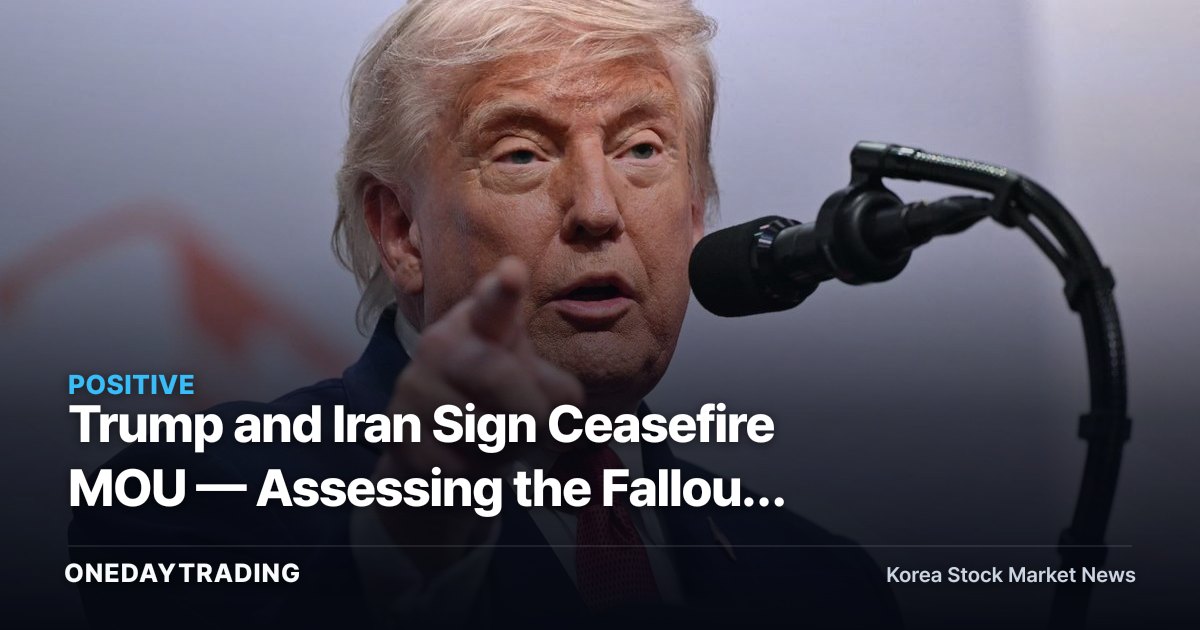
U.S. President Trump and Iranian President Pezeshkian have signed a memorandum of understanding (MOU) aimed at ending the war. The key takeaway: if geopolitical risk in the Middle East eases, the risk premium embedded in international oil prices could unwind. For Korea, which imports all of its crude oil, this would be favorable for industry sectors with heavy fuel-cost exposure such as airlines and shipping, while acting as a headwind for some defense themes that have relied on wartime demand.
Why It Matters Now
The Middle East is a critical artery for global crude supply. Armed conflict surrounding Iran has raised fears of a blockade of the Strait of Hormuz, layering a geopolitical premium onto oil prices. An agreement pointing toward an end to hostilities is therefore a catalyst for unwinding that premium. Because Korea imports virtually all of its crude oil, a downward stabilization in oil prices is a macro variable directly tied to easing both trade-balance and inflation pressures.
That said, the binding force and strength of implementation of the agreement remain uncertain — President Trump himself, at the G7 summit, suggested this might not be the kind of document he would sign. An MOU is a form of agreement with weak legal enforceability, so until the actual ceasefire reaches the implementation and verification stages, the market will struggle to fully price in the news. The fact that geopolitical news is often reversed within a single day is another source of volatility.
Frequently Asked Questions
- Why does it affect oil prices first? Conflict involving Iran and the Middle East amplifies fears of supply disruption and pushes oil prices higher, whereas signals of an end to hostilities work in the opposite direction by stripping out the risk premium.
- Is this a positive catalyst for the Korean stock market? Through the channels of downward oil-price stabilization and a recovery in risk appetite, it is broadly favorable, but the impact is mixed across industry sectors.
- Which sectors benefit most directly? The most cited are airlines and shipping, where fuel costs are a major component of expenses, as well as domestic-demand and consumer-related sectors that benefit from easing import-driven inflation.
- Are there any risks? An agreement at the MOU stage has uncertain implementation, so if conflict reignites, oil prices could rebound quickly.
Impact on Related Stocks and Sectors
- Airlines (Korean Air, Asiana Airlines) Jet fuel is a major item in operating costs, so stable oil prices translate into lower unit operating costs — a direct positive for margins.
- Refiners (S-Oil, SK Innovation, GS) The effect is two-sided. A demand recovery is favorable for refining margins, but in a phase of sharply falling oil prices, inventory valuation losses can arise, so the direction is not straightforward.
- Shipping and Transport Easing fuel-cost burdens such as bunker oil, along with stabilization of the Hormuz and Middle East shipping routes, is favorable in terms of operating costs and freight-rate volatility.
- Defense (Hanwha Aerospace, LIG Nex1) Easing geopolitical tensions may weigh on near-term investor sentiment, but Korean defense exports are diversified across Europe and the Middle East, so it is hard to conclude that a single Middle East issue would break the trend.
- Export Manufacturing (Hyundai Motor, Samsung Electronics, etc.) Stable oil prices and exchange rates, along with a recovery in risk appetite, offer an indirect benefit channel on both the cost and sentiment fronts.
Points to Watch When Investing
- An MOU is a form of agreement with weak binding force. Until the actual ceasefire implementation and verification procedures are confirmed, it is safer not to over-price the news.
- The direction of oil prices moves alongside other variables such as OPEC+ output-cut policy and U.S. inventory data. A single ceasefire is not enough to determine the trend.
- For refiner stocks, falling oil prices are not automatically a positive catalyst. It is necessary to separately examine refining margins and inventory valuation gains/losses in quarterly earnings.
- Short-term sharp gains and drops driven by geopolitical news are frequently reversed. Entry calls for managing position size on the premise of a phase of heightened volatility.
Overall Outlook
If the agreement leads to an actual ceasefire, it opens a path toward downward oil-price stabilization and a recovery in risk appetite via a reduction in the Middle East risk premium. In that case, fuel-cost-sensitive sectors such as airlines and shipping are the clearest beneficiary candidates. The opposite scenario lies in the MOU's low binding force and implementation uncertainty. Given that President Trump himself questioned the nature of the document, a reignition of conflict could produce the exact opposite flow — oil prices spiking back up and defense stocks coming into focus. The next checkpoints are the ceasefire implementation and verification timeline, OPEC+ policy decisions, and shifts in Brent and WTI oil price levels.
This article is auto-summarized and analyzed content based on original news reporting. View Original (CNBC)