
At a Glance
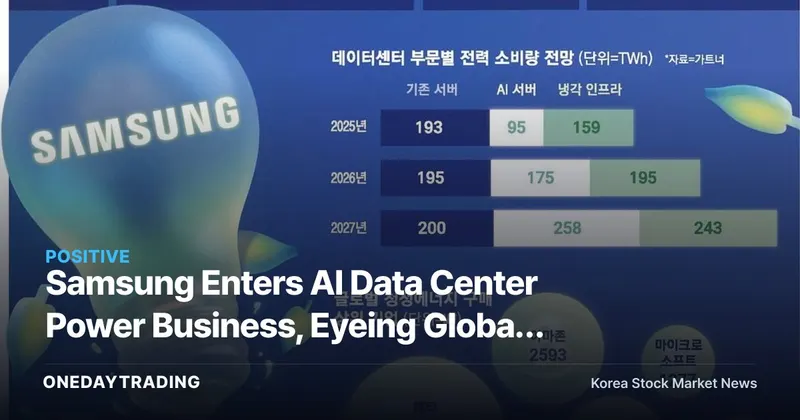
As the power demand of artificial intelligence (AI) data centers grows explosively, the very structure of the energy industry is changing — an AI-driven energy transition that is now gathering full momentum. Samsung is seeking to establish a foothold in the global market by leading with a new business model that combines power supply for data centers with energy efficiency. Ripple effects are expected across related industries, including power equipment, power generation, and cooling.
Why It Matters Now
With the spread of generative AI, a single data center now consumes several times the power of conventional facilities of the past. Operating high-performance AI chips at scale requires a stable, large-capacity power infrastructure, while the cost of cooling the heat they generate is also surging. Power procurement and efficiency have emerged as critical variables for a data center's competitiveness.
This trend goes beyond simply using more electricity; it creates integrated demand spanning power equipment, generation facilities, and energy management solutions. Behind Samsung's move into the data center power and energy domain — leveraging its semiconductor and electronics technology capabilities — lies a strategy to seize this enormous new market early.
Geopolitical factors also affect energy prices and supply stability. When tensions rise in major oil-producing regions such as the Middle East, energy procurement costs and volatility increase, and the value of companies with the ability to secure stable, in-house power supply may come to the fore.
Frequently Asked Questions
- Why do AI data centers use so much power? Running tens of thousands of high-performance AI accelerators around the clock — plus the cooling needed to dissipate the heat they generate — consumes far more power than ordinary facilities.
- What is Samsung's new energy model? It is an approach that combines and integrates the power supply, energy efficiency, and management solutions a data center needs — interpreted as a business form that goes beyond simply supplying components.
- What does it mean for domestic investors? Long-term demand could form across related industries such as power equipment, transformers, cooling, power generation, and cables, potentially translating into earnings momentum for the relevant listed companies.
- Will earnings be reflected immediately in the short term? Because there is a time lag between order intake and revenue recognition in data center infrastructure investment, expectations may be priced into share prices in advance, so it is necessary to monitor the actual trend in orders.
Related Stocks & Sector Impact
- Samsung Electronics As the key player driving the new data center power and energy business on the foundation of its semiconductor and electronics technology, it draws attention for securing a new growth engine.
- Power Equipment & Transformer Sector Demand for transformers, power distribution, and power solutions could rise as data center power infrastructure is expanded.
- HD Hyundai Electric, LS Electric, and Hyosung Heavy Industries As leading power-equipment stocks, this group is expected to benefit directly from the expansion in data center-driven power equipment demand.
- Power Generation & Nuclear Sector As the need to secure stable, large-capacity power sources grows, the medium- to long-term demand for generation facilities and nuclear-related industries could come to the fore.
- Cooling & Infrastructure-Related Stocks Rising demand for data center thermal management leaves room for expanded business opportunities in cooling solutions and construction infrastructure.
Points to Watch When Investing
- For new businesses, expectations tend to run ahead at the initial announcement stage, so investors should account for the time lag between actual orders and revenue recognition.
- Competition among large global players is intense in the data center power market, and securing market share determines earnings.
- Profitability may waver depending on energy and raw-material prices and geopolitical factors.
- Stocks (tickers) that have made a short-term sharp gain (surge) on theme expectations alone carry high volatility, so an approach that verifies the earnings basis is advisable.
Overall Outlook
On the optimistic side, AI data center-driven power demand is a structural, long-term trend, and if Samsung seizes the global market early with an integrated energy model, a trickle-down effect across domestic related industries such as power equipment and power generation can be expected, along with a new growth engine. That said, the uncertain timing of monetization for the new business, intense global competition, and the variables of energy prices and geopolitical risk are clear downside factors. Rather than relying on expectations at the announcement stage, a strategy of taking a phased approach by confirming actual orders and earnings is reasonable.
This article is content automatically summarized and analyzed based on the original news. View original (Maeil Business Newspaper, Corporate)