
Summary
BGF Retail, the operator of CU, deciding to install a mobility-assistance help-bell QR service across its stores nationwide is not, in itself, a catalyst that moves the share price. Still, it should be read as a signal that the convenience-store sector — facing saturation in store count — is attempting to differentiate along non-price competitive axes such as accessibility and ESG.
The key point is that the investment implications hinge on whether this cost is passed on to franchisees or absorbed as headquarters investment, and on whether it is regulatory compliance in nature or voluntary differentiation.
What Happened
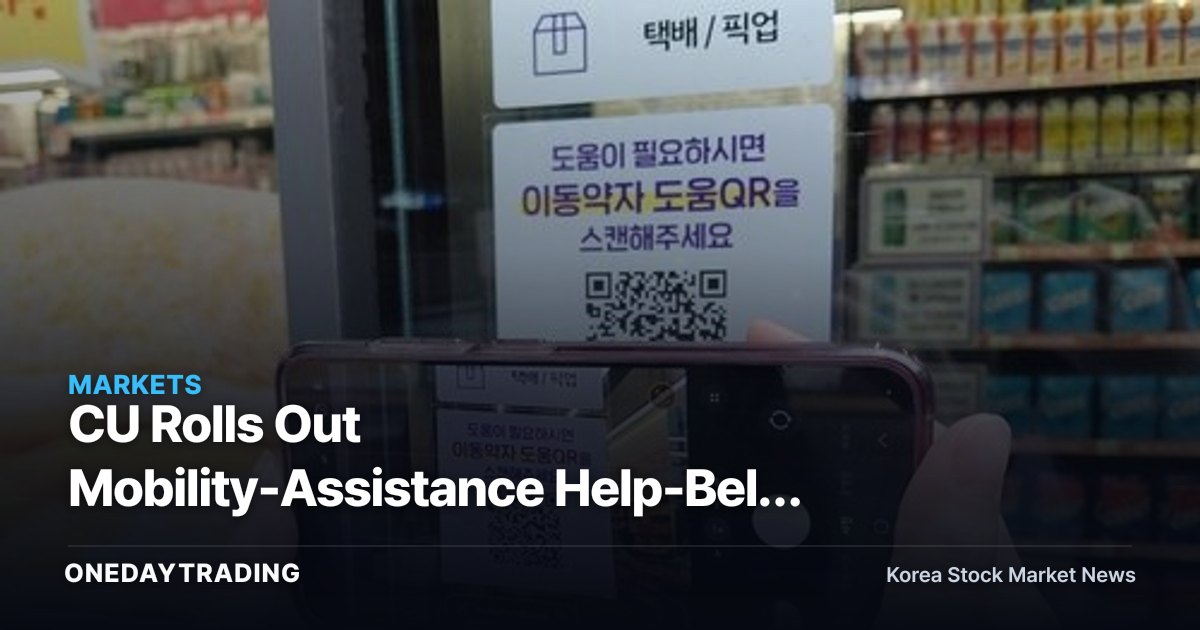
CU, the convenience-store brand operated by BGF Retail, announced that it will introduce a mobility-assistance help-bell QR service at the entrances of roughly 18,000 stores nationwide. When wheelchair users or customers with limited mobility scan the QR code affixed to the entrance with their smartphone, a help request is sent to store staff. A distinctive feature is that it operates with nothing more than a QR sticker, requiring no separate equipment installation.
The scale of a nationwide blanket rollout is meaningful. Convenience stores possess a network asset in which, once headquarters sets a franchise standard, the same service can be deployed simultaneously across tens of thousands of stores. This move represents a case of converting that network into social accessibility infrastructure.
That said, for a QR-based staff call system, the crux lies less in additional equipment investment than in the burden of staff response and the firm establishment of operating manuals. The rollout itself carries little cost, but the actual quality of operation depends on each store's operational capacity.
Structural Background
Korea's convenience-store market is at a mature stage, with store count surpassing 50,000 and diminishing room for new openings. As the center of gravity for revenue growth shifts from store-count expansion toward sales per store and brand loyalty, accessibility and ESG are emerging as non-price competitive tools that raise brand favorability without spending directly on advertising.
Institutionally, too, obligations related to convenience for people with disabilities and others are being strengthened, so preemptive accessibility investment serves as a buffer that reduces future regulatory risk. This is a factor that pressures not only BGF Retail but also competitors such as GS Retail to respond similarly.
Impact on Stocks and Sectors
- BGF Retail: The party behind this move. The impact on near-term earnings is limited, but the cumulative effect on ESG ratings and brand trust could feed into its core convenience-store franchise competitiveness.
- GS Retail: A direct competitor operating GS25; if accessibility and ESG competition intensifies, pressure to adopt similar services will grow. Costs may rise while the scope for differentiation narrows.
- Convenience-store and retail-distribution sector: In that non-price competition is expanding into areas beyond price and fees, this gradually affects the operating-cost structure of the franchise model as a whole.
- Emart and other general retailers: The trend of strengthening offline accessibility acts as an indirect variable that raises the ESG baseline across large-scale retail.
Bull vs. Bear Scenarios
On the bull side, leadership in accessibility and ESG could translate into brand differentiation and competitiveness in recruiting franchisees, becoming an intangible asset that lifts sales per store and trust metrics. Amid tightening regulation, preemptive action serves as a shield that reduces future cost and reputational risk.
On the bear side, by contrast, such socially oriented services have a clear limitation: their weak causal link to earnings makes them hard to connect directly to share-price momentum. Rather, the convenience-store sector's intrinsic variables — franchisee profitability, rising labor and rental costs, and the slowdown in store openings due to saturation — sway the share price far more. If accessibility investment only adds to operating burdens without leading to differentiation, it may end up as nothing more than a cost factor.
Investor Action Points
- Check the trends in sales per store and same-store sales growth in BGF Retail's and GS Retail's next-quarter earnings to gauge changes in core business strength.
- Examine commentary on cost structure — franchisee profitability, labor costs, rent — in earnings materials to assess whether ESG investment is spilling over into a cost burden.
- Monitor net store-opening trends and convenience-store saturation to gauge the pace at which the growth driver is shifting toward non-price competition.
- Track changes in ESG ratings and the schedule of accessibility-related regulatory changes to see whether the value of regulatory compliance is actually reflected in evaluations.
BGF Retail in Real-Time Data
BGF Retail's latest closing price is 110,200 won (+2.04% from the previous day), and the signal light combining foreign and institutional supply-demand (order flow) with news and momentum is 🟢 Buy-leaning. With foreign investors, news, and momentum positive, it is worth keeping an eye on.
- ▲ Supply-demand (order flow) continuity — Foreign investors net buyers for 3 consecutive days (+600 million won)
- ▲ News flow — 3 positive catalysts vs. 1 negative catalyst — positive catalysts lead
Recent related news is favorable, with 3 positive catalysts and 1 negative catalyst.
※ Price and foreign/institutional supply-demand (order flow) data are provided by Korea Investment & Securities (KIS) and are as of the time of publication.
This article is content automatically summarized and analyzed based on the original news. View original (Yonhap News, Industry)