
Key Summary
The venture industry has moved to push back against the current capital market reform plan, which simultaneously advances a segment split dividing the KOSDAQ market into premium and general tiers, a promotion/relegation system that forces movement between grades, a ban on duplicate listings, and stricter delisting requirements. On the surface this is a debate over reordering market structure, but because it could change the supply-demand (order flow) and fundraising environment for the small-cap and venture companies listed on KOSDAQ, it is an issue that compels investors to reassess their stock (ticker) selection criteria.
What Happened
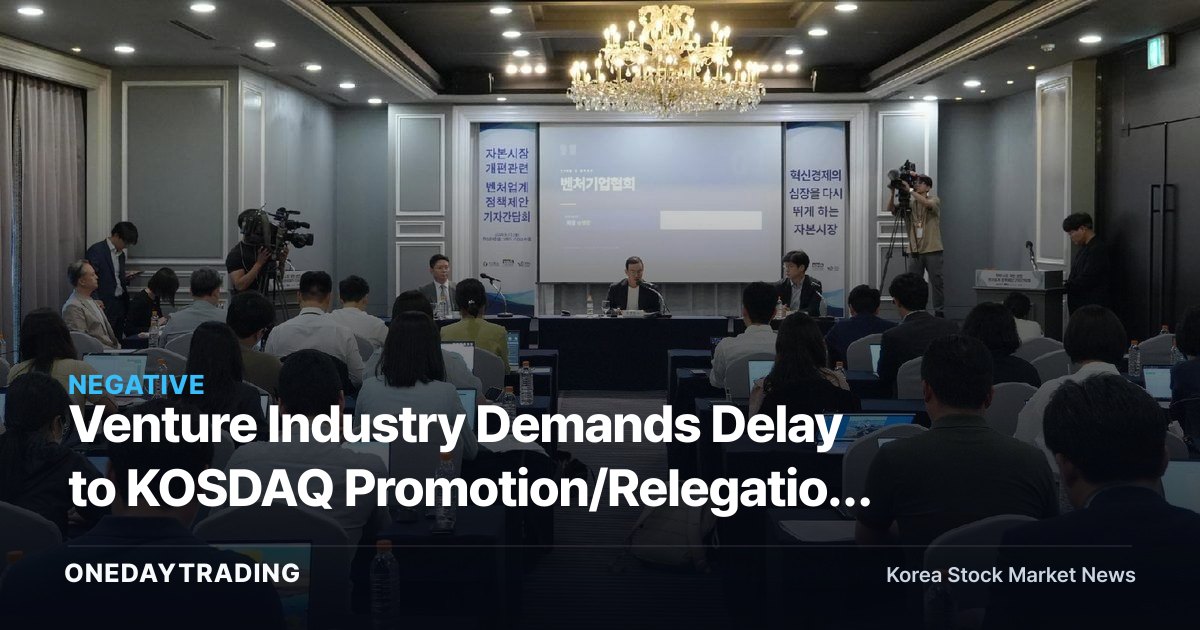
The venture industry held a joint press briefing and formally requested revisions to the capital market reform plan. At the core is the promotion/relegation system, which would split KOSDAQ into a premium tier and a general tier and move companies up or down grades based on earnings and qualifying requirements. The industry voiced concern that companies placed in the lower tier could effectively be perceived as a second division, taking on diminished trust and a stigma effect.
It further argues that if the ban on duplicate listings and stricter delisting requirements are layered on at the same time, growth-stage venture companies would absorb the shock of these regulatory changes all at once. Rather than rejecting the framework itself, the industry called for a delay and revision — postponing the implementation date and refining the detailed criteria.
Background and Context
This reform plan is an extension of the value-up drive aimed at weeding out marginal companies on KOSDAQ and bolstering market trust. Clearing out troubled "zombie" companies is positive for premium stocks, but the crux of the conflict is that if the same yardstick is applied uniformly to venture companies going through growing pains, they could be locked into the lower tier on the basis of short-term earnings weakness alone. In effect, expectations of restructuring and fears of stigma coexist within the same policy.
Impact on the Market and Stocks
- Loss-making, low-liquidity KOSDAQ small caps that could be classified into the lower segment may see their trading volume and valuations pressured as institutional investors and foreign investors steer clear and supply-demand (order flow) drains away.
- KOSDAQ premium stocks with stable earnings and governance have room to command a relative premium as beneficiaries of a flight to quality.
- If the ban on duplicate listings is tightened, the fundraising route via spin-off listings of subsidiaries narrows, becoming a variable in the capital policy of companies with parent-subsidiary dual-listing structures.
- Stricter delisting requirements raise the risk of exit for stocks flagged as under administrative watch or with a trading-suspension history, increasing the risk of theme-driven trading in cheap, troubled stocks.
- Indirect effects could also ripple out to the IPO schedules and valuation expectations of unlisted growth companies — including venture capital firms — that have built their exit strategies on the premise of a KOSDAQ listing.
Investor Checkpoints
- Watch the segment classification criteria and implementation timing to be announced by financial authorities and the exchange, and check which tier your holdings would fall into using revenue, profit, and liquidity metrics.
- Track whether a delay in applying the promotion/relegation system and transitional provisions are reflected in the final plan, in line with the policy announcement schedule.
- For stocks at risk of being designated under administrative watch, examine the quantitative delisting-related requirements — such as shareholders' equity, revenue, and audit opinion — alongside quarterly earnings.
- For companies caught up in duplicate-listing or physical spin-off issues, monitor for any disclosures revising subsidiary listing plans.
Outlook
If the delay and revisions are accepted and the plan is settled into a phased, differentiated application, it could preserve the effect of weeding out troubled stocks while cushioning the shock to venture companies, leading to a broad recovery of trust across KOSDAQ. Conversely, if the strong original plan is implemented as is, a hollowing-out of supply-demand (order flow) and a contraction in fundraising for lower-tier stocks could materialize, risking a deeper discount on some small-cap and venture names. Even though the policy's direction is set, the detailed criteria and pace of application will determine the fate of individual stocks — so for now, a differentiated response based on the financial soundness of each individual stock is the rational approach.
This article is content automatically summarized and analyzed based on the original news report. View original (Maeil Business Newspaper, Corporate)