
Key Takeaways
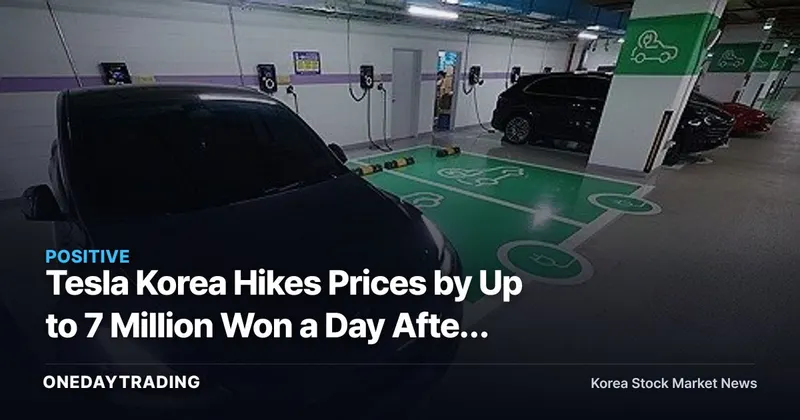
A day after clearing the Ministry of Environment's subsidy assessment, Tesla Korea raised factory prices across its entire lineup by up to 7 million won. Given that domestic EV subsidies typically run in the low millions of won per model, the increase effectively lets the manufacturer absorb most of the subsidy's value. Consumers' actual out-of-pocket cost is little changed from before the subsidy was confirmed — or even higher — while, on the flip side, the conditions are now in place for Hyundai Motor and Kia to regain relative price competitiveness.
What Happened
Immediately after clearing the Ministry of Environment's EV subsidy eligibility assessment, Tesla Korea raised prices on its entire domestic lineup by up to 7 million won. This sequence — qualifying for the subsidy, then immediately raising prices so the manufacturer absorbs the consumer benefit — is an efficient pricing-optimization strategy, but it runs directly counter to the subsidy's public-policy purpose: expanding EV adoption and easing the cost burden on consumers.
Nor is this the first time the pattern has appeared. Tesla has repeatedly adjusted prices in the Korean market immediately after subsidy policy changes. The more this repetition is tolerated, the more clearly it exposes a gap in policy design over who actually ends up capturing the subsidy.
Background and Context
Korea's EV subsidy program works by having the Ministry of Environment set support amounts by model at the start of the year, which are then disbursed following an eligibility assessment. Tesla has treated passing this assessment as a precondition for continuing to operate in Korea, and has followed a pattern of adjusting prices immediately afterward to capture the subsidy's value. This latest increase comes at a time when Hyundai's Ioniq series and Kia's EV lineup have steadily built competitiveness on both performance and price, making Tesla's premium positioning less self-evident than before. Raising prices in a segment where the demand base isn't rock-solid tends to push the lost demand toward competing models — that's the mechanics behind the spillover-benefit scenario.
Market and Stock (Ticker) Impact
- Hyundai Motor and Kia: As Tesla's effective purchase price rises, the price gap with comparable domestic models narrows. A demand shift is expected toward models that compete directly with Tesla, such as the Ioniq 6, EV6, and EV9. That said, this effect is likely limited to price-sensitive buyers rather than Tesla's brand-loyal customer base, so the scale shouldn't be overestimated.
- LG Energy Solution and Samsung SDI: If Tesla's domestic sales in Korea actually slow, there could be an indirect effect on battery supply volumes. However, since Tesla's battery procurement is managed globally, it's unlikely that a shift in Korean domestic demand alone would lead to adjustments in supply contract volumes.
- Imported EV brands broadly: If authorities add a price-freeze or price-increase-cap clause to subsidy eligibility conditions, it would constrain pricing strategy not just for Tesla but for other foreign EV brands as well. Tighter regulation would structurally favor domestic brands.
- EV charging infrastructure stocks: If higher purchase costs slow the pace of EV adoption, the timeline for charging infrastructure utilization rates to improve would be pushed back — and so would the timeline for charging operators' profitability recovery.
Investor Checkpoints
- Follow-up action from the Ministry of Environment and the Ministry of Land, Infrastructure and Transport: If authorities add a price-increase-cap clause to subsidy eligibility conditions or request a re-review of subsidy eligibility, Tesla's pricing strategy in Korea would need to be readjusted. Watch for the timing of any official statement from the ministries.
- July domestic EV sales data (to be released by KAMA): The fastest way to check whether Tesla's domestic sales actually decline following this price hike, and whether Hyundai and Kia's EV sales rise in response.
- Comparing the size of the price hike against the subsidy amount, by model: How much the price increase exceeds the subsidy amount is a useful gauge of how much of the benefit the manufacturer is capturing. Detailed price-increase figures are worth tracking.
- Hyundai Motor and Kia's Q3 earnings guidance (due in October): Whether Tesla's price hike actually translates into improved demand for domestic brands will first show up quantitatively in Q3 domestic EV sales data.
Outlook
The bullish scenario is straightforward: Tesla's price hike drives away price-sensitive buyers, Hyundai and Kia capture that demand, and domestic EVs' share of the home market rises meaningfully. It would also help domestic brands if authorities revise how subsidies are administered in a way that narrows foreign brands' room to game pricing.
The risk lies in the conditions. If Tesla's brand loyalty proves stronger than expected and sales barely dip, the spillover benefit will fall well short of expectations. And if authorities take no action on this case either, the pattern becomes a precedent — giving other foreign brands an incentive to follow the same playbook of raising prices right after subsidies are confirmed. Unless policy design is improved to ensure more of the subsidy benefit actually reaches consumers, this case will remain just another instance of a structural problem repeating itself. The next things to watch are the Ministry of Environment's official position and July's domestic sales figures.
This article was automatically summarized and analyzed based on the original news report. View original (Yonhap News, Industry)