
3-Line Briefing
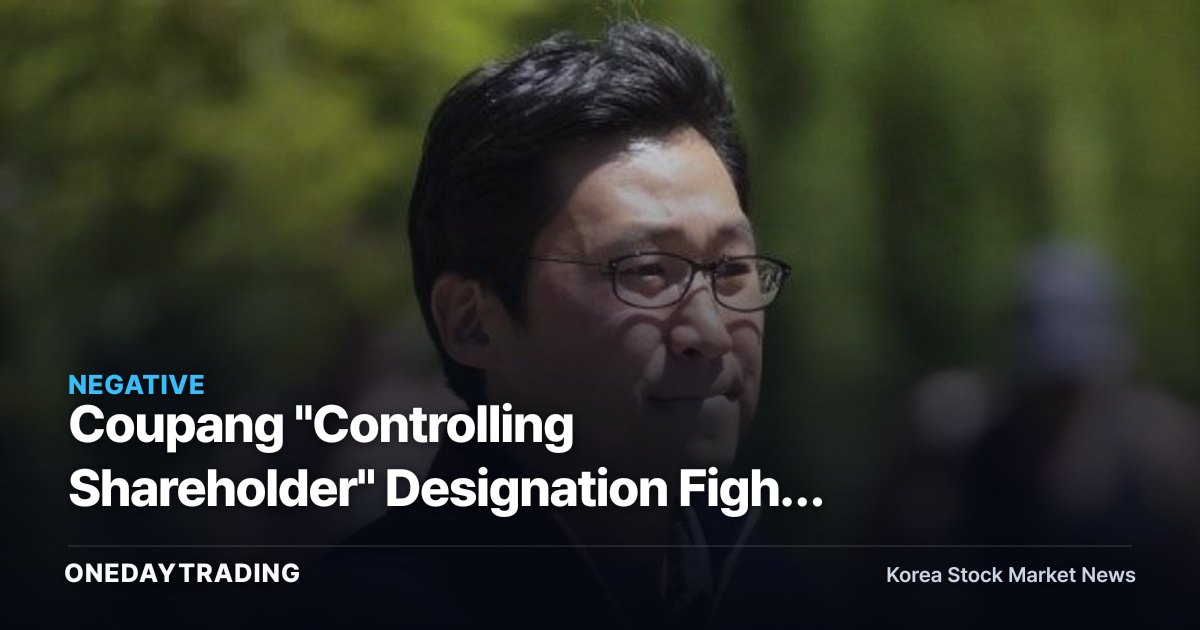
- After the Fair Trade Commission designated Coupang founder and Coupang Inc. Chairman Kim Bom-suk as the "same person" (controlling shareholder), Coupang contested the ruling, kicking off a legal battle.
- The point of contention is whether regulatory responsibility attaches to an individual (Kim Bom-suk) or to the U.S. parent company (Coupang Inc.); the outcome will determine the scope of oversight over transactions with relatives and affiliates.
- Coupang argues that the FTC reversed a stance it had maintained for five years without any change in circumstances, and the dispute is likely to escalate into an administrative lawsuit.
What Changes
The crux of this matter is not whether Coupang's business is booming or struggling, but rather how governance regulation is applied. Once a company is designated a large business group, the question of who the "same person" is determines who falls under the regulatory net — disclosure obligations, rules against self-dealing (funneling business to insiders), and reporting of the scope of relatives. If the controlling shareholder is confirmed to be Kim Bom-suk as an individual, there is greater scope for the shareholdings and transactions held by his relatives and related parties to be brought under oversight.
Conversely, if the "same person" is recognized as the U.S. corporation Coupang Inc., as Coupang contends, many of the regulations imposed on an individual controlling shareholder would be difficult to apply. Since the FTC had judged on a corporation-centered basis for years before changing direction, which side's logic the court accepts will set a precedent for other foreign-controlled corporate structures going forward.
From an investor's standpoint, what matters is that this dispute touches not on Coupang's core business performance such as revenue or margins, but on the non-financial variables of regulatory cost and governance uncertainty.
Reading the Numbers and Context
Coupang is citing, as grounds for procedural impropriety, the fact that the FTC reversed a judgment it had maintained for five years without any meaningful change in circumstances. That said, what has been disclosed so far centers on the legal issues surrounding the legitimacy of the ruling, and this in itself does not immediately change Coupang's transaction volume, logistics investment, or earnings estimates. The short-term share-price impact is therefore likely to manifest through the indirect channel of a shift in the regulatory risk premium.
Beneficiary and Affected Stocks
- Coupang (Coupang Inc., CPNG): The direct party. If individual controlling-shareholder designation is confirmed, the burden of disclosing and monitoring transactions with relatives would rise, potentially becoming a governance-discount factor — but it is a variable to be viewed separately from core business profitability.
- Naver: Within the e-commerce competitive landscape, tougher regulation of Coupang could be raised in terms of relative regulatory fairness, but the impact on its core business is limited.
- Domestic retail and logistics peers: Once the criteria for "same person" determinations on foreign-controlled structures are established, this will affect the regulatory predictability for similar companies in the future.
Risk Check
- The legal dispute is likely to be drawn out, and if the first-instance and appellate rulings diverge, uncertainty could persist for a long time.
- The regulatory issue is separate from core business earnings, so it is difficult to determine the share-price direction from this matter alone.
- If individual controlling-shareholder designation is confirmed, the burden of disclosing transactions with relatives and related parties risks acting as a governance discount.
- If the ruling on the legitimacy of the FTC's action spreads to other foreign-controlled companies, the regulatory-environment variable for the entire industry sector could grow.
One-Line Conclusion
Since this is a matter that stirs governance and regulatory risk rather than core business earnings, the appropriate approach is to gauge changes in the regulatory premium by using the court's rulings and the FTC's follow-up actions as benchmarks, rather than reacting to a short-term shock.
This article is content automatically summarized and analyzed based on the original news report. View original (Maeil Business Newspaper, Corporate)