
Key Takeaways
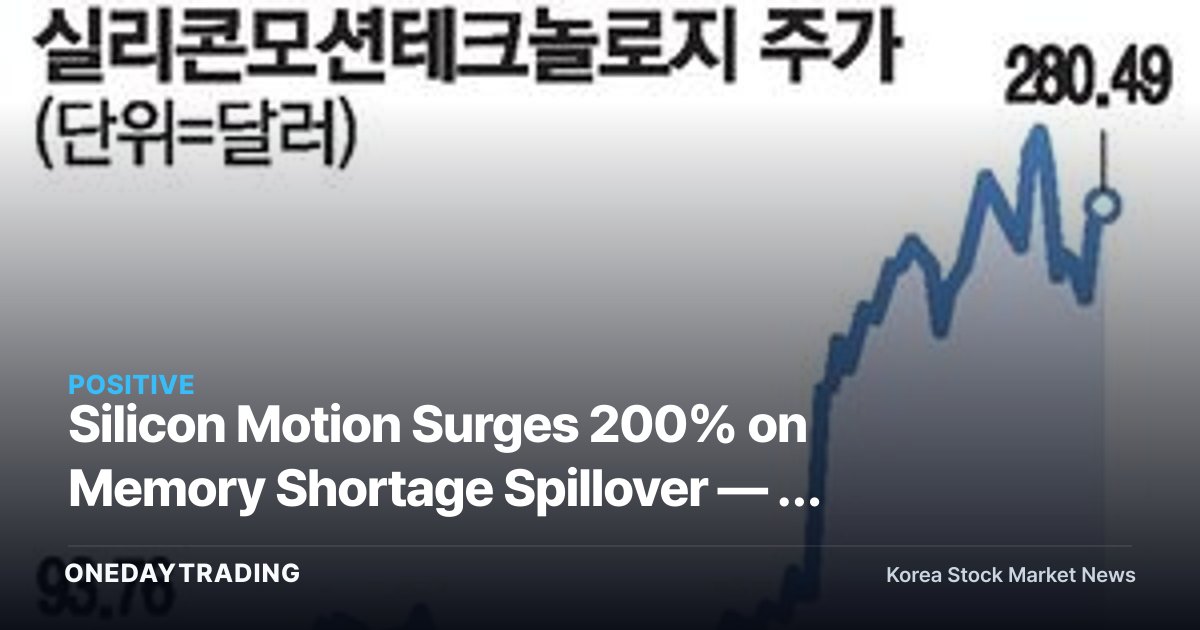
Silicon Motion Technology, a company specializing in NAND flash controllers, has surged nearly 200% this year, drawing the attention of U.S. semiconductor investors. As an explosion in AI data center demand deepens a broad memory supply shortage, analysts say Silicon Motion — a core supplier of controllers — is reaping a direct spillover benefit.
What Happened
Silicon Motion designs the controller chips that act as the brains of NAND flash storage devices such as SSDs and eMMC. While it does not make memory cells itself, it supplies the controllers that are essential to turning NAND into actual products, so its shipments naturally rise alongside growing NAND demand.
As investment in AI servers and data centers climbed steeply this year, demand for high-capacity storage surged, and at the same time memory makers concentrated production on high-value products, leaving overall NAND supply tight. As a result, NAND prices rebounded and controller adoption widened, lifting both Silicon Motion's earnings and its share-price expectations together.
Background and Context
The NAND market has long languished under oversupply and falling prices. But as AI training and inference data exploded, demand for high-capacity enterprise SSDs revived, and the view that the memory cycle is turning upward is gaining traction. Controller makers bear little direct exposure to memory price swings while still benefiting from rising shipment volumes, putting them in a position widely seen as offering relatively stable growth leverage during a cycle recovery.
Impact on the Market and Stocks
- Silicon Motion (SIMO): Rising NAND shipments translate directly into expanded controller sales, making it a direct beneficiary of earnings momentum.
- SK Hynix: With its NAND and enterprise SSD businesses, it is expected to be a key beneficiary of the memory supply shortage and price rebound.
- Samsung Electronics: As the world's largest NAND manufacturer, it sits squarely in the path of rising prices and expanding high-capacity SSD demand.
- Micron (MU): It is regarded as a representative beneficiary of rising NAND prices and the recovery in AI-driven memory demand.
- Korea's chip materials, parts and equipment sector: Higher memory utilization rates have room to spread warmth to back-end and materials suppliers.
Investor Checkpoints
- With a near-200% surge already priced in, investors need to check valuation to gauge how much of the expected earnings improvement the current share price has already discounted.
- It is important to confirm through quarterly earnings and guidance whether NAND prices and enterprise SSD shipment trends are actually translating into results.
- Because controllers tend to lag or move in step with the memory cycle, volatility can rise if memory prices correct.
- The possibility of a slowdown in AI data center investment or customer inventory adjustments also needs to be monitored.
Outlook
On the optimistic side, as long as AI infrastructure investment continues, demand for high-capacity NAND will grow structurally, and Silicon Motion — a core controller supplier — can keep reaping the direct benefit of expanding shipments. If the memory cycle enters a full-fledged upswing, the scope for earnings improvement could widen further. That said, profit-taking pressure following the short-term surge, memory price volatility, and the risk that the AI investment cycle slows more than expected are clear downside factors. It is therefore advisable to acknowledge the trend while taking a cautious approach that combines staggered entry with confirmation of earnings.
This article is auto-summarized and analyzed content based on the original news report. View original (Maeil Business Newspaper, Securities)