
Key Summary
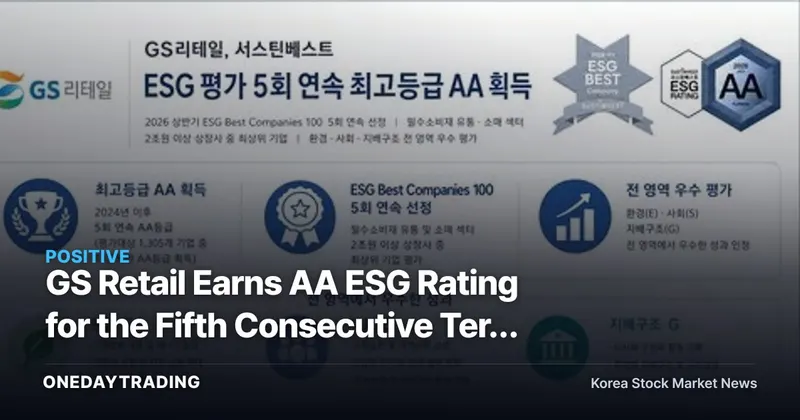
GS Retail received the top AA rating in the first-half assessment conducted by domestic ESG rating agency Sustinvest. This marks the fifth consecutive top-tier rating, signaling that the company's governance and social management frameworks are being maintained consistently — not as a one-off achievement.
Retail stocks have traditionally traded at valuation discounts due to low growth prospects and owner-family governance concerns. While a stable ESG rating does not directly resolve those discount factors, it can serve as a supporting variable that lowers the inclusion threshold for institutional investors and foreign investor capital.
What Happened
Sustinvest is one of Korea's leading ESG rating agencies, assessing listed companies across three pillars: Environmental (E), Social (S), and Governance (G). GS Retail secured the top AA rating in this first-half assessment, with the company describing it as a fifth consecutive achievement of the highest rating.
What deserves attention is not the absolute rating but the consistency. ESG ratings tend to be volatile, as criteria and weightings differ by agency. Maintaining the top rating from the same agency for five consecutive terms suggests minimal score deterioration across disclosure transparency, social metrics related to partners and consumers, and board operations.
That said, it is important to clearly distinguish that this announcement is not a cash-flow-linked event such as a new order win or an earnings guidance revision, but rather an external certification of non-financial metrics.
Background and Context
GS Retail is an offline and omni-channel distribution operator with businesses spanning convenience stores (GS25), supermarkets (GS The Fresh), home shopping, and hotels (Parnas). The convenience store segment is the core driver of revenue and profit, with store opening pace, franchise structure, and consumer spending sensitivity being the primary determinants of earnings.
Domestically, the Corporate Value-Up Program has strengthened the trend of grouping ESG, shareholder returns, and governance improvement together as re-rating themes. Within this context, maintaining an ESG rating carries practical significance — passing the ESG screening criteria of institutional investors and qualifying for inclusion in responsible investment funds.
Market and Stock Impact
- GS Retail: The direct party. A stable ESG rating can reduce the inclusion barriers for pension funds and ESG funds, broadening the potential buyer base. However, since the fundamental share price drivers are per-store convenience store revenue and the profitability of the home shopping and hotel segments, the near-term price impact from the rating itself is limited.
- GS (Holding Company): As the parent company with GS Retail as a subsidiary, governance rating improvements at the subsidiary level can serve as a favorable factor in discussions around the holding company discount.
- Convenience Store and Retail Competitors (BGF Retail, etc.): As ESG becomes an industry-wide evaluation standard within the industry sector, rating gaps could increasingly act as a relative advantage or disadvantage in institutional capital allocation.
- Retail Sector Overall: In conjunction with the value-up and responsible investment themes, supply-demand (order flow) concentration toward stocks (tickers) with strong ESG metrics may gradually emerge.
Investor Checklist
- Next-quarter earnings: convenience store same-store sales growth and whether operating profit margins recover — earnings are a more primary share price driver than ESG.
- Progress on restructuring and profitability improvements in the home shopping and hotel segments, along with related disclosures.
- Timing and substance of value-up disclosures (shareholder return policy, share buyback and dividend plans).
- Whether ESG fund inflows from foreign investors and institutional investors translate into actual changes in holdings — monitor supply-demand (order flow) trends.
Outlook
On the positive side, maintaining a stable ESG rating is a gradual positive catalyst in the value-up environment — broadening accessibility for institutional investors and foreign investors, and contributing to long-term re-rating that reduces the governance discount. On the other hand, ESG certification is a non-financial metric that does not directly feed into earnings estimates, and if core business variables such as consumer spending slowdowns and convenience store expansion competition deteriorate, the share price could come under pressure regardless of the rating. It is prudent to separate the rating as a positive catalyst from cash-flow variables such as earnings and shareholder returns, and confirm it alongside signals of core business recovery.
GS Retail: A Real-Time Data Snapshot
GS Retail's most recent closing price was ₩21,450 (−3.81% from the prior session). The composite signal incorporating foreign investor and institutional investor supply-demand (order flow), news, and momentum reads 🔴 Caution. Foreign investor positioning and momentum are negative, warranting caution at this time.
- ▼ Supply-Demand (Order Flow) Continuity — Foreign investors have been net sellers for five consecutive sessions (−200 million won)
- ▼ Trend Alignment — Short- and medium-term downtrend alignment (day: −3.8% · 1 week: −7.7% · 1 month: −20.6%)
※ Price and foreign investor/institutional investor supply-demand (order flow) data are provided by Korea Investment & Securities (KIS) and are current as of the time of publication.
This content is automatically summarized and analyzed based on the original news article. View Original (Yonhap News Industry)