
Three-Line Briefing
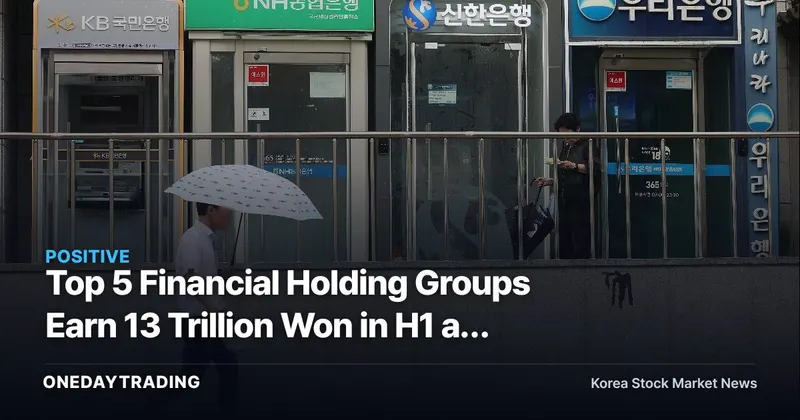
- The top five financial holding groups (KB, Shinhan, Hana, Woori, and Nonghyup) posted combined net profit of 13 trillion won in the first half of this year, setting a new all-time high
- At KB Financial Group and Shinhan Financial Group, expanding profits at their brokerage subsidiaries drove group earnings, while Hana Financial Group and Woori Financial Group held up on the strength of their banking divisions alone
- Combined net profit at the brokerages under the top five holding groups approached 1 trillion won, and NH Nonghyup Financial Group used that momentum to overtake Woori Financial Group and rise to fourth place among the holding groups
What's Changing
What the 13 trillion won figure really reveals isn't that banks did good business — it's which holding groups owned a brokerage. If banks had hit a record high on interest income alone, that would signal successful defense of net interest margin, but this round of earnings tells a different story. KB Securities and Shinhan Investment & Securities captured the rise in stock market trading value and the recovery in corporate finance demand during the first half, converting them into brokerage and trading revenue that lifted group net profit. The larger the share securities units contribute to a holding group's net profit, the more sensitive that group's earnings become to the stock market cycle rather than the interest rate cycle.
On the other side, Hana Financial Group and Woori Financial Group drove their first-half performance through their banking divisions alone. This exposed a structural limitation — either lacking a large brokerage subsidiary altogether (Woori Financial Group) or having one that is comparatively small in scale. Earnings that lean on bank interest income look stable, but they are also fully exposed to net interest margin pressure once the benchmark interest rate resumes its decline. Today's strong results have split into two distinct paths, and depending on which variable — interest rates or the stock market — moves first, each group will hold up, or falter, at a different pace going forward.
NH Nonghyup Financial Group's climb past Woori Financial Group to fourth place reflects the same dynamic. Nonghyup Financial Group, which owns NH Investment & Securities, absorbed the recent stock market tailwind far more directly than Woori did. The ranking shift itself is symbolic, but the underlying driver is ultimately a matter of capital allocation. It signals a widening profit gap between holding groups with a securities business in their portfolio and those without one.
Numbers in Context
The fact that combined net profit at the holding groups' brokerage units approached 1 trillion won reads as a sign that earnings structures once concentrated in bank interest income are gradually diversifying. That diversification, however, was uneven across the five groups. The two holding groups that own KB Securities and Shinhan Investment & Securities fully captured the benefits of this cycle, while holding groups with comparatively small — or effectively no — brokerage subsidiaries were left on the sidelines of the same trend. Even within the record 13 trillion won combined result for the top five holding groups, two very different stories are layered on top of one another.
Stocks (Tickers): Winners and Losers
- KB Financial Group — Expanding brokerage and investment-banking revenue at KB Securities has lifted its contribution to group net profit, positioning the group to benefit during stock market upswings
- Shinhan Financial Group — Improved earnings at Shinhan Investment & Securities now support profit alongside the banking division as a second pillar, boosting earnings stability
- NH Investment & Securities — The key driver behind parent company Nonghyup Financial Group's rise in the rankings, directly reflecting the benefits of the recovery in stock market trading value
- Hana Financial Group — Its continued reliance on bank-only earnings leaves it relatively more exposed to net interest margin pressure once the next rate-cutting phase begins
- Woori Financial Group — The absence of a large brokerage subsidiary was confirmed as a weakness in this round of earnings differentiation, and the group was also overtaken by Nonghyup Financial Group in the holding-group rankings
Risk Check
- Brokerage earnings are cyclical, tied to trading value and stock market direction, so there is no guarantee the current strength will carry through the second half
- If the benchmark interest rate falls further, holding groups more dependent on bank interest income will feel net interest margin pressure first
- Financial stock prices may have already priced in much of the expectation for record earnings, leaving room for valuation concerns to surface once earnings are announced
- As the earnings gap between holding groups widens, it could trigger competition for M&A deals aimed at strengthening brokerage subsidiaries, which may become a cost burden in the short term
Bottom Line
The 13 trillion won figure is impressive, but the fact that KB and Shinhan built it differently than Hana and Woori is the real variable that will separate this industry sector next quarter. The moment the stock market enters a correction, the gap that has opened up now could just as easily move in the opposite direction.
KB Financial Group: A Real-Time Data Snapshot
KB Financial Group's most recent closing price was 171,500 won (-2.72% versus the previous day), and the traffic-light signal combining foreign and institutional supply-demand (order flow) with news and momentum reads 🔴 Caution. Because foreign investor, institutional investor, and momentum signals are all negative, caution is warranted right now.
- ▼ Dual Selling — Foreign investors −6.2 billion won · Institutional investors −10.5 billion won, selling in tandem
- ▲ News Flow — 3 positive catalysts vs. 0 negative catalysts — positive catalysts prevail
Recent related news comprises 3 positive catalysts and 0 negative catalysts, a favorable mix.
※ Price and foreign/institutional supply-demand (order flow) data are provided by Korea Investment & Securities (KIS) and are current as of publication time.
This article is content automatically summarized and analyzed based on the original news report. View Original (Maeil Business Newspaper, Economy)