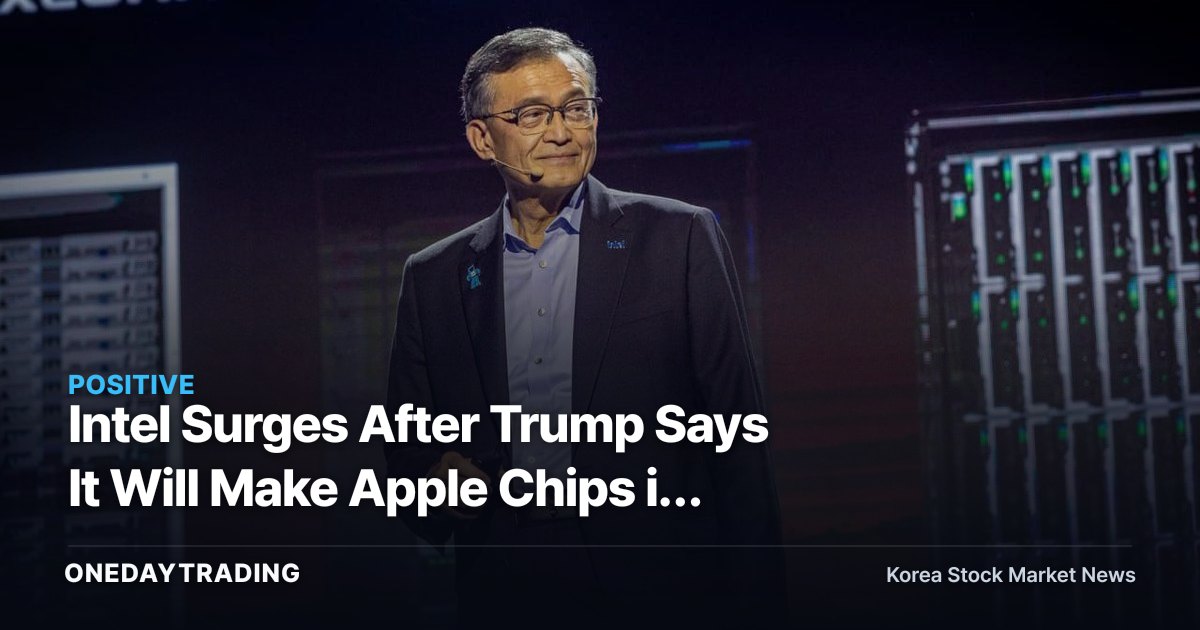

At the heart of this development is the fact that Apple — one of the most demanding customers around — was floated as a potential client just as Intel works to transform itself from a company that designs and manufactures its own chips into a foundry that produces chips on contract for outside customers. From an investor's standpoint, what matters is not a one-off political remark but the structural question of whether Intel Foundry Services (IFS) can translate utilization rates and advanced-node yields into actual orders from large customers. Because a foundry is a capital-intensive business with high fixed costs, landing a single major customer creates a leverage structure in which higher utilization translates directly into improved profitability.
Three-Line Briefing
- Intel shares surged in pre-market trading after President Trump said the company would manufacture Apple chips within the United States.
- The remark is a signal that fueled expectations Intel's foundry could secure large external customers on advanced process nodes.
- Still, with no formal contract, volume, or process node confirmed, the gap between the comment and an actual order remains a variable.
What Changes
Intel has long relied on an integrated device manufacturer (IDM) model in which it makes its own CPUs, but in recent years it has been spinning off and strengthening its foundry business in a bid to enter the contract-manufacturing market split between TSMC and Samsung Electronics. The challenge has been securing credible outside customers. Apple is a flagship client that has entrusted all of its in-house-designed chips to TSMC's advanced processes, so a scenario in which even part of Apple's volume shifts to Intel would be a symbolic event proving Intel Foundry's technological credibility to the market.
The fact that production would take place inside the U.S. also ties into policy considerations. Against a backdrop that has emphasized reshoring the semiconductor supply chain, Intel — which owns advanced fabs in the U.S. — sits in the path of potential policy benefits. That said, a political remark does not immediately translate into a binding supply contract, and it typically takes a long time for a customer to validate process nodes and yields.
Through the Numbers and Context
The concrete facts conveyed by the original report are that Intel shares jumped sharply in pre-market trading, that the speaker was President Trump, and that the customer in question is Apple. Specific production volumes, processes, timelines, and dollar amounts have not been disclosed. It is therefore reasonable to read the current stage not as a change reflected in earnings but as a phase in which expectations have been priced in ahead of the fact, with the trajectory of Intel's foundry revenue and disclosures on the share of external customers becoming the metrics that will separate substance from hype.
Beneficiaries and Casualties
- Intel: The core player directly reflecting expectations of winning external foundry customers. Improved utilization would offer substantial profitability leverage.
- Apple: Supply-chain diversification could reduce reliance on a single partner, though it comes with near-term cost and validation burdens.
- TSMC: The possibility of part of Apple's volume shifting away could, over the long term, become a competitive pressure on market share.
- Samsung Electronics: If competition over U.S.-based production and customer acquisition intensifies in the foundry race, pressure to reassess strategy grows.
- Semiconductor equipment stocks: If the operation and expansion of advanced fabs in the U.S. materializes, it becomes a forward driver of demand for front-end process equipment.
Risk Check
- The gap between a political remark and a binding supply contract — volume, process, and timeline remain unconfirmed.
- The possibility that customer validation of the yield and stability of Intel's advanced processes takes a long time.
- Valuation strain from expectations being priced in ahead of the fact, and heightened volatility if the remark is walked back or scaled down.
- The pressure that large-scale capital expenditure places on profitability if the foundry's turn to profit is delayed.
Bottom Line
Expectations of landing a major customer have the potential to mark an inflection point in Intel's foundry pivot, but until actual order disclosures and process-yield data are confirmed, this is a phase to approach by weighing the gap between expectation and substance.
This article is content automatically summarized and analyzed based on the original news report. View original (MarketWatch)