
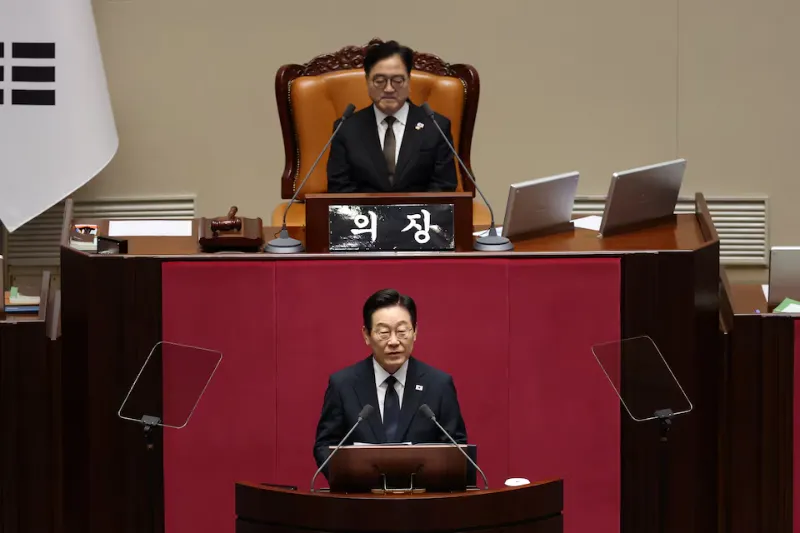
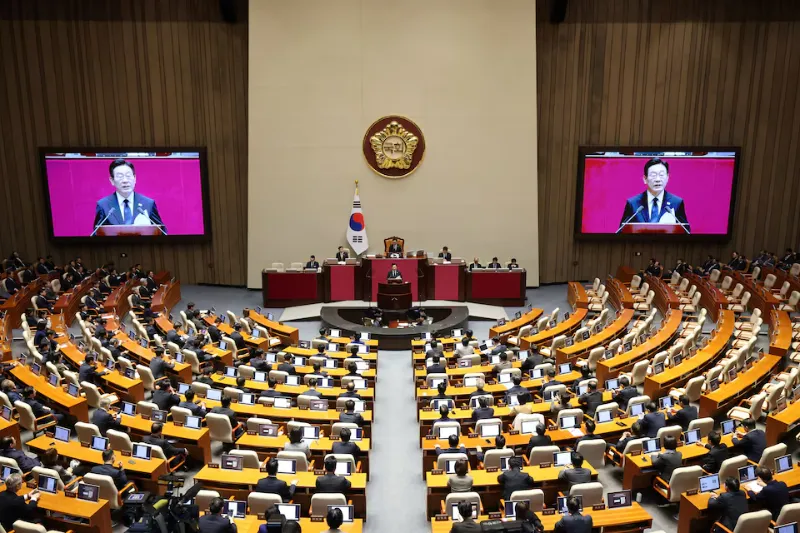
South Korea's economy is catching its breath once again. With the government recently declaring officially that "the economy stands at a turning point," there are signs that it may finally be emerging from a long tunnel of stagnation. On the 4th, President Lee Jae-myung emphasized a trajectory of economic recovery and announced that the 2026 budget had been set at roughly 728 trillion won.
This budget is particularly notable for including large-scale investment centered on the AI, semiconductor, and content industries, and it is being interpreted as a starting signal for South Korea's full-fledged transition into a technology-driven industrial nation.

A combination of factors lies behind this economic rebound. As global trade tensions have eased and the United States has signaled a course toward rate cuts, South Korea's export-driven economy has gained some breathing room. Indeed, the country's third-quarter economic growth rate came in at 1.2%, beating expectations. Semiconductor exports in particular showed a recovery, while domestic consumption also edged up modestly thanks to government cash support and tax benefits. To sustain this momentum, the government plans to channel a substantial portion of next year's budget into strategic industries. At the center of this effort are the advancement of AI technology, the strengthening of next-generation semiconductor competitiveness, and the cultivation of the content industry.
What stands out is that this policy is not merely a stimulus measure, but rather a long-term strategy aimed at fundamentally upgrading the structure of industry itself. The government has put forward a plan to intensively foster national strategic technologies over the next five years and to secure a competitive edge in global markets through collaboration with private enterprises. In the AI field in particular, it will expand support for research and development (R&D) of hyperscale language models, while pursuing both regulatory easing and cloud infrastructure support so that startups and small and medium-sized enterprises can readily enter the AI ecosystem.
In the semiconductor field, large-scale tax credits and the expansion of production infrastructure will likewise be pursued on the basis of the "K-Chips Act." Support will extend not only to large corporations such as Samsung Electronics and SK Hynix, but also to small and medium-sized enterprises in the design and equipment sectors. In the content industry, the development of globally oriented IP (intellectual property) and the production of digitally converged content—spanning the metaverse, games, webtoons, and films—is expected to gain full momentum. Notably, the government has defined "the fusion of AI technology and the content industry" as a core growth axis under this budget, pledging to provide new opportunities for creators and developers.
These changes carry significance well beyond the level of government. They are also a signal to developers, content planners, and marketers that the direction of the market is clearly shifting. "Technology-centered storytelling" is becoming the market mainstream, and an era is opening in which AI takes its place not as a mere supporting tool for creation, but as a partner. Real-time content production based on Unity or Unreal Engine, brand experiences within metaverse spaces, and AI-driven interactive storytelling are set to become some of the areas with the greatest growth potential going forward.
That said, this economic rebound does not signify a full recovery. The global economy remains unstable, and issues such as US-China tensions and the realignment of global supply chains persist. The fact that domestic demand is not recovering as quickly as exports also weighs on the outlook. Experts point out that "while this budget may serve as a starting point for transforming the economy's fundamentals, translating it into tangible results will require the innovation capacity of the private sector to provide the backbone." Ultimately, the government's role is to "create the environment," while the true protagonists are the creators and technology developers on the ground in industry.
Even so, this measure marks a clear change. What is most striking is that the South Korean government, which in past crises had tended to stop at short-term stimulus, this time chose a structural approach centered on "investment in future industries." It is a moment in which the paradigm of economic growth is shifting from "quantitative expansion" to "qualitative transformation." As AI, semiconductors, and the content industry connect into a single axis, a new keyword—"K-Innovation"—is coming to the fore.
An official at an economic research institute forecast that "South Korea has now reached the point of building a creative economic model that fuses technology and culture, going beyond being a mere manufacturing powerhouse," adding that "if AI, content, and semiconductors are brought together, global competitiveness will be multiplied." The official went on to emphasize that "for this change to translate into tangible results, however, on-the-ground developers, creators, and startups must take the lead."
This budget announcement is not merely a set of figures reflecting the trajectory of the national economy; it is a barometer of what kind of future South Korea will prepare over the next five years. And at the center of that future are technology and content.
In the end, the winners of the AI era will not be the governments that handle data, but the creators and developers who craft stories and connect the world.