
Key Takeaways
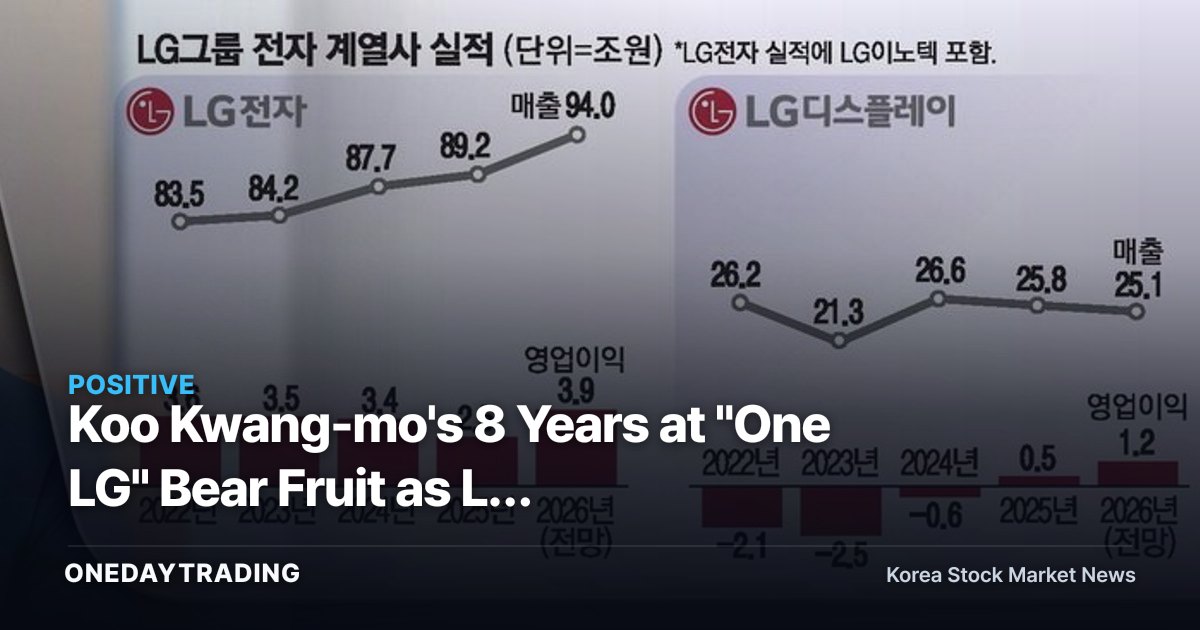
As LG's three electronics affiliates (LG Electronics, LG Innotek, and LG Display) enter record annual earnings territory, Chairman Koo Kwang-mo's business overhaul is now translating into bottom-line results. The crux is not mere top-line growth but a shift in the center of gravity toward B2B, high-value-added areas such as automotive electronics and HVAC, which has changed the quality of profits. For investors, an earnings structure that has stepped back from sensitivity to the home-appliance cycle could provide grounds for a valuation re-rating.
What Happened
With Chairman Koo Kwang-mo marking his eighth anniversary in office on the 29th, his portfolio strategy is back in the spotlight alongside improving earnings at LG Electronics and its component affiliates. Over this period, LG has exited the smartphone business and cleared out non-core operations through joint ventures and divestitures, while reallocating resources toward growth pillars such as automotive electronics and heating, ventilation, and air conditioning (HVAC).
The significance of this shift lies in reducing LG Electronics' dependence on the cyclical TV and home-appliance businesses that have driven its earnings volatility, while securing a stable revenue pool through an order-based automotive electronics business and an HVAC business tied to data-center and building demand. Among the component affiliates, LG Innotek still carries the seasonality of customer-dependent businesses such as camera modules, but LG Display is moving past its loss-making phase and reshaping its fundamentals around OLED.
Background and Context
The consistent direction under Chairman Koo's leadership has been one of selection and focus—concentrating on areas of strength and shifting into fields with clear future demand. Automotive electronics ride on structural demand, as electrification and premiumization of finished vehicles raise the value of electronic components installed per vehicle, while HVAC is buoyed by data-center cooling demand stemming from the spread of artificial intelligence and the transition to eco-friendly heating. Diversification away from sole reliance on home appliances raises hopes that it can cushion the economic cycle.
Impact on the Market and Stocks
- LG Electronics: If a larger share of automotive electronics and HVAC improves earnings stability, there is room for the home-appliance discount to ease. That said, short-term earnings volatility remains, depending on TV and home-appliance demand, logistics costs, and the exchange rate.
- LG Innotek: Earnings hinge on its major customer's new-product cycle and camera-module pricing. The fact that quarterly swings can be large when customer shipments slow is a double-edged sword.
- LG Display: A growing OLED share and a recovery in utilization rates are the key variables for a return to profit, leaving it sensitive to panel prices and the pace of demand recovery.
- Automotive electronics supply chain: An expansion in LG Electronics' automotive electronics orders could create a trickle-down effect for automotive component and software partners, raising the prospect of benefits across the broader automotive-electronics value chain.
- HVAC theme: Amid expanding data-center cooling demand, LG Electronics' chiller and cooling business could come to the fore as a new growth driver.
Investor Checkpoints
- In the next quarterly earnings release, watch the segment-level figures to see how much the revenue and operating margin of the automotive electronics and HVAC divisions offset the home-appliance slowdown.
- The trend in disclosed cumulative order backlog for the automotive electronics business is a key indicator of future revenue visibility.
- Check whether LG Display's utilization rates and OLED shipments can establish a sustained return to profit.
- Keep an eye on external variables that can sway quarterly earnings, such as the won-dollar exchange rate, logistics costs, and major customers' shipment schedules.
Outlook
The optimistic scenario is one in which automotive electronics orders are recognized in earnest as revenue and HVAC absorbs data-center demand, allowing LG Electronics to be re-rated from a cyclical home-appliance stock into a diversified industrial and B2B company. Conversely, if home-appliance demand cools further amid a global consumption slowdown, or if customer dependence in the component affiliates and panel-price volatility coincide, there is a risk that hopes for record earnings end up as nothing more than short-term momentum. The possibility that expectations of all-time-high earnings are already partly priced into the shares—that is, valuation burden—is another variable to consider.
LG Electronics in Real-Time Data
LG Electronics' latest closing price is 211,500 won (-7.44% from the previous day), and the signal light combining foreign and institutional investor order flow with news and momentum is 🟡 Neutral / Wait-and-See. With positive and negative signals mixed, this is a zone to watch.
- ▲ Order-flow continuity — foreign investors net buyers for 3 consecutive days (+2.6 billion won)
- ▲ News flow — 3 positive catalysts vs. 0 negative catalysts — positive catalysts prevail
Recent related news is favorable, with 3 positive catalysts and 0 negative catalysts.
※ Price and foreign/institutional investor order-flow data are provided by Korea Investment & Securities (KIS), as of the time of publication.
This article is content automatically summarized and analyzed based on the original news. View original (Maeil Business Newspaper, Corporate)