
Summary
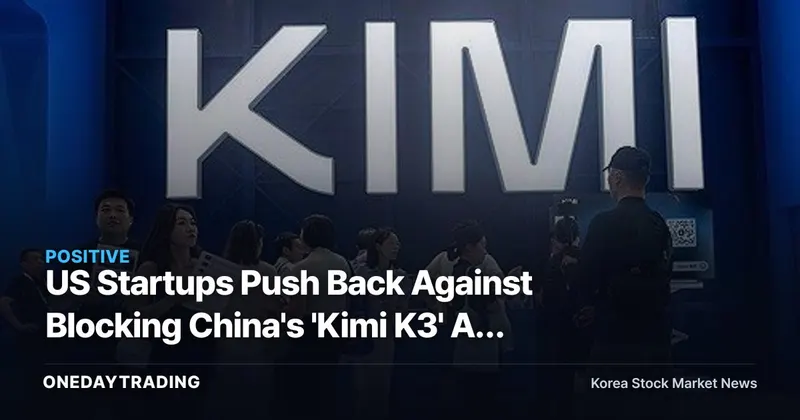
After China's Moonshot AI released the open-weight model "Kimi K3" with publicly available weights, drawing buzz across developer communities, the US startup industry has openly pushed back against moves to restrict access to Chinese AI models. The core issue here isn't model performance itself, but the fact that the open-weight ecosystem is undermining the pricing power of closed frontier models — and that ripple effect ultimately extends to data center infrastructure and memory semiconductor demand.
The Full Story
Kimi K3 is an open-weight model whose weights can be downloaded directly and deployed or fine-tuned on a company's own servers. Unlike closed models from OpenAI, Anthropic, and similar providers that require paying per API call, startups using Kimi K3 only need to cover infrastructure costs to access frontier-level performance essentially for free. This is exactly the point US startups are objecting to. If access to Chinese models is institutionally blocked, the logic goes, the low-cost alternative disappears, forcing a return to expensive closed-model APIs.
This isn't an ideological debate — it's a cost-structure issue. For early-stage startups in particular, model training and inference costs make up a large share of the bottom line, and open-weight models have served as a lever cutting that cost line by more than half.
Structural Background
US efforts to counter China on AI have so far been built around the hardware axis — export controls on advanced GPUs. But at the software layer, model weights can be downloaded across borders with no such barrier, leaving a gap in the control net. The fact that Chinese labs, working with relatively constrained computing resources, keep releasing open-weight models like Kimi K3 one after another signals a challenge to the very premise of trying to widen the technology gap through chip export controls alone. At the same time, as open-weight models proliferate, the number of startups and companies adopting them grows too — and so does the volume of inference computation they consume.
Stock and Sector Impact
- SK Hynix (000660): The spread of open-weight models disperses inference demand — once concentrated among a handful of closed-model services — across the self-hosted servers of many startups and companies, raising total inference compute volume overall. This is a mechanism that broadens the base of demand for HBM and server DRAM.
- Samsung Electronics (005930): The same logic applies to its memory semiconductor business, while its foundry arm stands to benefit as the customer base of startups designing their own AI chips expands.
- Naver: There's a growing incentive to offset some of the cost of advancing its own large-scale model, HyperCLOVA X, by fine-tuning open-weight models instead — but as low-cost competing models multiply, the pressure to differentiate its proprietary model also intensifies.
- Kakao: Since many small and mid-sized AI service startups operate within Kakao's platform ecosystem, lower model-sourcing costs for these startups will also affect the pace at which Kakao-linked AI services roll out.
Bull vs. Bear Scenarios
The bullish scenario is one where intensifying open-weight competition lowers the barrier to AI adoption and expands the overall demand pie. As the user base grows, total inference compute rises, which feeds directly into memory and server demand. The bearish scenario is one where near-free Chinese models erode the API pricing power of closed US models, squeezing software companies' profitability and potentially leading to scaled-back next-generation data center investment plans. If the latter plays out, the pace of growth in semiconductor demand could slow as well.
Investor Action Points
- Track the timeline for legislative and administrative action from the US Congress and executive branch on restricting access to Chinese AI models.
- Check whether SK Hynix and Samsung Electronics raise their HBM and server DRAM demand guidance in their upcoming earnings releases.
- Monitor whether closed-model providers such as OpenAI and Anthropic shift their API pricing policies.
- Watch whether Naver and Kakao mention greater use of open-weight models in their proprietary AI model roadmaps.
SK Hynix: Live Market Data
SK Hynix's most recent closing price was 1,885,000 won (+3.01% from the prior day), and the signal combining foreign investor/institutional investor supply-demand (order flow) with news and momentum reads 🟢 Buy-leaning. Foreign investor activity, news flow, and momentum are all positive, making this stock (ticker) worth watching.
- ▲ News Flow — 9 positive catalysts vs. 1 negative catalyst — positive catalysts dominate
Recent related news skews favorable, with 9 positive-catalyst stories versus 1 negative-catalyst story.
※ Price and foreign/institutional investor supply-demand (order flow) data are provided by Korea Investment & Securities (KIS) and reflect figures as of publication time.
This article was automatically summarized and analyzed based on the original news report. View original (Yonhap News Agency, Securities)