
At a Glance
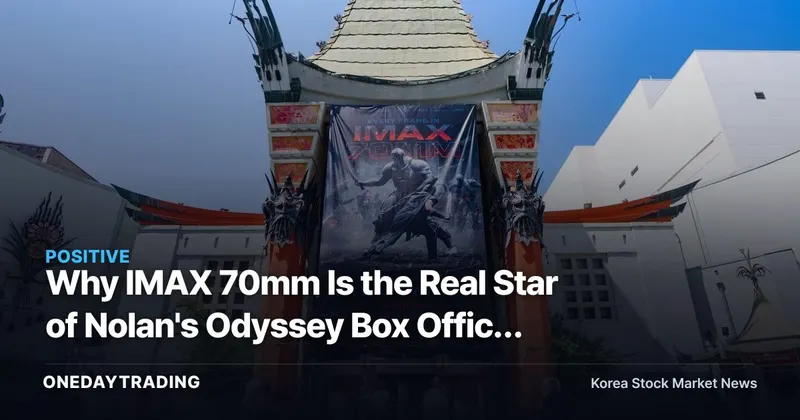
Fans eager to watch Christopher Nolan's new film "The Odyssey" in IMAX 70mm film format are booking flights and camping out overnight in line at box offices. This isn't just a display of fandom — it's a sign that IMAX's business model, which extracts revenue from a single premium screening format, is working exactly as designed.
Why It Matters Now
Box-office buzz and company profits need to be viewed separately. Even before "The Odyssey's" official box-office numbers are in, the overnight lines and long-distance pilgrimages to 70mm theaters have already become news in their own right. Here's why that matters for IMAX: regardless of whether the film succeeds at the box office, IMAX collects a set percentage of premium ticket prices from theaters as royalties. 70mm film screenings represent the top-tier format with a higher price point than digital IMAX, so as more moviegoers flock to it, both per-screen revenue and IMAX's cut grow in tandem.
More importantly, supply is artificially constrained. Theaters capable of actually projecting 70mm film are scarce — just a handful worldwide. Due to the costs of print production, shipping, and maintaining legacy projection equipment, even IMAX has no plans to expand this format indefinitely. That engineered scarcity is exactly what drives audiences to travel long distances and wait in line, while also allowing theaters to sell out without cutting prices. The fact that Nolan is a director with a strong, well-known preference for film projection reignites the format's buzz with every new release.
That said, how much of this enthusiasm translates into earnings for studios and theater chains is a separate question. The number of moviegoers that 70mm theaters can accommodate is a tiny fraction of the total release footprint, so even with strong buzz, the format's contribution to the film's overall box office may be limited. It would be premature to judge "The Odyssey's" box-office performance based on IMAX premium screenings alone.
FAQ
- Q. How is IMAX 70mm different from standard IMAX? A. Instead of digital projection, it uses actual film prints run through large analog projectors, delivering a more immersive experience that is generally rated higher — and priced accordingly.
- Q. Is IMAX actually making money from this buzz? A. IMAX operates a screening-format licensing business, taking a set percentage of the premium ticket revenue theaters collect. As per-screen revenue rises, so does IMAX's share.
- Q. Why doesn't IMAX add more 70mm theaters? A. High costs for print production, logistics, and projector maintenance mean IMAX itself is deliberately controlling the pace of expansion. Limited supply also helps justify the premium pricing.
- Q. Does this buzz represent the film's overall box-office performance? A. No. The audience size at 70mm theaters is small relative to the full theatrical release, so total box-office results need to be checked separately.
Related Stocks (Tickers) and Sector Impact
- IMAX (IMAX) — The primary beneficiary, as licensing fees flow directly into revenue. Higher per-screen attendance density and ticket prices translate directly into greater royalty revenue.
- Comcast (Universal Pictures) — As the parent of "The Odyssey's" distributor, whether this pre-release buzz converts into actual attendance will affect the studio's earnings.
- Theater chains such as Cinemark and AMC Entertainment — Theaters equipped with 70mm facilities share in the benefit of higher average ticket prices, but the impact varies widely depending on whether a given location has the equipment.
- Film print and specialty projection equipment companies — Demand for print production and distribution may see a temporary bump, but the scale is small enough that the earnings impact is limited.
Investment Considerations
- While 70mm screening buzz generates high visibility, this format still represents a small share of IMAX's overall revenue.
- The release effect is a one-time event. Without a steady pipeline of major follow-up releases, premium screening revenue will revert to typical levels.
- When evaluating theater chain stocks (tickers), investors should check individual locations' 70mm equipment status, seating capacity, and local market conditions.
- Box-office performance and IMAX licensing revenue move independently — even if a film underperforms at the box office, sold-out 70mm screenings still generate royalty income.
Overall Outlook
The optimistic scenario is that Nolan's film-format marketing becomes a recurring "event screening" formula with every new release, structurally lifting IMAX's premium-format revenue share over time. Conversely, if this current wave of enthusiasm proves to be a short-lived, early-release phenomenon, standard theater revenue will regain its dominant share once the wide release begins, and the premium format's contribution could normalize faster than expected. The key indicators to watch are clear: IMAX's disclosed share of opening-weekend revenue for "The Odyssey," and the premium-format attendance share relative to total screens that Universal will reveal in its next earnings report.
This article was automatically summarized and analyzed based on the original news report. Read the original (CNBC)