
At a Glance
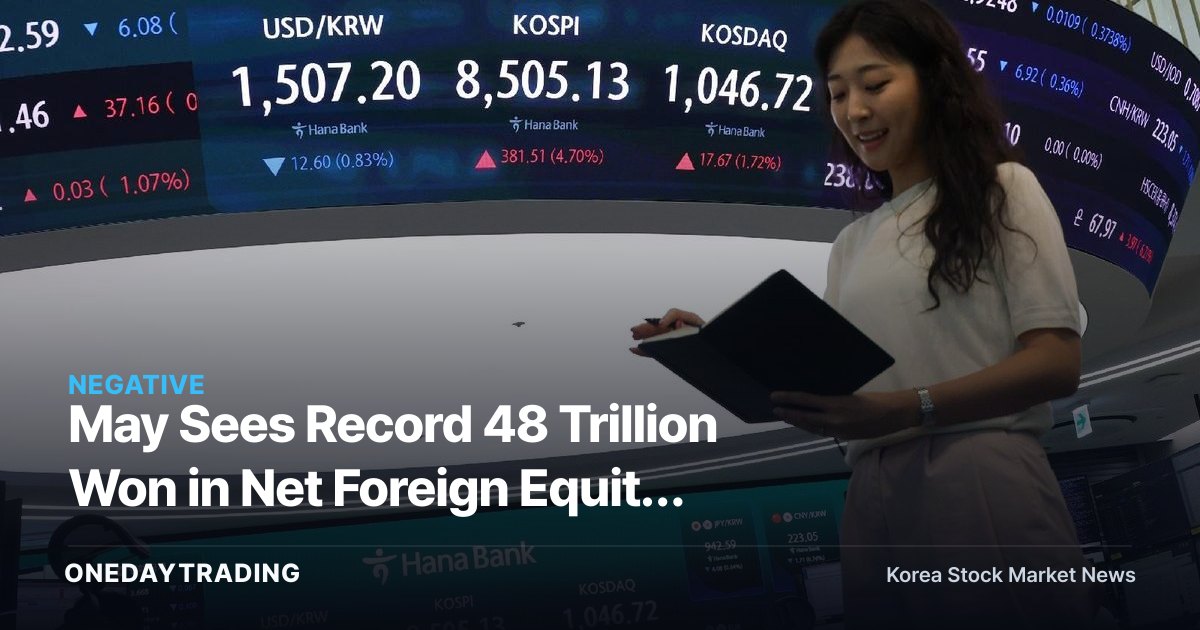
According to Bank of Korea data, foreign investors engaged in large-scale profit-taking in the domestic stock market this past May, driving roughly 39 trillion won in net outflows from Korea's financial markets. In particular, net equity outflows reached around 48 trillion won, the largest on record. That said, the bond market saw a net inflow of 5.6 billion dollars over the same period, supporting the KOSPI's downside.
Why It Matters Now
Foreign supply-demand (order flow) is a key variable determining the direction of Korea's stock market. Because foreign investors account for a large share of KOSPI market capitalization, when they turn to selling, downward pressure on the index builds, centered on large-cap stocks. May's record net equity outflow is read as the combined result of moves to realize profits accumulated during the index's earlier rally and a shift in global risk appetite.
Even so, it is notable that the KOSPI held up rather than suffering a sharp drop (plunge). Domestic retail investors and institutional investors absorbed the foreign selling, while foreign funds actually flowed into the bond market. This suggests that confidence in Korean assets as a whole has not fully departed; rather, it may reflect an asset-allocation flow in which capital shifts between stocks and bonds.
Exchange rates and global interest rate trends are also variables. In a phase of won weakness, foreign investors tend to sell equities out of concern over currency losses, so whether the won-dollar exchange rate stabilizes going forward serves as a gauge for timing a return by foreign investors.
Frequently Asked Questions
- Why did foreign investors sell stocks so heavily — profit-taking during the index's rally, a cooling of global risk appetite, and avoidance of currency losses amid won weakness all worked together.
- So why did the KOSPI hold up — domestic retail and institutional buying absorbed the foreign volume, and foreign funds flowed into bonds on a net basis, limiting any broad exit from Korean assets.
- What does the net bond inflow mean — it indicates that foreign investors bought Korean government bonds and the like on safe-haven demand and yield appeal, a fund flow different in nature from equity selling.
- Will foreign investors come back — a shift to net buying is possible if exchange rates stabilize, corporate earnings improve, and the global liquidity environment recovers, but it is too early to say for certain.
Impact on Related Stocks and Sectors
- Samsung Electronics and SK Hynix — large-cap semiconductor stocks with high foreign ownership that react sensitively to supply-demand (order flow) shifts along with the index.
- Exporters such as Hyundai Motor — won weakness is favorable for earnings, but concern over foreign investors' currency losses can become a trigger for selling, making the impact double-edged.
- Financial stocks such as KB Financial and Shinhan Financial Group — exposed simultaneously to bond yields and foreign supply-demand (order flow), with dividend appeal giving them a defensive character.
- Brokerage stocks — a representative sensitive industry sector whose earnings swing with trading value and foreign order-flow volatility.
- KOSPI index ETFs — index-linked products whose flows are directly affected by the direction of foreign supply-demand (order flow).
Points to Watch When Investing
- Monthly fund flows are historical data, so they may already be substantially priced into share prices and should be interpreted as lagging indicators.
- Net equity outflows and net bond inflows should be viewed separately; one should not simply sum them and conclude there has been a broad exit from Korean assets.
- Macro variables that drive foreign supply-demand (order flow) — the won-dollar exchange rate, U.S. interest rates, global risk appetite — need to be checked together.
- Rather than overreacting to a record figure in any single month, it is wise to look for signals of a trend shift toward net buying or net selling.
Overall Outlook
On the optimistic side, the fact that the KOSPI held up without a sharp drop (plunge) despite record foreign net equity outflows suggests that the domestic supply-demand base has grown deeper. If exchange rates stabilize and corporate earnings and the global liquidity environment improve, foreign capital could flow back in and become a driver of an index rebound.
On the risk side, however, if U.S. interest rate direction and won weakness persist, foreign selling could continue further and downward pressure centered on large-cap stocks could intensify once again. Ultimately, the stabilization of exchange rates and foreign supply-demand (order flow) in the short term, and improvement in corporate earnings over the medium term, are set to be the key variables determining the direction of Korea's stock market.
This article is content automatically summarized and analyzed based on the original news report. View Original (Maeil Business Newspaper, Securities)