
At a Glance
At a meeting between the ruling party's floor leadership and the Federation of Korean Trade Unions (FKTU), excess-profit sharing was raised alongside labor-management coexistence. It is not yet a legislated matter, but it could serve as a directional guide for future labor and distribution policy—making it a signal worth checking in advance for investors watching the cost structure and shareholder-return capacity of high-margin industry sectors.
Why It Matters Now
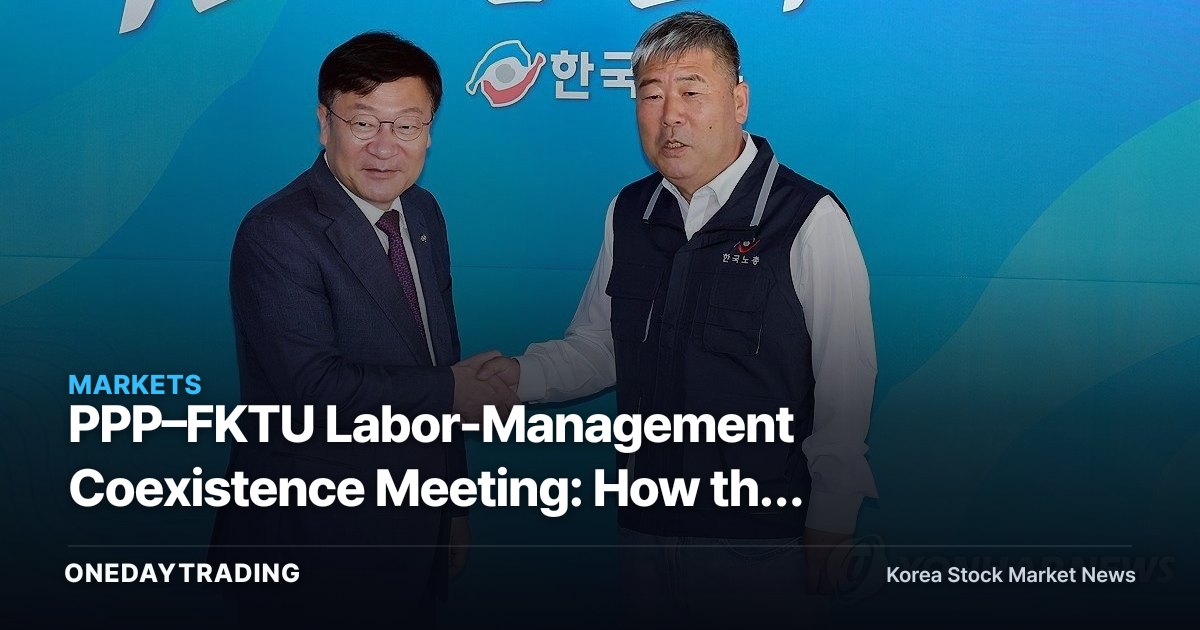
The fact that floor leader Jung Jum-sik chose the FKTU as his first external engagement after taking office reads as a political message that he intends to place labor issues high on the political agenda. The excess-profit sharing raised by the union side refers to the concept of requiring companies that post profits above a certain level to share part of that excess with workers; should it actually be institutionalized, labor-related costs would rise, directly affecting operating profit margins and the funds available for dividends and share buybacks.
That said, at this stage the policy is merely an agenda item that has been put on the table—the specific scope of application, the calculation method, and whether it would be mandatory have not been determined at all. It is therefore more reasonable to approach this as background information for gauging medium- to long-term policy risk rather than as a catalyst that drives individual stock (ticker) prices. It is also worth bearing in mind that profit-sharing and cooperative profit-sharing proposals have been raised repeatedly in the past, yet cases of them leading to legislation have been limited.
Frequently Asked Questions
- What is excess-profit sharing? It is a distribution-policy concept that encourages or requires companies to allocate part of any profit beyond normal levels to workers or partner firms.
- Will it be reflected in corporate earnings right away? No. It is at the stage of being raised as a discussion item at a meeting, with no legislative or implementation timeline set.
- Which companies are sensitive to this? High-margin and cyclical industry sectors—whose profit margins can temporarily spike depending on the economy and business conditions—are relatively more exposed.
- What should investors watch? They can check, in sequence, whether the party formally proposes the policy, how the scope of application and calculation criteria are specified, and how strongly the business community pushes back.
Affected Stocks and Sectors
- Refining and chemicals With quarterly profit volatility high during periods of widening refining margins and spreads, this group could find itself at the center of cost-burden debates if the excess-profit concept were applied.
- Financials (banks and holding companies) Having already faced "win-win finance" pressure when interest income surges during periods of rising rates, the group is sensitive to the distribution agenda.
- Semiconductors Given that operating profit margins post sharp gains (surge) during business-cycle recoveries, the group could become a potential target of the distribution debate—though there are strong counterarguments citing global competition and investment burdens.
- Labor-intensive industry sectors with a high labor-cost ratio Because additional labor-related costs are passed directly through to margins in this structure, the impact would vary depending on how the policy is designed.
Points to Watch When Investing
- There is a wide gap between remarks made at a political meeting and actual legislation. The remarks themselves should not be immediately translated into an earnings variable.
- Since the distribution burden could affect dividend payout ratios and buyback policy, stocks (tickers) with a large share of shareholder returns should be tracked separately for policy developments.
- Even for high-margin stocks (tickers), counter-logic such as global competition and the need for capital expenditure is at work, so the likelihood of uniform application is limited.
- Because the direction of labor issues frequently shifts depending on partisan and labor-government relations, one should not overreact to a single remark.
Overall Outlook
If institutionalization becomes a reality, downward pressure from cost variables for high-margin industry sectors and reduced funds for shareholder returns could come to the fore. Conversely, if the discussion stays at a declaratory level or retreats amid business-community pushback, the market impact is likely to be minimal. At this point, rather than treating it as a basis for buying or selling any particular stock (ticker), it is appropriate to monitor whether the labor and distribution policy line takes concrete shape, together with quarterly earnings.
This article is auto-summarized and analyzed content based on the original news. View original (Yonhap News)