
Summary
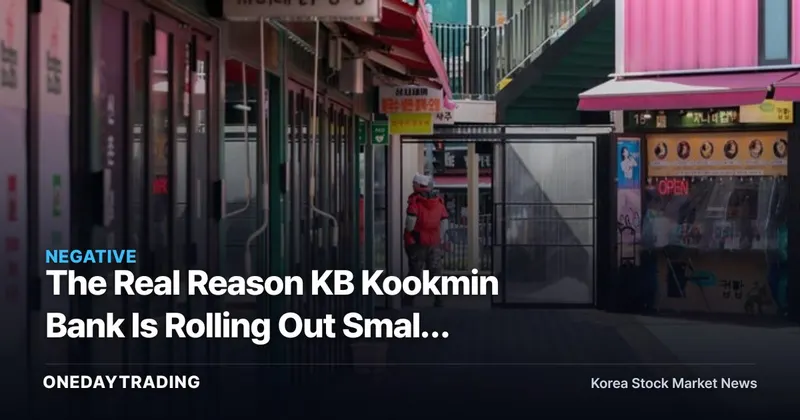
From July 6 to 8, KB Kookmin Bank will run a win-win finance program in North Jeolla Province that combines funding support with operational know-how consulting for small business owners. As shrinking consumption pushes more self-employed operators into financial distress, commercial banks have been rolling out support for neighborhood merchants one after another — but this should not be read simply as corporate social responsibility. The moment a bank reaches out first tends to coincide with the moment cracks are already being detected inside its loan portfolio.
The Full Story
This program rests on two pillars: funding support and operational know-how consulting. Unlike past win-win finance efforts that simply lent money, the addition of management consulting suggests the bank has internally concluded that interest relief alone won't be enough to prevent defaults. When self-employed borrowers' revenue itself is declining, extending loan maturities or cutting interest rates does little to restore their repayment capacity.
Not just Kookmin Bank but also Shinhan, Hana, and Woori — the major bank holding companies — have competitively expanded rate cuts and consulting-based support for small business owners this year. It's reasonable to view this simultaneous push not as individual banks' goodwill, but as tied to the semiannual cycle in which financial regulators require banks to announce win-win finance plans. The banking sector has routinely disclosed the scale of its win-win finance efforts — interest cashback, rate reductions, consulting support — much like it reports earnings.
Structural Background
Structurally, this trend follows a familiar path: weak consumption → falling self-employed revenue → rising loan repayment burden → pressure on banks to build up loan-loss provisions. For banks, the cost of win-win finance has two faces. In the short term it shows up as explicit costs — lost interest income and consulting expenses — but it can also proactively manage risk before defaults turn into actual delinquencies, potentially easing future provisioning burdens. The key question is which of these two effects hits earnings first, and how significantly.
Stock (Ticker) and Sector Impact
- KB Financial Group - Expanded group-wide win-win finance spending, including this Kookmin Bank program, is a drag on interest income growth, but the asset-quality management effect across its regional branch network — where self-employed loan exposure is high — could help ease credit costs over the long run.
- Shinhan Financial Group, Hana Financial Group, Woori Financial Group - As these groups roll out similarly competitive small business support measures, industry-wide net interest margin pressure and rising SG&A costs are likely to follow in tandem.
- Regional bank holding companies (e.g., BNK Financial Group) - With a higher share of small business and self-employed loans than commercial banks, these lenders are more exposed to both the direct impact of weak consumption and the cost burden of win-win finance.
- Specialized credit and savings bank sector - If commercial banks' expanded win-win finance draws high-quality self-employed borrowers back to commercial banks, the resulting adverse selection — being left with lower-credit-quality borrowers — could weigh more heavily on this sector.
Bull vs. Bear Scenarios
The bullish scenario emphasizes that win-win finance lowers policy risk. If banks step in with support proactively, it weakens the rationale for further regulatory intervention (such as windfall-profit clawbacks or forced rate cuts), which could help narrow the chronically low P/B valuation discount on bank stocks. The bearish scenario, conversely, reads this expanded support itself as a signal that self-employed loan defaults are nearing a tipping point. In that case, loan-loss provisioning from the third quarter onward could come in larger than expected, risking downward revisions to net profit estimates. Both scenarios should be treated as conditional inferences rather than confirmed conclusions at this stage.
Investor Action Points
- Watch third-quarter earnings releases from bank holding companies for changes in self-employed/small business loan delinquency rates and provisioning levels.
- Track the timing and scale of financial regulators' seasonal win-win finance plan announcements to distinguish whether costs are voluntary or driven by policy pressure.
- Follow self-employed loan delinquency statistics released by the Bank of Korea and the Financial Supervisory Service in the months following expanded win-win finance announcements.
- Compare bank stocks' P/B ratios and dividend yields before and after announcements of expanded win-win finance costs to gauge shifts in the valuation discount.
KB Financial Group by the Numbers
KB Financial Group's most recent closing price was 169,600 won (+2.79% from the previous session), and the signal combining foreign and institutional investor supply-demand (order flow) with news and momentum reads 🟡 neutral / wait-and-see. With positive and negative signals mixed, this is a range worth watching.
- ▲ Trend alignment — Short- and medium-term uptrend alignment (session +2.8% · 1-week +13.5% · 1-month +3.2%)
- ▲ News flow — 4 positive catalysts vs. 1 negative catalyst — positive catalysts lead
Recent related news skews favorable, with 4 positive catalysts versus 1 negative catalyst.
※ Price and foreign/institutional investor supply-demand (order flow) data are provided by Korea Investment & Securities (KIS) and are current as of publication.
This article was automatically summarized and analyzed based on the original news report. View original (Maeil Business Newspaper, Economy)