
Key Takeaways
The Korea Federation of Micro Enterprise (KFME) and Naver (035420) have wrapped up the Busan Port Village pop-up under Local Studio, a project to discover regional food-and-beverage (F&B) brands, and provided a total of 300 million won — 100 million won each — to three selected companies. The amount itself is far too small to move Naver's earnings. But viewed not as simple corporate social responsibility, but as an upstream investment through which Naver draws local small merchants into its own commerce ecosystem, the move points to a bigger picture: the competitive landscape in local commerce.
What Happened
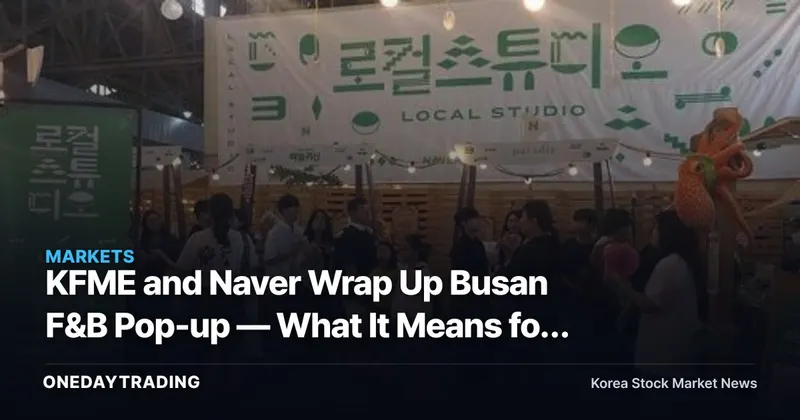
Local Studio is a program that discovers regional food-and-beverage (F&B) brands and connects them with growth capital and sales channels. At the Busan event, a pop-up format was used to create direct touchpoints with consumers, after which three selected companies each received 100 million won in funding.
The key lies in how the support is structured. Rather than simply handing out cash, the program is designed to also provide brand exposure, hands-on experience running an offline pop-up, and the potential to connect with Naver's online sales, search, reservation, and payment infrastructure. For small merchants, this channel access may matter more than the funding itself.
From Naver's perspective, programs like this serve as a channel for bringing promising regional F&B operators into its Smart Store, Place, reservation, and Pay ecosystem at an early stage.
Background and Context
South Korea's commerce market is a battleground between Coupang's logistics-driven direct-purchase model and Naver's platform-and-search-based intermediary model. Naver's strength lies in its overwhelming search traffic and an ecosystem that ties together a vast number of small and mid-sized sellers via Smart Store. Continuously securing quality new sellers is therefore foundational to growth in Naver's commerce gross merchandise value (GMV).
Regional small merchants and F&B businesses have historically leaned heavily offline, leaving online-platform penetration relatively low in this segment. Targeting this space aligns with a strategy to widen the pool of new transactions.
Market and Stock Impact
- Naver: This is less a direct beneficiary event than one facet of a longer-term strategy to strengthen its local commerce and small-merchant ecosystem. A broader seller base builds a thicker foundation for commerce fees, advertising, and Pay revenue. That said, the financial contribution from this particular event is negligible.
- Coupang (U.S.-listed): The more aggressively Naver moves to capture regional small-merchant and F&B sales channels, the more competitive intensity could rise in the local and fresh-food space. This is not a direct hit, but it is a variable in the competitive landscape.
- Delivery and reservation platforms, and payment-related stocks: F&B businesses moving online translates into demand for ordering, reservations, and simple payment services. This structure channels traffic toward platforms that own payment infrastructure, such as Naver Pay.
- Regional food-and-beverage and franchise-related stocks: The impact on individual stocks (tickers) is limited, but improving access to growth capital and sales channels for local F&B brands is favorable for overall industry-sector expansion.
Investor Checkpoints
- Watch Naver's commerce-segment GMV growth rate and new-seller trends at next quarter's earnings release — these are the metrics that will reveal the actual results of the ecosystem-expansion strategy.
- Also check Naver Pay transaction volume alongside management commentary on penetration into offline and local segments.
- Track competitors such as Coupang and delivery platforms as they push into local, fresh-food, and small-merchant markets, along with trends in their marketing spend.
- Weigh whether the expansion of these shared-growth/CSR-type programs leads to rising costs, or instead pays off as a revenue base built on securing new sellers.
Outlook
On the optimistic side, securing an early lead in the regional small-merchant ecosystem strengthens Naver commerce's seller diversity and differentiated content supply, reinforcing the virtuous cycle between search and commerce. On the other hand, the risks are just as clear. A single event has essentially no financial effect, and intensifying commerce competition alongside the cost burden of marketing and shared-growth programs could weigh on profitability. In addition, it takes time for platform support of small merchants to translate into actual transaction volume, making this hard to view as a near-term share-price catalyst. It is more reasonable to treat this event not as direct grounds for an investment decision, but as a reference signal for reading the direction of Naver's local commerce strategy.
Naver by the Numbers: Real-Time Data
Naver's most recent closing price was 204,000 won (+2.31% versus the prior session), and the composite signal — combining foreign-investor/institutional-investor order flow (supply-demand) with news and momentum — reads 🔴 Caution. With foreign investors, institutional investors, and news all skewing negative, caution is warranted right now.
- ▼ Twin-engine selling — foreign investors sold a net 65.8 billion won and institutional investors sold a net 16.7 billion won
- ▼ 52-week range position — sitting near the 52-week low, at the 12th percentile
Recent related news skews negative, with 0 positive catalysts and 1 negative catalyst.
※ Price and foreign/institutional supply-demand (order flow) data are provided by Korea Investment & Securities (KIS) and are current as of the time of publication.
This article is automatically summarized and analyzed content based on the original news report. Read original (Yonhap News, Industry)