
Summary
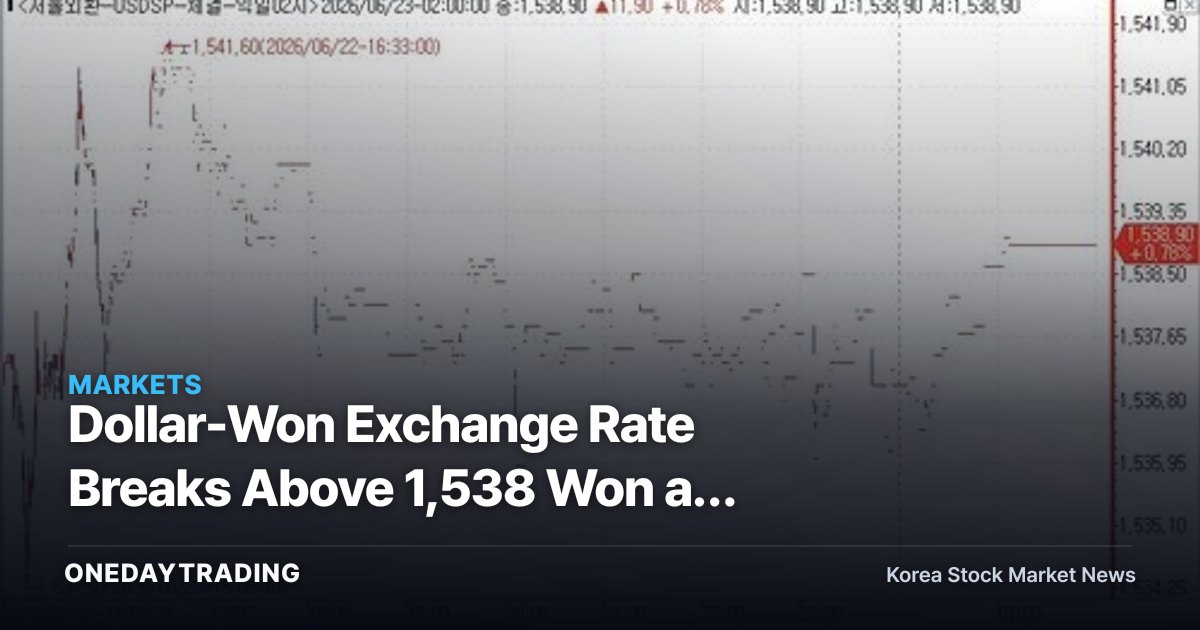
The dollar-won exchange rate closed at 1,538.90 won as a hawkish Fed stance strengthened the dollar. The won settling firmly into the 1,530s is not merely an FX data point — it is a variable that simultaneously shifts exporters' profitability, import costs, and the cost structure of firms carrying foreign-currency debt. For investors, this is a phase in which currency gains and losses run in exactly opposite directions depending on the stock (ticker), making a sector-by-sector selective approach essential.
What Happened
The direct driver of this rate move is broad dollar strength stemming from hawkish signals out of the U.S. Federal Reserve (Fed). Whenever the Fed hints at the possibility of slowing the pace of rate cuts, U.S. government bond yields and the dollar index rise together, and currencies like the won — whose relative rate appeal has dimmed across emerging and near-emerging markets — come under downward pressure.
A close at 1,538.90 won means the dollar-won has already pushed past the 1,500-won level, once regarded as a psychological resistance line, and entered a higher range. The exchange rate is a function of three axes — the Korea-U.S. rate gap, the trade balance, and foreign investor fund flow — and a hawkish Fed is the single most powerful near-term variable pulling the rate-gap axis in the dollar's favor.
Structural Background
Behind the prolonged weakness of the won lie the inverted Korea-U.S. benchmark interest rate structure and concerns about a slowing Korean economy. The wider the rate gap, the weaker the incentive to hold won from a carry-trade perspective, and renewed net selling of Korean equities and bonds by foreign investors can push the exchange rate higher again — forming a vicious cycle. In addition, the higher the exchange rate level, the more import-driven inflation is stoked, narrowing the Bank of Korea's room to maneuver on monetary policy — another structural burden.
Stock and Sector Impact
- Hyundai Motor and Kia (autos): As flagship exporters that earn a large share of revenue overseas in dollars, they enjoy strong operating-profit leverage when a weaker won boosts the won value of the same dollar revenue upon conversion.
- Samsung Electronics and SK hynix (semiconductors): With high export ratios, they are expected to benefit from currency gains, but they also import some equipment and materials in dollars, so rising input costs partly offset the upside.
- Korean Air (airlines): It pays for jet fuel, aircraft lease costs, and foreign-currency debt in dollars, making it a textbook currency-loser stock that sees both fuel costs and foreign-exchange translation losses rise when the exchange rate climbs.
- S-Oil and SK Innovation (refining): Importing crude in dollars raises input costs, but the impact cuts both ways since the higher costs can be passed on through refining margins and export prices.
- Korea Electric Power (utilities): With a large share of fuel imports and foreign-currency debt, a high exchange rate structurally increases both cost and interest burdens.
Bull vs. Bear Scenarios
Bull scenario: If a high exchange rate lifts the won-converted earnings of exporters and foreign investors rekindle their sense of undervaluation appeal, profit momentum could come to the fore led by autos and semiconductors. Should the exchange rate gradually stabilize below 1,500 won, room would also open up for a rebound in stocks burdened by import input costs.
Bear scenario: A further sharp gain (surge) in the exchange rate would pressure earnings through rising import-driven inflation and translation losses at firms with foreign-currency debt, while an outflow of foreign investor funds risks weighing on valuations across the broader market. A note of caution: exchange-rate volatility itself raises corporate FX-hedging costs, so the benefit to exporters may not be as large as expected.
Investor Action Points
- Gauge whether dollar strength will persist by checking the next Fed FOMC, the dot plot, and Powell's remarks for signals on the rate-cut path.
- Use whether the dollar-won breaks above or falls below the 1,500 and 1,550 won levels as inflection points to adjust exposure between exporters and import-cost-sensitive stocks.
- In exporters' next-quarter earnings, verify whether the currency effect actually translates into higher operating profit, while also reviewing the FX-hedging gain/loss footnotes.
- Monitor foreign net buying and net selling flows alongside government bond yields to track the direction of fund outflows and inflows.
This article is content automatically summarized and analyzed based on the original news report. View original (Yonhap News Securities)