
Three-Line Briefing
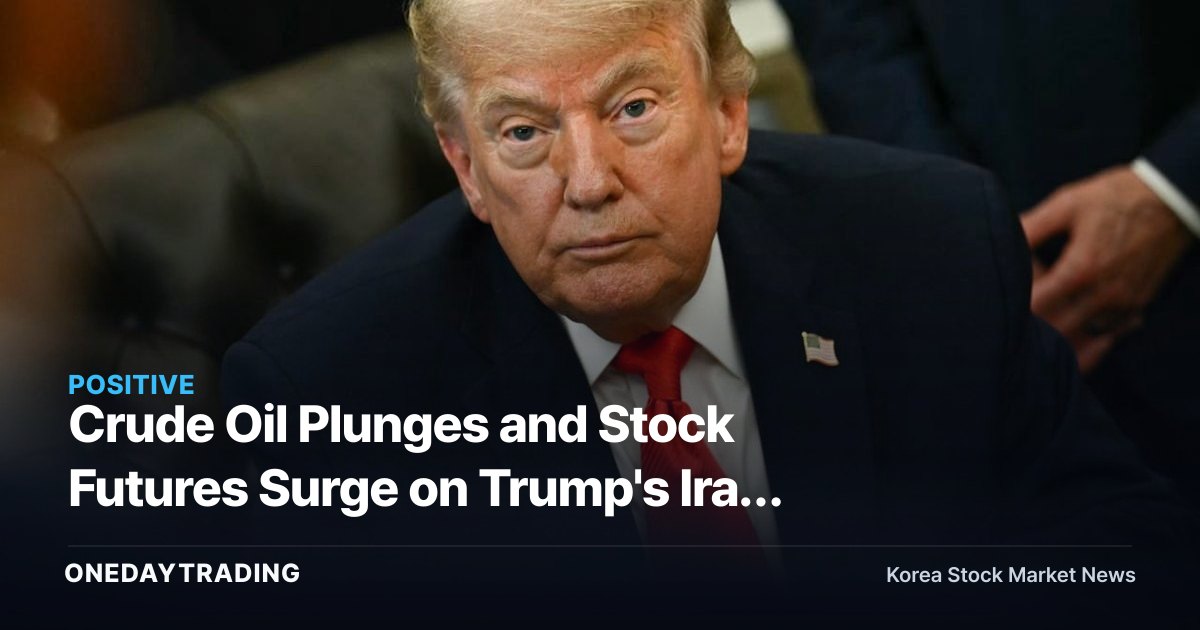
- U.S. President Trump announced that he had reached an agreement on a peace deal with Iran, shifting a months-long standoff into a phase of de-escalation.
- With Middle East tensions easing, the risk of a Strait of Hormuz blockade has receded, sending international oil prices lower while U.S. stock futures surged across the board.
- The retreat in geopolitical risk has stoked appetite for risk assets, raising hopes for a relief rally in the Korean market as well.
What's Changing
The crux of this announcement is that the navigational uncertainty around the Strait of Hormuz — through which roughly one-fifth of global crude supply passes — is now lifting. The market had been pricing in a strait blockade as a worst-case scenario, and the resulting supply-disruption fears had layered a risk premium onto oil prices. With news of the agreement, that premium is unwinding rapidly.
Lower oil prices go beyond a simple shift in commodity prices. For the Korean economy, which is heavily dependent on energy imports, they work through two channels: easing cost burdens and softening inflation pressure. At the same time, the retreat in geopolitical uncertainty draws foreign investor capital back into risk assets, lifting overall market sentiment across the KOSPI and KOSDAQ.
By the Numbers and Context
The Strait of Hormuz is the world's largest energy transport route, carrying tens of millions of barrels of crude oil and liquefied natural gas each day. Every time blockade fears flared, oil prices saw a sharp gain (surge) over a short span, burdening the global economy with the threat of an oil shock — so this easing of tensions produces the opposite shock, a positive ripple effect in the form of falling costs. That said, the specific implementation terms of the deal and its durability remain variables that still need to be confirmed.
Stocks: Winners and Losers
- Korean Air and Asiana Airlines: With jet fuel making up a large share of costs, the expectation of improved profitability on lower oil prices is most direct here.
- Shipping stocks such as HMM: A dual benefit is possible from eased fuel-cost burdens and the stabilization of maritime shipping routes.
- KEPCO (Korea Electric Power): Lower fuel costs for power generation could reduce cost burdens and ease earnings volatility.
- S-Oil, SK Innovation, and GS: Refining stocks are exposed to inventory valuation losses and refining-margin volatility risk during a period of falling oil prices, raising concerns over near-term pressure.
- Exporters such as Hyundai Motor: A recovery in global risk appetite and stable costs are favorable to overall market sentiment.
Risk Check
- The detailed implementation terms of the peace deal are opaque, and should the agreement falter, oil prices could see another sharp gain (surge).
- If the drop in oil prices is excessive, it could deal a direct blow to the earnings of the refining and energy sectors.
- The Middle East situation carries many variables, and the possibility that a temporary relief rally could reverse cannot be ruled out.
- If concerns over a global economic slowdown overlap, the boost from a recovery in risk appetite may be limited.
Bottom Line
Easing geopolitical risk and falling oil prices are favorable relief-rally catalysts for airlines, shipping, and domestic demand, but a balanced approach that also weighs the uncertainty of the deal's implementation and the pressure on refining stocks is needed.
This article is auto-summarized and analyzed content based on the original news report. View Original (MarketWatch)