
Summary
Whenever a large-scale personal data breach erupts in the public sector, the first place investors should look is not the party at the center of the incident, but the cybersecurity sector that absorbs the resulting security demand. This case — in which personal information was leaked from the government-led "Startup for All" initiative that drew more than 62,000 applicants — should not be viewed as a one-off incident, but rather read as a signal for gauging public-sector data protection budgets and the replacement cycle for security solutions.
That said, it is worth keeping in mind that while such incidents can give security stocks short-term momentum, there is a significant time lag before that translates into earnings.
What Happened
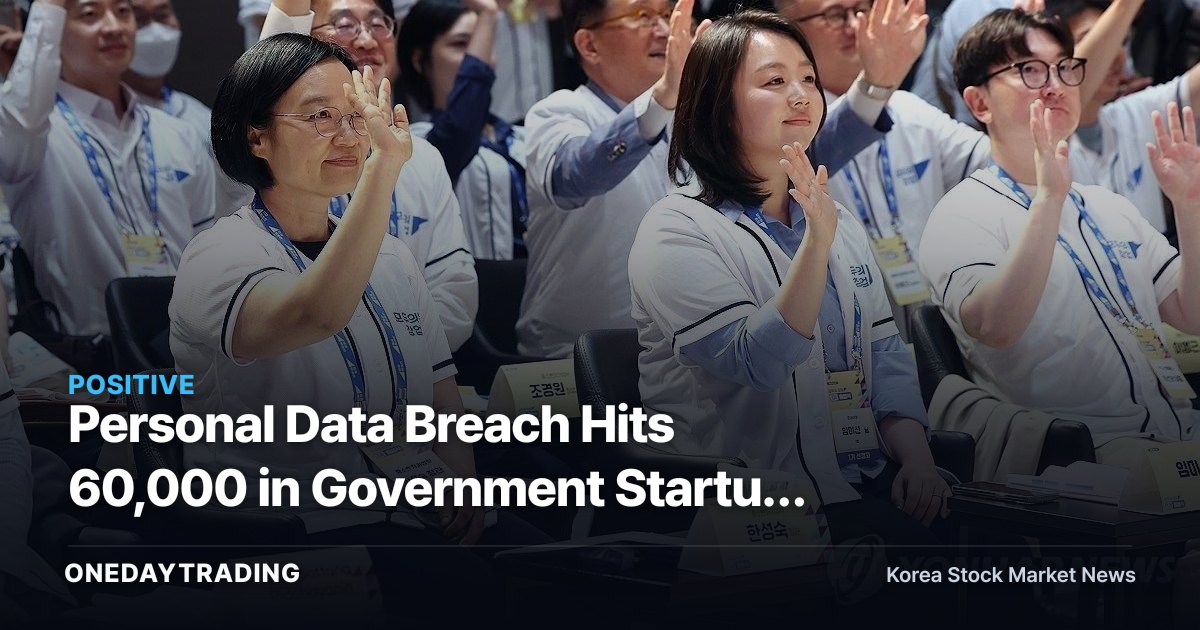
The "Startup for All" project, which the government promoted under the banner of revitalizing the startup ecosystem, attracted more than 62,000 applicants. As a policy initiative it was a marketing success, but the leak of applicants' personal information to outside parties has dented the program's credibility.
Government platforms that draw a large number of applicants all at once end up collecting vast amounts of personal data in a short period. In a structure where sensitive information — identity, contact details, business ideas, and the like — is concentrated in one place, the risk of a breach grows when access-rights management and system reviews cannot keep pace with the surge in demand.
The direction of the follow-up response will differ depending on whether this incident stemmed from a system vulnerability or from operational and management negligence. The former would translate into demand to reinforce security solutions, the latter into demand to strengthen internal controls and authentication systems.
Structural Background
Behind the recurring personal data breaches in Korea — across both public and private sectors — lies a structural gap in which security investment fails to keep pace with the rapid expansion of digital administration and platforms. The more policy initiatives there are, the larger the volume of data the government directly collects and stores, which simultaneously increases both data protection obligations and review costs.
When a breach becomes a social issue, it tends to spill over into stronger oversight by regulators and discussions of increased security budgets for public institutions. The reason the cybersecurity sector reacts sensitively to incident news is the expectation that these policy and budget channels will translate into real demand.
Impact on Stocks and Sectors
- AhnLab: As Korea's flagship cybersecurity stock, it is the first name cited whenever public- and corporate-sector security demand comes into focus. With a large weighting in endpoint and managed-security services, it is a direct beneficiary candidate of expanded public-sector orders.
- WINS: With strengths in public and telecom infrastructure security, such as network intrusion prevention systems (IPS), it could see order momentum during a phase of expanded government security investment.
- Raonsecure: With mobile authentication and identity management solutions, it aligns with the trend toward stronger identity verification and access control.
- SGA Solutions and KSign: As providers of data encryption and access-rights management solutions, they are linked to demand for tighter controls at the personal-data storage stage.
- Secuve: As a firm specializing in authentication and access control, it stands to capture niche benefits when public-sector security reviews are tightened.
Bull vs. Bear Scenarios
The bull scenario is one in which this incident triggers public-sector security reviews and discussions of budget increases. If the government raises security standards across data-collection platforms as a whole, solution replacements and new orders would rise, which could translate into orders for security firms.
The bear scenario is equally clear. The pattern of security stocks posting a short-term sharp gain (surge) immediately after an incident, only to pull back when actual orders fail to materialize, has repeated itself. Because the cybersecurity sector is highly dependent on public-sector orders, delayed budget execution erodes earnings visibility, and the boost from incident news can fade quickly, leaving behind only valuation burden.
Action Points for Investors
- Watch for any announcements from the government or National Assembly on increased public-sector data protection budgets or strengthened security-review mandates.
- In security firms' quarterly earnings releases, check whether public-sector order backlogs and new contract disclosures are actually increasing.
- During the short-term surge immediately after an incident, waiting to confirm order visibility before acting is more favorable on a risk-adjusted basis than chasing the move.
- Monitor the findings of the Personal Information Protection Commission's investigation and how subsequent sanctions or recommendations ripple through sector demand.
AhnLab in Real-Time Data
AhnLab's latest closing price is 57,400 won (-1.88% from the previous day), and its signal light — combining foreign and institutional supply-demand (order flow) with news and momentum — is 🟡 Neutral / Wait-and-See. With positive and negative signals mixed, this is a zone to watch.
- ▼ Trend Alignment — Short- and medium-term downward alignment (intraday -1.9% · 1-week +0.0% · 1-month -7.4%)
- ▼ 52-Week Position — Near the 52-week bottom at 11%
※ Price and foreign/institutional supply-demand (order flow) data are provided by Korea Investment & Securities (KIS) and are as of the time of publication.
This article is content automatically summarized and analyzed based on original news. View original (Yonhap News)