
At a Glance
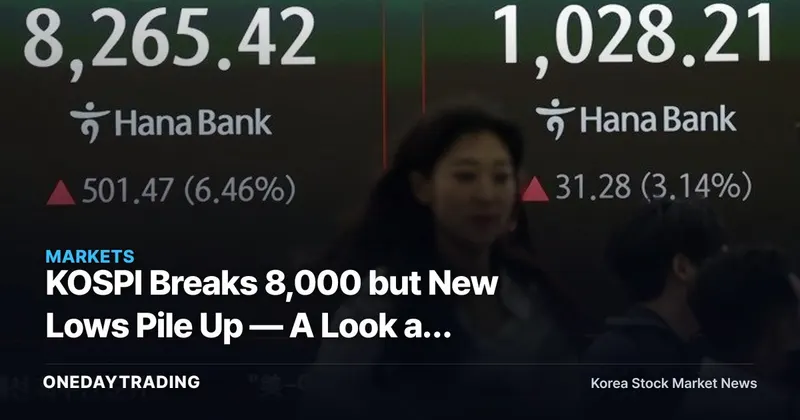
This year the KOSPI extended its powerful rally to break above the 8,000 level for the first time ever, but beneath the surface the market has seen an extreme split, with stocks (tickers) hitting 52-week highs and stocks (tickers) hitting 52-week lows appearing in roughly equal numbers at the same time. That's why more investors are finding that even as the index climbs, their own portfolios are flat — or even in the red.
Why It Matters Now
The key point in this phase is that a rising index does not mean every stock (ticker) is rising. The KOSPI's move past 8,000 is largely the product of heavily weighted semiconductor names and a handful of leading industry sectors, meaning much of the index's advance has been concentrated in a small number of large-cap stocks (tickers). Small- and mid-cap stocks (tickers) with weak earnings momentum or left out of favorable supply-demand (order flow), by contrast, have been pushed to new lows over the same period — moving in the opposite direction entirely.
This polarization stems from a herding effect in which capital flows almost exclusively into names seen as safe and with confirmed growth prospects. As the global AI investment cycle and foreign investors' buying have concentrated in specific sectors, the performance gap between individual stocks (tickers) within the same market has widened to record levels. Judging the market purely by the index level makes it easy to overlook underperformance in the names you actually hold.
For investors, checking which group your own holdings fall into now matters more than watching the index level. In a market where new highs and new lows coexist, sector and stock (ticker) selection is effectively what determines returns.
Frequently Asked Questions
- The KOSPI is at 8,000 — why isn't my stock up? Because the index's gains are concentrated in a handful of large-cap names such as semiconductors, stocks (tickers) with a small market capitalization weighting have barely benefited from the rally.
- Is it normal for new highs and new lows to rise together? This polarization signal often appears in the later stages of a bull market or during periods of heavy concentration, and suggests the market's underlying strength is uneven.
- When will the left-behind stocks (tickers) catch up? If the pace of gains in leading sectors slows or profit-taking emerges, capital could rotate into undervalued, neglected names, though the timing is hard to pin down.
- Is it safe to chase these stocks now? Names that have already entered new-high territory carry heightened volatility, so a phased approach and a close check on valuation are needed.
Related Stocks (Tickers) and Sector Impact
- Samsung Electronics (005930) — the single largest index-weighted name, at the center of the new-high trend as expectations for the semiconductor cycle drive the index higher.
- SK Hynix (000660) — has emerged as a core member of the leading-stocks group on the back of rising expectations for high-bandwidth memory demand.
- Semiconductor sector — as a direct beneficiary of the AI investment cycle, this sector has drawn concentrated capital inflows and formed the upper end of the polarization.
- Small- and mid-cap domestic-demand and cyclical stocks (tickers) — with weak earnings momentum and left out of the supply-demand (order flow), many of these names have hit new lows.
- Securities and financial sector — benefiting from rising trading value and index strength, but differentiation among individual names has appeared here as well.
Points to Watch When Investing
- Don't mistake the index level for the health of the market as a whole — check the relative standing of your own holdings directly.
- Excessive concentration in a small number of leading stocks (tickers) can raise volatility risk once profit-taking sets in.
- A stock (ticker) at a new low isn't automatically a bargain — distinguish between temporary weakness and a genuine deterioration in earnings and fundamentals.
- Manage the risk from individual stocks (tickers) amid this polarization through phased buying and diversification.
Overall Outlook
In the optimistic scenario, continued earnings improvement centered on semiconductors keeps the index strong, and as profit-taking capital later rotates into neglected names, the polarization could gradually ease. However, an index rally that depends on a narrow set of leading stocks (tickers) risks widening the gap between the index and investors' actual returns if momentum in that sector fades. In the end, this is a phase where separating the winners from the losers stock by stock and checking valuations matters more than ever — a strategy focused on the fundamentals of one's own holdings, rather than the index level, remains the sound approach.
This article was automatically summarized and analyzed based on the original news report. View original article (Maeil Business Newspaper, Securities)