
Summary
Early-stage funding news for a private startup does not directly move the share prices of listed companies, but where the capital flows offers a clue to the direction of a theme. Quad's Pre-A round is a case showing that domestic capital is moving into quantum and photonics-based precision measurement fields such as superconducting single-photon detection, and it is worth connecting to the longer-term thematic momentum of listed companies spanning the quantum communications, LiDAR, and semiconductor inspection value chains.
What Happened
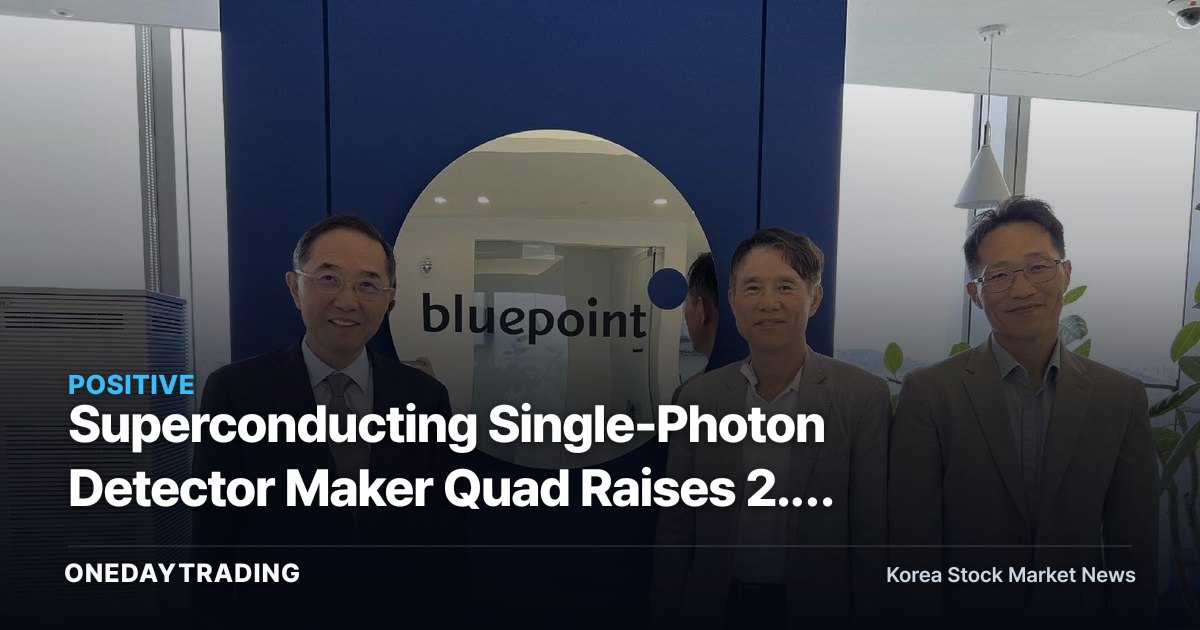
Quad, which develops its own superconducting nanowire single-photon detectors (SNSPDs), has closed a 2.1 billion won Pre-A round. The round drew participation from backers including Bluepoint, an active early-stage deep-tech investor.
The SNSPD that Quad works on is a detection device capable of capturing extremely faint signals down to the level of a single particle of light (a single photon). The company is developing both the light-sensing device and the system that operates it, with a vision of broadening its applications beyond quantum-technology research equipment to defect inspection on industrial sites and LiDAR used in autonomous driving and spatial recognition.
A Pre-A round is closer to a stage of technology validation and securing early references than to mass production. The 2.1 billion won scale, too, is less a large-scale commercialization investment than seed capital aimed at improving device performance and validating use cases.
Structural Background
Single-photon detectors are a core measurement component for quantum computing and quantum communications, and they are drawing attention as a technology for relieving bottlenecks in defect inspection — which grows increasingly demanding as semiconductors shrink — and in the sensitivity race for next-generation LiDAR. The more accurately faint optical signals can be read, the more the distance and speed of quantum key distribution, the detection limits of inspection equipment, and the measurement range and resolution of LiDAR all improve together.
That said, the SNSPD's limitations are clear: it requires a cryogenic environment, which makes both system cost and operating difficulty high. As a result, for now the primary market is high-value areas such as research, defense, and precision measurement, while expansion into industry and mobility depends on how quickly cooling and miniaturization technologies can catch up.
Impact on Stocks and Industry Sectors
- Quantum and photonics components (Wooriro): Operating in optical communications and single-photon detection, it has the most direct thematic overlap with the quantum and photonics measurement demand that SNSPD fuels. That said, the revenue contribution is not immediate and largely reflects forward-looking expectations.
- Quantum cryptographic communications (Xgate): Improvements in single-photon detection performance tie directly to the transmission distance and stability of quantum key distribution (QKD), providing a favorable backdrop for expectations of commercializing quantum cryptography networks.
- Quantum security and random-number chips (KCS): As the quantum-based security ecosystem grows, it is an indirect-beneficiary candidate in that the demand base for chips and solutions widens.
- Quantum and optical communications equipment (Coweaver): It has a downstream demand path in which orders for transmission and relay equipment increase once the build-out of quantum communication networks gains momentum.
- Semiconductor inspection and LiDAR value chain: If single-photon-level detection extends into defect-inspection precision and LiDAR sensitivity, the related inspection and sensor industry sectors could emerge as long-term application areas.
Bull vs. Bear Scenarios
The bull case rests on the government's push to nurture quantum technology dovetailing with private deep-tech investment, creating a flow in which both capital and policy stream simultaneously into core measurement technologies like single-photon detection. In that case, quantum and photonics theme stocks could price in expectations faster than earnings, showing a volatile rise.
The bear-case variables are equally clear. This deal is a 2.1 billion won early round for a private startup and is effectively unrelated to the current earnings of the listed companies mentioned. The quantum theme is a segment where valuation burdens relative to actual revenue are frequently flagged, so a pullback could be large when the catalyst fades or when profits are taken.
Investor Action Points
- Read this news not as a basis for buying any individual stock, but as a signal of capital inflow into the quantum and photonics theme, kept separate from stock-picking.
- For the related listed companies, check whether expectations are confirmed in the numbers through quarterly earnings and disclosures of actual revenue and order intake in their quantum and photonics segments.
- Use the government's quantum-technology R&D, defense, and communications policy schedules and budget-allocation announcements as indicators for gauging momentum.
- When the theme posts a sharp gain (surge), look at trading volume, short selling, and valuation together, and manage volatility risk during the window when the catalyst fades.
This article is content automatically summarized and analyzed based on the original news report. View original (Maeil Business Newspaper, Corporate)