
At a Glance
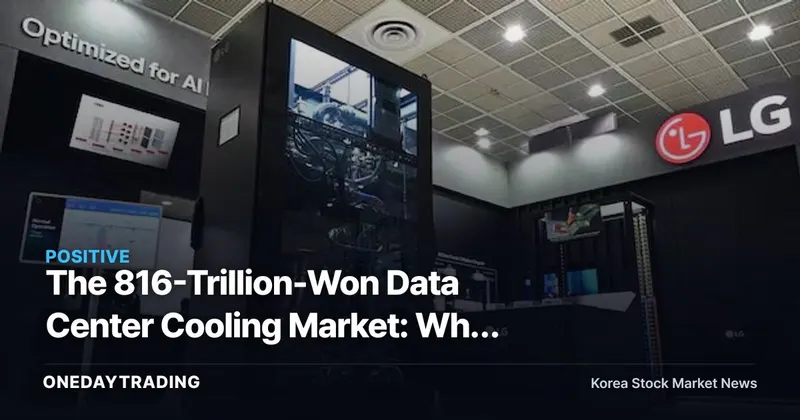
As the heat density of AI computing has outpaced the processing limits of conventional HVAC equipment, data center cooling has been elevated from a supporting piece of infrastructure to a standalone industry. The global market is estimated at 816 trillion won, and beyond Samsung Electronics and LG Electronics, domestic refiners and shipbuilders have now formally entered the fray. As immersion cooling — submerging servers in insulating fluid — becomes the mainstream approach, heavy industry players with fluid-production capacity and large-tank fabrication expertise are reshaping the competitive landscape.
Why It Matters Now
The reason cooling demand has surged is physically straightforward. A single rack of GPU servers used for AI training can consume more than 100kW, a level at which conventional air cooling — blowing in cold air — struggles to dissipate heat. When cooling can't keep pace, servers throttle or their lifespan shortens. That is why data center operators are rushing to shift toward immersion cooling and direct liquid cooling (DLC).
Refiners' rationale for entering rests on chemistry. The insulating fluids used in immersion-cooling tanks are hydrocarbon-based synthetic oils or fluorine-based fluids — materials that overlap with what refining and chemical operations already handle. By converting part of an existing refining line or leveraging a chemicals division, the cost of entry is relatively low. Given that these fluids require repeated replacement, the prospect of recurring revenue following the initial delivery adds to the appeal.
Shipbuilders' logic rests on structural fabrication capability. The large-tank and piping design expertise used to build LNG cargo containment systems and cryogenic tanks translates directly into building immersion-cooling vessels. However, with shipbuilders' order backlogs currently running high, diverting dock capacity toward data center tanks carries a real opportunity cost. Without a dedicated business unit or subsidiary, it could come at the expense of core shipbuilding margins.
FAQ
- Can immersion cooling actually replace air cooling? Technically, yes — but retrofitting existing data centers for immersion cooling requires installing new dedicated tanks, piping, and fluid-supply infrastructure. The more realistic path is that newly built data centers adopt it first, while existing facilities transition gradually as equipment reaches replacement cycles.
- How long would it take for refiners to actually start supplying specialty fluids? For large hyperscalers, quality certification through pilot delivery typically takes around two years. Earnings contribution during the certification period is limited, and how the stock market prices in this lag is central to any investment decision.
- Is Samsung and LG Electronics' existing cooling business under threat? Both companies' market share and installation networks remain strengths in the air-cooling/HVAC market. However, as immersion cooling's share grows, the market itself is being restructured toward fluids and tanks rather than HVAC equipment. Both companies are expanding their liquid-cooling lineups, but a new dynamic has opened up in which they must compete directly with chemical companies in materials and fluids.
- What does the global competitive landscape look like? Global players such as Vertiv, Schneider Electric, and 3M have already built up a track record in the liquid-cooling market. For domestic companies to enter overseas hyperscalers' supply chains, obtaining global certification and building a local service network are prerequisites.
Related Stocks and Sector Impact
- Samsung Electronics · LG Electronics: Both stand to benefit from overall growth in the data center cooling market, but as the shift to immersion cooling accelerates, there is a risk that revenue from their existing air-cooling HVAC lineups gets diluted. The pace of their liquid-cooling portfolio expansion and actual order wins will be the key stock-price variables.
- Refiners such as S-Oil and SK Innovation: With refining margins declining, the immersion-cooling fluid market offers a viable avenue for expanding high-value-added specialty chemical portfolios. That said, investors should account for the time it takes for the certification period and initial pricing formation to feed through to earnings.
- Shipbuilders such as HD Hyundai and Hanwha Ocean: The technological fit is clear, but with current shipbuilding order backlogs demanding priority on equipment and manpower, the real trigger for stock-price reflection will be when the data center tank business is spun into a distinct unit and order wins are actually disclosed.
- Small- and mid-cap cooling materials and components stocks: Large-cap entry does expand the overall market pie, but intensified competition could pressure unit pricing. A gap may widen between companies that secure exclusive supply contracts with major players and those that do not.
Investment Considerations
- 816 trillion won is a long-term projection: This figure represents the endpoint of a growth trajectory, not the current market size. Investors should first assess how much of this figure is already priced into current valuations. Stock reactions at a stage with no order disclosures or actual deliveries amount to buying the narrative first.
- A declaration of entry is not the same as an order: Refiners' and shipbuilders' moves into the cooling market are still at the stage of signaling direction. If share prices run ahead before actual order values, delivery start dates, and margin structures materialize, there is a risk of correction.
- Resource competition with core businesses: For shipbuilders, absorbing the current order backlog requires equipment and manpower as a priority. How much capacity can realistically be allocated to the cooling business will determine how quickly it can be commercialized.
- Barriers posed by established global players: Even with a track record built in domestic data centers, entering global hyperscalers' supply chains requires separate international certification and localization costs. It will be difficult to capture a share of the 816-trillion-won pie through the domestic market alone.
Overall Outlook
If the AI data center investment cycle proves prolonged, the growth direction of the cooling market itself is clear. As long as Big Tech's capex guidance keeps rising, power and cooling demand will grow in tandem, and if refiners' and shipbuilders' capabilities translate into actual deliveries, the current HVAC-centered competitive landscape will shift. The bullish scenario is one where immersion-cooling adoption accelerates faster than expected and domestic refiners' fluid supply connects into global data center operators. The risk scenario is one where the pace of transition is slower than expected, or tightening environmental regulation on specific cooling fluids narrows the market. The signals to watch next are each company's data-center-cooling-related order disclosures, and the quarterly earnings contribution from Samsung's and LG's liquid-cooling products. A declaration of entry without an order is not yet a market.
Samsung Electronics: Real-Time Data Snapshot
Samsung Electronics' most recent closing price was 314,500 won (-5.84% versus the previous session), and the signal combining foreign/institutional supply-demand (order flow) with news and momentum reads 🔴 Caution. With foreign investors, institutional investors, and momentum all negative, caution is warranted right now.
- ▼ Supply-Demand (Order Flow) Continuity — Foreign investors net-sold for 9 consecutive days (−1.08 trillion won)
- ▼ Twin-Sided Selling — Foreign investors −1.08 trillion won · institutional investors −585.4 billion won selling in tandem
- ▼ Trend Alignment — Short- and medium-term downtrend alignment (-5.8% today · -7.6% over 1 week · -9.9% over 1 month)
- ▲ News Flow — 8 positive catalysts vs. 1 negative catalyst — positive catalysts dominate
Recent related news skews favorable, with 8 positive catalysts versus 1 negative catalyst.
※ Price and foreign/institutional supply-demand (order flow) data are provided by Korea Investment & Securities (KIS), as of the time of publication.
This article is auto-summarized and analyzed content based on the original news report. View original (Maeil Business Newspaper, Corporate)