
3-Line Briefing
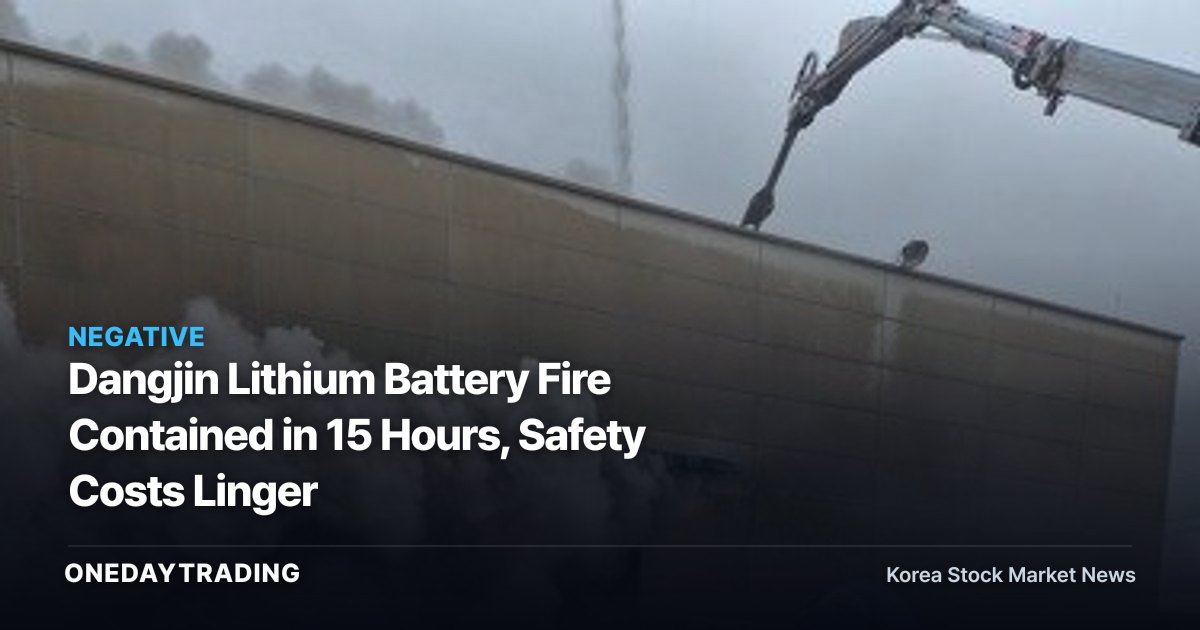
- The fire at a lithium-battery factory warehouse in Dangjin, South Chungcheong Province, was extinguished after 15 hours, with no risk of reignition confirmed.
- However, the signal this incident sends to the market is less about production disruption than about safety costs, insurance premiums and equipment-validation burdens across the secondary-battery industry sector.
- Whether the fire remained confined to the warehouse or spread to the production line is the stock (ticker) market’s dividing line. Based on this report, panic has eased, but the safety premium remains.
What Changes
The Dangjin lithium-battery fire is not merely a local accident. At lithium-battery plants, thermal management, storage methods and the speed of firefighting response during the production and movement of battery cells and materials are directly linked to costs and credibility. Such a fire therefore prompts a renewed review of safety investment, insurance premiums and delivery-management costs across the industry sector, even if it does not immediately trigger an earnings shock.
The scope of the accident is the key issue. The fire began in a warehouse, was extinguished after 15 hours, and posed no risk of reignition—facts that cut off the tail risk. By contrast, if the fire had spread to the production line, lower utilization and delayed shipments would have appeared in the numbers first. The market is likely to read this incident as a reassessment of operating risk rather than production losses.
Events like this do not always affect secondary-battery stocks in the same way. A one-off fire may be forgotten over time, but if accidents continue in the same industry, valuation multiples are pressured first. Even if growth expectations remain intact, higher safety spending slows the pace of margin recovery.
Looking at the Numbers and Context
Three figures were confirmed in this report. The fire broke out at 7:24 a.m. on the 31st, it took 15 hours to extinguish, and there was no risk of reignition. These three points determine how large the market perceives the risk to be. The lengthy suppression effort shows the seriousness of the response, while the absence of reignition reduces tail risk.
The battery industry has a high proportion of capital expenditure and fixed costs. When a safety accident occurs, indirect costs—such as insurance premiums, inspection cycles, equipment replacement and permitting responses—rise before direct losses do. For stock prices to recover, confirmation that similar incidents will not recur matters more than simply identifying the cause of this accident.
Potential Beneficiaries · Affected Stocks
- LG Energy Solution: As the industry leader, it is the first to reflect news-driven market sentiment. Rising safety costs or a more conservative operating decision could weigh on its multiple.
- Samsung SDI: Stocks (tickers) carrying premium valuations are more sensitive to safety issues. Even without production disruption, investors first price in validation costs.
- SK Innovation: With expectations for battery-business expansion, a heavier industry-wide safety burden could undermine the rationale for investment speed and capital allocation.
- EcoPro BM: Materials stocks are affected less by direct damage than by demand sentiment and the expansion trend. If industry conditions weaken, the pace of customer orders becomes more important.
- POSCO Future M: Investments in cathode materials and other materials are also linked to safety issues. Repeated accidents would tighten standards across the supply chain.
Risk Check
- If damage to the production line emerges later, this interpretation could prove too benign.
- If similar accidents continue, insurance premiums and safety investment will rise, slowing the pace of margin recovery.
- Stronger inspections and regulations from authorities could delay expansion schedules.
- Conversely, if there is no additional damage and follow-up investigations narrowly define the cause, the shock could dissipate quickly.
Bottom Line
The Dangjin lithium-battery fire is less a problem of recovering secondary-battery demand than an event that puts safety costs and operating risk back into prices. The immediate focus should be whether production was disrupted, the results of follow-up investigations, and what companies say about safety investment and insurance premiums at their next earnings releases.
Frequently Asked Questions
Is the Dangjin lithium-battery fire immediately a negative catalyst for secondary-battery stocks?
Because no damage to the production line has been confirmed, it is difficult to conclude that the incident will immediately cause a major earnings cut. However, the market sees such accidents as signals of higher safety costs and insurance premiums, as well as pressure on valuation multiples. As a result, the impact on stock prices is more likely to appear first in sentiment and valuation multiples than in production disruption.
Why is the report that there is no risk of reignition important?
The absence of reignition means the tail risk of the flames spreading again has diminished. Even though suppression took 15 hours, preventing additional damage lowers the possibility of a prolonged shutdown. The market may remove some fear at this point, but it will not erase the safety premium entirely.
What should investors check next?
First is the cause of the fire and the actual extent of the damage. Second is whether the company separately discloses production disruptions or shipment delays. Third is how insurance premiums, safety-equipment investment and inspection costs are discussed at the next earnings release. These three points will determine whether the industry shock is temporary or a structural burden.
LG Energy Solution Key MetricsAs of 2026-09-01
| Period returns | 1 week +10.04% 1 month +25.79% |
|---|---|
| Trading value · Trading volume | 159.2 billion won · 425,288 shares |
| Supply-demand (order flow) | Foreign investors net buying +3.3 billion won Institutional investors net buying +8.6 billion won |
| Recent news tone | Positive catalyst 1 · Negative catalyst 0 |
Price and supply-demand data are real-time values from Korea Investment & Securities (KIS); supply-demand and news-tone figures are calculated by One-Day Trading.
Supply-Demand · Momentum Assessment🟢 Buyers in Control
Foreign investors, institutional investors, news and momentum are positive, making the stock worth watching.
- ▲Dual buyingForeign investors +3.3 billion won · Institutional investors +8.6 billion won buying together
- ▲Trend alignmentShort- and medium-term upward alignment (today +2.2% · 1 week +10.0% · 1 month +25.8%)
Upcoming Dates to Watch
- 09.10Simultaneous futures and options expiryMediumQuadruple witching — watch for volatility and supply-demand disruption
- 09.16FOMC policy-rate decisionHighU.S. Federal Reserve monetary-policy announcement — direction of rates and the dollar
- 10.08Index options expirationLowKOSPI200 options expiration
- 10.22Bank of Korea Monetary Policy BoardHighBenchmark interest rate decision meeting
This article is automatically summarized and analyzed based on the original news report. View original (Yonhap News Industry)