
At a Glance
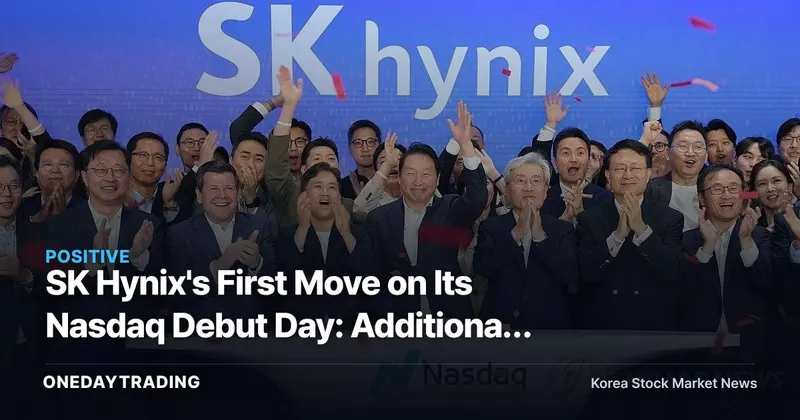
At its Nasdaq debut, SK Hynix directly raised the possibility of additional investment in U.S.-based semiconductor facilities. Given that the remarks coincided with intensifying pressure from the U.S. government for domestic investment, this statement reads less like a simple celebratory remark and more like a preemptive step to manage tariff and regulatory risk. The key questions are whether this additional investment will actually translate into expanded HBM packaging lines, and how quickly the associated costs will show up in margins.
Why It Matters Now
The HBM supply chain broadly splits into two stages: wafer processing (DRAM fabs) and back-end packaging (TSV and bonding). SK Hynix's HBM competitiveness stems from its domestic fabs in Icheon and Cheongju, but for shipments to U.S. customers including Nvidia, having final packaging and quality verification closer to the customer offers a clear advantage. With the U.S. government pushing for domestic semiconductor production, relocating or expanding back-end packaging lines within the U.S. would deliver a dual benefit: lowering tariff exposure while shortening the physical distance to customers.
The catch is cost. New overseas fabs carry higher labor and initial operating costs than domestic ones, and typically take longer to stabilize yields compared with existing lines at home. Because HBM stacks multiple layers of DRAM connected via through-silicon vias, yield management grows more difficult as the number of stacked layers increases. If a new line is built in the U.S., initial yields are likely to start out lower than at the domestic mother fab, and SK Hynix would have to absorb the cost of that ramp-up period on its own.
The Nasdaq listing carries significance as a funding channel that can help offset this cost burden. Rather than relying solely on won-denominated capital to fund large-scale facility investment in the U.S., gaining direct access to dollar capital markets better aligns the currency of funding with the currency of spending, which also helps manage FX risk. The Nasdaq debut and the mention of additional investment should not be viewed as separate events, but as part of a single plan to raise dollar funding for expanding U.S. production capacity.
Frequently Asked Questions
- Does the Nasdaq listing affect SK Hynix's domestic listing status? Its KOSPI listing remains unchanged; the Nasdaq debut is a separate capital-raising process aimed at U.S. investors and does not directly affect domestic trading.
- Is the additional U.S. investment a confirmed plan? At this stage, only the possibility has been mentioned. The specific investment size, location, and timing will need to be confirmed through future board approval and disclosures.
- Why mention U.S. investment now? This is interpreted as a signal aimed at preemptively managing tariff and regulatory risk at a time when U.S. government pressure for domestic semiconductor production is intensifying.
- What is the impact on HBM competitiveness? Until a U.S. back-end packaging line is actually up and running, production capacity and yields at the domestic Icheon and Cheongju fabs remain the key variables driving earnings.
Related Stocks (Tickers) and Sector Impact
- SK Hynix The Nasdaq listing secures a dollar-funding channel, and investment in the U.S. that lowers tariff risk would strengthen the stability of HBM supply to U.S. customers.
- Samsung Electronics If rival SK Hynix secures a head start in U.S. production capacity, Samsung Electronics could face relatively greater competitive pressure in securing U.S. HBM and foundry customers.
- Hanmi Semiconductor As a key supplier of TC bonders used in HBM back-end packaging, Hanmi Semiconductor could see increased equipment orders if SK Hynix's overseas line expansion materializes.
- SK Square As the holding company holding a stake in SK Hynix, changes in SK Hynix's enterprise value are directly reflected in SK Square's equity-method gains and net asset value.
Investment Considerations
- The U.S. investment remains at the stage of a stated possibility; it is premature to price in excessive expectations before specific amounts, locations, and timelines are disclosed.
- New overseas lines tend to start with lower yields and take time for utilization rates to stabilize, which could act as a margin-dilutive factor in the near term.
- U.S. semiconductor policy direction could shift with changes in administration or trade negotiations, meaning the investment plan itself could remain fluid.
- Share price volatility tied to the Nasdaq listing may move independently of KOSPI trading, so investors should monitor any divergence between the two markets.
Overall Outlook
In the optimistic scenario, U.S. investment meaningfully resolves tariff risk, and the dollar funding secured through the Nasdaq listing flows smoothly into next-generation HBM investment. In this case, long-term supply contract stability with U.S. customers would improve, and the cost competitiveness centered on domestic fabs would be reinforced by a policy-risk buffer from overseas production bases. Conversely, if the investment announcement fails to translate into concrete execution, or if yield stabilization at an overseas line takes longer than expected, a phase could emerge in which cost burdens are reflected first, ahead of any benefit. The capital expenditure guidance to be given at the next quarterly earnings release, along with any disclosures related to a new U.S. line, will be the first indicators confirming the substance behind these remarks.
SK Hynix by the Numbers: Real-Time Data
SK Hynix's most recent closing price is KRW 2,180,000 (-0.27% vs. the previous session), and the composite signal combining foreign investor/institutional investor order flow with news and momentum reads 🟡 Neutral / Wait-and-See. With positive and negative signals mixed, this is a stock (ticker) to watch.
- ▲ News Flow — 2 positive catalysts vs. 1 negative catalyst — positive catalysts lead
Recent related news skews favorable, with 2 positive catalysts versus 1 negative catalyst.
※ Price and foreign/institutional investor order-flow data are provided by Korea Investment & Securities (KIS) and are current as of publication time.
This article was automatically summarized and analyzed based on the original news report. View Original (Yonhap Infomax)