
Three-Line Briefing
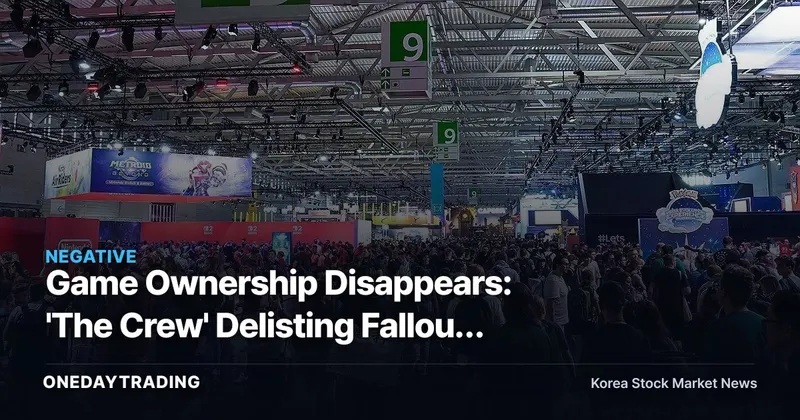
- Ubisoft shut down the servers for its online racing game The Crew, blocking purchasers from even launching the game they had bought
- The incident sparked a citizens' petition in Europe calling for a ban on arbitrary game service shutdowns, which has surpassed the European Commission's one-million-signature review threshold to gather more than 1.4 million signatures
- Domestic Korean game companies with heavy exposure to live-service and subscription-based revenue are not immune to similar ownership disputes and regulatory costs going forward
What's Changing
It has been a long time since the gaming industry's revenue model shifted from packaged sales to service-based licensing. The problem lies in the gap between what users see at checkout and the actual nature of the contract they're entering. Users click a "purchase" button, but what they're really buying is a license valid only for as long as the publisher keeps the servers running. The Crew case stands out because it's the first time this gap has landed squarely in court and on the regulatory table. The game, which lacked even an offline mode, vanished entirely from users' libraries the moment the service ended, and refunds were limited.
The controversy deepened when a Ubisoft executive suggested that users need to get comfortable with not owning their games. The remark was read by some as candidly voicing the industry's real stance, while others criticized it as dismissive of consumer rights. California already passed legislation in 2024 requiring digital storefronts to label transactions as license sales rather than purchases, with enforcement beginning in 2025. Labeling regulation is already a reality, and the next step is shifting toward substantive regulation that restricts service shutdowns themselves.
By the Numbers
The Stop Killing Games petition has cleared the European Commission's threshold for launching a legislative review — one million signatures spanning at least seven member states — and has climbed past 1.4 million signatures. What this number signals isn't merely public opinion; it triggers a procedural obligation for the European Commission to issue an official response. For game companies, if rules mandating offline modes or server migration upon service shutdown become reality, both shutdown costs and ongoing maintenance costs would rise in tandem.
Stocks in Focus
- Krafton: Heavily reliant on long-running live-service revenue from titles like PUBG: Battlegrounds, putting it directly in the line of fire if regulatory costs tied to service shutdown or maintenance increase
- NCsoft: The Lineage franchise has been running on live servers for over 20 years, making it a prime candidate to become a precedent-setting case in any user ownership dispute
- Netmarble: Operates numerous live-service IPs, meaning compliance costs — such as mandatory offline modes upon service termination — could weigh heavily if such regulations take hold
- Kakao Games: Its strategy of expanding the live-service share of new titles could increasingly collide with this regulatory risk
- Pearl Abyss: A negative scenario could emerge if the burden of sustaining long-running online games like Black Desert overlaps with delays in new title launches
Risk Check
- Stop Killing Games is an EU-based petition and carries no direct legal binding force over Korean game companies
- Whether the European Commission actually legislates, and when, remains uncertain, and industry pushback could water down any resulting rules
- If mandates for offline modes or server migration become reality, upfront design costs would rise, squeezing margins on new game development
- An opposite scenario also can't be ruled out: stronger consumer protections could, over the long run, boost trust in games and improve purchase conversion rates
Bottom Line
The game-ownership debate hasn't yet shown up as a line item on Korean game companies' earnings reports, but for firms with heavier live-service revenue exposure, a single future shutdown announcement carries growing potential to snowball into litigation and regulatory costs. The next indicators to watch are the deadline for the European Commission's official response and whether any domestic game companies issue service-shutdown notices of their own.
Krafton in Real-Time Data
Krafton's most recent closing price was 238,000 won (-0.21% from the previous day), and the signal combining foreign investor/institutional investor supply-demand (order flow) with news and momentum reads 🟡 Neutral · Wait-and-see. With positive and negative signals mixed, this is a range worth watching.
※ Price and foreign/institutional investor supply-demand (order flow) data are provided by Korea Investment & Securities (KIS) and reflect figures as of publication.
This article is automatically summarized and analyzed content based on the original news report. View original (Yonhap News, Industry)