
Key Takeaways
The Bank of Japan's additional rate hike is not merely a domestic Japanese monetary policy event—it is a variable that simultaneously shakes the pricing competitiveness of Korean exporters and global fund flow. If the yen reverses from weakness to strength, the relative pricing of Hyundai Motor and Samsung Electronics improves versus Japanese rivals such as Toyota and Sony; at the same time, the risk of an unwinding of the yen carry trade—in which investors have borrowed low-interest yen to invest in risk assets—rises. This two-sided dynamic is what Korean investors should watch closely.
What Happened
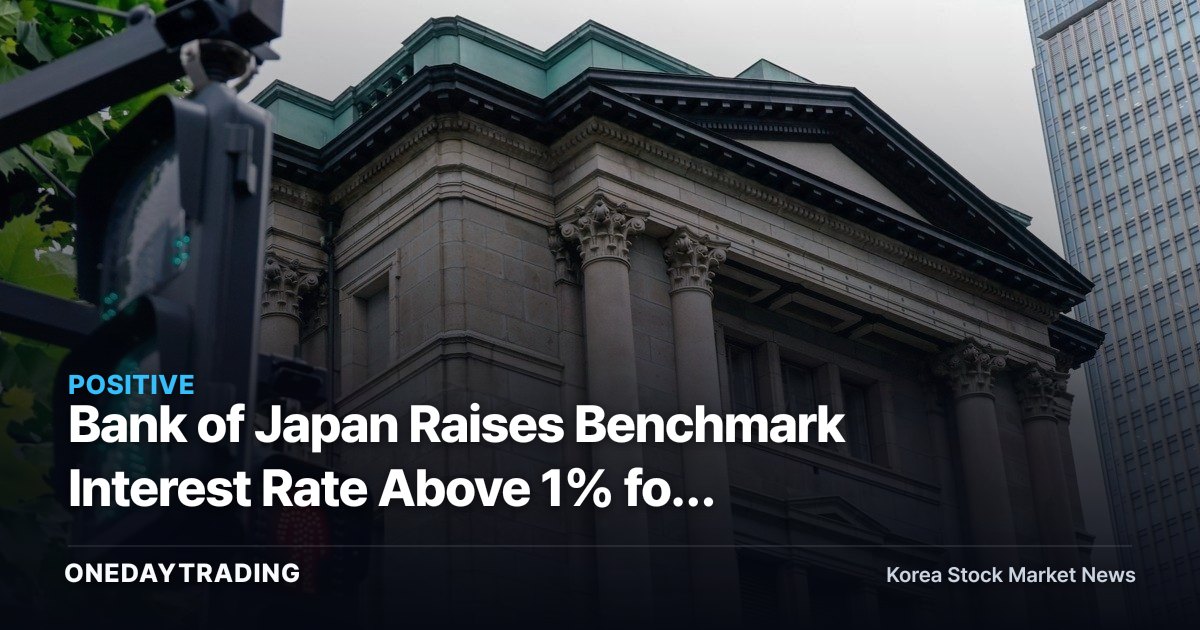
The Bank of Japan raised its benchmark interest rate at its monetary policy meeting on the 16th. It marks the first additional hike in six months, and the benchmark interest rate has entered the 1% range for the first time in roughly 31 years. The BOJ cited concerns that the rate of inflation would exceed its 2% target as the reason for the hike.
Japan long maintained ultra-low interest rates at negative or zero levels to support its economy and prices. This decision reflects the BOJ's judgment that a structure in which wages and prices rise together has taken hold, signaling that the trend toward monetary policy normalization is continuing.
What the market reacts to more sensitively than the hike itself is the path of future increases. The fact that the BOJ explicitly flagged concerns about inflation exceeding 2% can be read as a signal that it is leaving the door open to further hikes, influencing the direction of the yen's value and Japanese government bond yields.
Background and Context
The wide interest rate gap between the United States and Japan has long fueled yen weakness, which boosted the pricing competitiveness of Japanese exporters while weighing on Korean export stocks. If Japan raises rates and the gap between the two countries narrows, this dynamic could move in reverse.
That said, it is difficult to assume that a single hike will immediately cement the yen on a strengthening trend. Because the U.S. rate path, the pace of additional BOJ hikes, and the global risk-appetite mood all play a role, the direction of the exchange rate is determined by the sum of multiple variables.
Impact on the Market and Stocks
- Hyundai Motor and Kia: They compete directly with Japanese automakers in the global finished-vehicle market. If yen weakness eases, the burden of price competition in terms of local selling prices and incentives diminishes, raising expectations of a relative benefit.
- Samsung Electronics and SK hynix: With competitive and trading relationships intertwined with Japanese components and materials firms in the semiconductor and electronics segments, yen strength brings two opposing effects coexisting—higher costs for procuring Japanese-made materials and improved export competitiveness.
- POSCO Holdings and steel stocks: Steel is an industry sector where Korea-Japan competition is fierce, and a shift toward yen strength could work favorably for the export-price competitiveness of Korean products versus their Japanese counterparts.
- HD Hyundai Heavy Industries and shipbuilding stocks: For shipbuilding, where order backlogs and the share of dollar-denominated settlements are large, the won-dollar rate matters more than the yen-dollar rate—but in the competitive landscape with Japanese shipbuilders, exchange rate changes affect pricing power.
- Brokerage and financial stocks: If the unwinding of the yen carry trade gathers pace, volatility in global risk assets rises, which could be a negative variable for stock market trading value and investor sentiment in the short term.
Investor Checkpoints
- Watch for changes in the yen-dollar exchange rate level. Whether yen strength takes hold as a trend or stops at a temporary rebound will determine the scale of the benefit to Korean export stocks.
- Check the BOJ's next meeting and the governor's remarks for clues on the timing and pace of additional hikes.
- As a signal of yen carry trade unwinding, monitor global risk-asset volatility and foreign investors' supply-demand (order flow) together.
- In the next earnings releases of companies with heavy exposure to Japanese competition, such as Hyundai Motor and Kia, check the trends in overseas selling prices and incentives.
Outlook
If the easing of the yen-weakness burden continues, Korean export industry sectors that compete with Japan could see a gradual improvement in pricing competitiveness. Conversely, if the BOJ's pace of hikes proceeds faster than the market expects, yen carry unwinding could steepen, posing a risk of heightened volatility across global stock markets. Rather than drawing firm conclusions about individual stocks' profits and losses based on the exchange rate alone, an approach that gauges the impact while tracking the U.S. rate path and supply-demand (order flow) together is needed.
This article is auto-summarized and analyzed content based on the original news report. View original (Yonhap News Securities)