
At a Glance
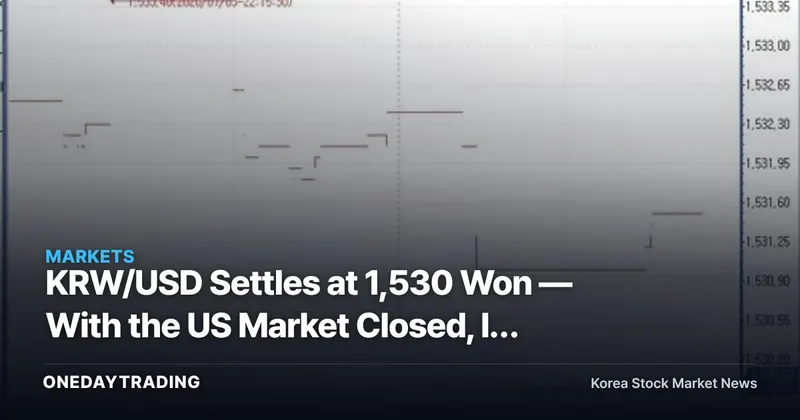
The KRW/USD exchange rate closed at 1,530 won. But what produced this level today wasn't fresh won-selling — it was the yen. With US equity and currency markets closed for Independence Day, there was no direct dollar buy/sell benchmark to reference, so the won-dollar pair instead rode along with dollar-yen movements. Only the next session, once US markets reopen, will reveal whether 1,530 won reflects a genuine trend or simply an illusion left behind by a liquidity vacuum.
Why It Matters Now
The path matters more than the print. When New York is closed, there's no real-time benchmark to stand in for the dollar index, and high-beta Asian currencies like the won end up tracking the yen's moves out of Tokyo as a proxy indicator. In other words, the close at 1,530 won looks less like fresh won-selling driven by genuine demand or speculative supply-demand (order flow), and more like a technical outcome of the yen filling the gap left by an absent benchmark. This distinction matters for a clear reason — if the weakness is demand-driven, the level should hold into the next session; but if it's simply liquidity-vacuum co-movement, a reversal could emerge the moment New York normalizes.
Drilling down into rates and valuation: if won weakness hardens into a genuine trend, rising costs for imported raw materials and energy would constrain the Bank of Korea's room to maneuver on monetary policy. At the same time, won-denominated export earnings would rise, which is a surface-level positive catalyst for large-cap exporters. The question is whether that positive catalyst is already largely priced in. If export stocks have already earned a premium during this won-weakness phase, then today's close at 1,530 won isn't new information that pushes valuations higher — it's simply a repeat of the existing story. The first task in this environment is separating what the market has already priced in from what it hasn't.
It's also worth noting where consensus is concentrated. If bets are piling up on continued won weakness, the trigger for the opposite scenario would be a yen reversal after New York normalizes, pulling KRW/USD back down with it. Reading too much directional signal into a single holiday-session close is the most common misread at this point.
FAQ
- Why does a US market holiday affect KRW/USD? — When the US currency market is closed, dollar buy/sell order flow itself dries up, removing the benchmark that KRW/USD normally references. In its place, the pair tends to move in tandem with dollar-yen trading out of Tokyo.
- What exactly does "tracking the yen" mean? — It means the correlation intensifies beyond normal levels: when the yen strengthens against the dollar, the won tends to strengthen too, and when the yen weakens, the won weakens in step.
- How significant is the 1,530 won level? — It confirms the won remains in a clearly weak range. Should this level become entrenched, it's a zone that could stoke concerns over import inflation and raise the odds of currency authorities stepping in.
- What should be watched next? — The opening quotes for KRW/USD in the next session once US markets resume normal trading, the policy stance from the upcoming Bank of Korea Monetary Policy Board meeting, and the schedule of upcoming US employment and inflation data releases.
Related Stocks and Sector Impact
- Hyundai Motor (005380) · Kia (000270) — Won weakness tends to boost won-translated revenue and operating profit from overseas sales, but it's worth checking whether an exchange-rate premium is already priced into the shares.
- Samsung Electronics (005930) · SK Hynix (000660) — With heavy export exposure, both benefit from the won-weakness translation effect, but the memory industry cycle remains the bigger driver of share prices than the exchange rate.
- Korean Air (003490) · low-cost carriers — Jet fuel purchases and aircraft lease payments are settled in dollars, so prolonged won weakness directly increases cost burdens.
- S-Oil (010950) · refiners — Crude oil import payments are dollar-denominated, so won weakness acts as a factor that raises the cost ratio.
- Banks and financial stocks — Wider FX volatility can strain foreign-currency liquidity management and the valuation of foreign-currency assets and liabilities, so won weakness isn't an unconditional positive catalyst.
Investment Considerations
- Holiday-session closing prices are prone to distortion from thin trading volume, so a single day's level shouldn't be mistaken for a trend.
- Moves driven by yen-tracking could reverse once US markets return to normal.
- For large-cap exporters seen as beneficiaries of won weakness, check valuations separately to see whether a premium is already priced in.
- Depending on each company's FX hedge ratio and settlement-currency structure, the same exchange-rate move can have very different actual effects on profit and loss.
Overall Outlook
The optimistic scenario is one where won weakness translates into genuine supply-demand (order flow), and the resulting translation-effect boost to large-cap exporters' earnings gets confirmed in the next earnings season. The risk scenario, conversely, is that today's close at 1,530 won is purely a product of the holiday-session liquidity vacuum, and once US markets normalize, the won reverses alongside the yen, rendering the level itself meaningless. What separates the two scenarios is the initial direction KRW/USD takes right after New York opens for the next session.
This article is automatically summarized and analyzed content based on the original news report. View Original (Yonhap News Agency, Securities)